
 German (DE)
  English (US)
  Spanish (ES)
  French (FR)
  Hindi (IN)
  Italian (IT)
  Russian (RU)
  2 weeks ago
When you buy through links on our articles, Future and its syndication partners may earn a commission.

A bevy of comets, a "blood moon" total lunar eclipse and impressive northern lights were just three of the skywatching highlights in 2025. Here's how they unfolded. | Credit: Credit: L-R, J. Winsky & M. Zamani (NSF NOIRLab), NASA AWESOME Mission, NASA/Don Pettit and Babak Tafreshi via X, Josh Dury
What was your skywatching highlight of 2025? A comet becoming visible to the naked eye? Mars disappearing behind the moon? Or did you glimpse a "blood moon" total lunar eclipse and see the northern lights at last?
Here's what happened in the skies in 2025, in spectacular images.
1. A Wolf Moon "eats" Mars

Mars rises out of a lunar occultation from Kitt Peak National Observatory in Arizona on Jan. 13, 2025. (Image credit: KPNO/NOIRLab/NSF/AURA/J. Winsky & A. Sorensen | Credit: J. Winsky & M. Zamani (NSF NOIRLab)
Mars comes to a bright opposition in Earth's sky only once every 26 months. But just before its big day came on Jan. 15, it grabbed skywatchers' attention when it crossed paths with the moon. North America had a ringside seat to the full Wolf Moon's occultation of the Red Planet, which happens just once every 14 years from a specific place on Earth's surface.
Read more: Mars hides behind the full Wolf Moon in gorgeous photos from around the world
2. A "great comet" appears

Comet C/2024 G3 (Atlas) appears in the sky over a rural area near Firmat, Argentina, on Jan. 20, 2025. | Credit: Patricio Murphy/SOPA Images/LightRocket via Getty Images)
If you don't remember 2025's "great comet," it's probably because you're in the Northern Hemisphere. Back in mid- to late January, Comet 2024 G3 (ATLAS) made a close pass of the sun before sprouting a bright, structured tail that delighted astrophotographers south of the equator. The comet even became bright enough to be visible in the daytime with the naked eye.
Read more: Why Comet G3 (ATLAS) will be 'remembered as the Great Comet of 2025' (photos)
3. "Blue Ghost" lands on the moon

Firefly Aerospace's Blue Ghost Mission 1 landed on the moon on March 2, 2025. | Credit: Firefly Aerospace
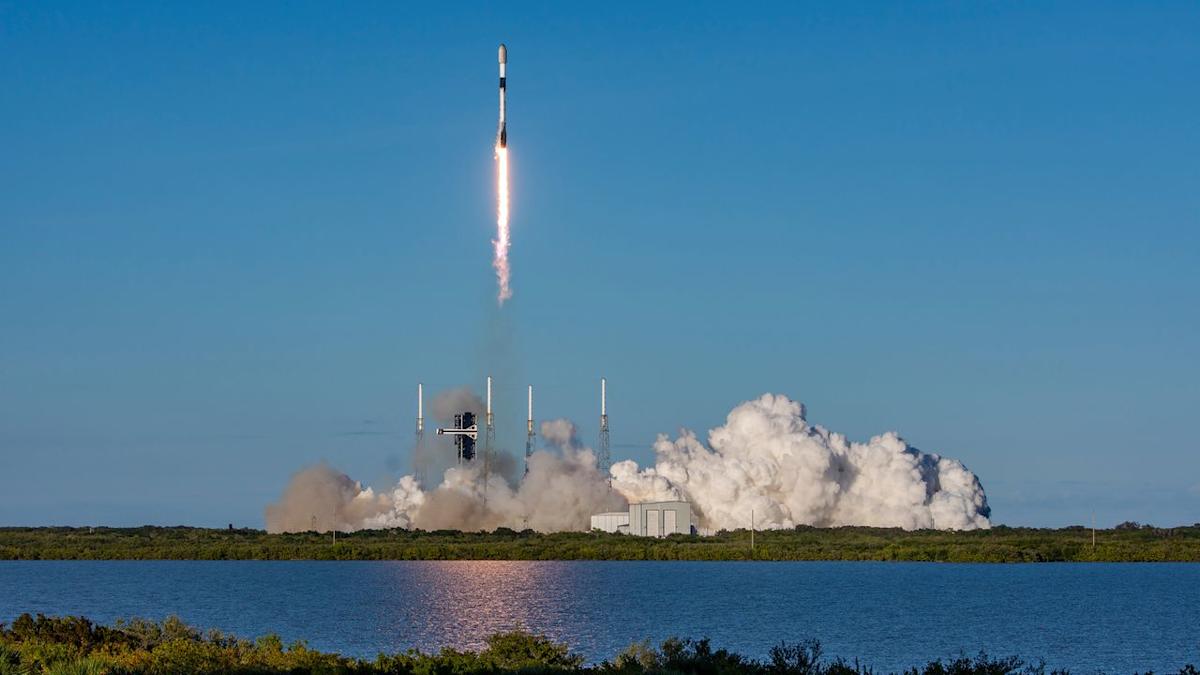
After launching atop a SpaceX Falcon 9 rocket in January, Texas-based Firefly Aerospace successfully landed its Blue Ghost spacecraft on the moon's 300-mile-wide (500 kilometers) Mare Crisium ("Sea of Crises") basin in early March, becoming the second private spacecraft ever to soft-land on the moon. The company shared a spectacular video showing Blue Ghost's descent and spectacular landing, complete with its own long lunar shadow.
Read more: Touch down on the moon with private Blue Ghost lander in this amazing video
4. A star trail is visible from orbit

NASA astronaut Don Pettit captured this long-exposure view showing Earth and stars as intense streaks over time, as seen from the International Space Station. | Credit: NASA/Don Pettit and Babak Tafreshi via X
Between September 2024 and April 2025, NASA astronaut Don Pettit — famed for his pioneering work in astrophotography from orbit — conducted his third mission on the International Space Station. In collaboration with astrophotographer Babak Tafreshi of The World at Night on the ground, Pettit took the art form to another level, capturing dozens of mesmerizing star trails.
Read more: Astronaut takes a mind-bending trip over Earth beneath star trails: Space photo of the day
5. A "blood moon" total lunar eclipse captivates skywatchers

Petr Horálek, NOIRLab's photo ambassador, captured a total lunar eclipse from the Cerro Tololo Inter-American Observatory in Chile. | Credit: CTIO/NOIRLab/NSF/AURA/P. Horálek (Institute of Physics in Opava)
The first total lunar eclipse in three years delighted skywatchers on March 13-14, 2025, when a full Worm Moon crept through Earth's central shadow in space for 65 minutes, making the lunar surface appear reddish-orange from our perspective on Earth. The event, visible from Earth's nightside, was captured with a moonbow from Kentucky and with the Milky Way from Chile. Another lunar eclipse on Sept. 7-8 made for some spectacular photos, including one taken over Egypt's White Desert.
Read more: Total lunar eclipse March 2025: Best photos of the "Blood Worm Moon"
6. Vapor tracers appear inside auroras

Vapor tracers light up the atmosphere over the Arctic Ocean as seen from Utqiagvik, Alaska, on March 25, 2025. | Credit: AWESOME Mission
Just as an aurora substorm erupted, two NASA sounding rockets poised for launch at Alaska's Poker Flat Research Range suddenly went skyward, releasing colorful vapor tracers within the aurora borealis, or northern lights. As part of the AWESOME mission, vapor tracers were imaged using cameras across northern Alaska to track winds, particle flows and magnetic changes during the outburst.
Read more: NASA launches rockets into auroras, creating breathtaking lights in Alaskan skies (photos)
7. Perseids blast through moonlight

A meteor streaks across the sky over Spruce Knob, West Virginia, on Aug. 3, 2025. | Credit: NASA/Bill Ingalls
It may be the Northern Hemisphere's favorite annual meteor shower, but the Perseids weren't a classic in 2025, as they were marred by an 84%-illuminated crescent moon. However, before the peak night of the Perseid meteor shower on Aug. 12-13, there was a short window of darkness, during which a few bright meteors were seen in the predawn hours. About 10 days before the peak night, NASA photographer Bill Ingalls took this long exposure of a Perseid meteor in Spruce Knob, West Virginia.
Read more: Perseid meteor shower 2025 outshines moon to put on a spectacular show (photos)
8. An interstellar comet grows a tail

A deep image of the interstellar comet 3I/ATLAS by the Gemini South Telescope in Chile. | Credit: International Gemini Observatory/NOIRLab/NSF/AURA/Shadow the Scientist. Image Processing: J. Miller & M. Rodriguez (International Gemini Observatory/NSF NOIRLab)/T.A. Rector (University of Alaska Anchorage/NSF NOIRLab)/M. Zamani (NSF NOIRLab).
For comet hunters, 2025 was a landmark year, primarily because it saw the discovery of the third interstellar object ever to visit our solar system. Comet 3I/ATLAS, as it came to be known, followed in the wake of 'Oumuamua (1I/2017 U1) in 2017 and 2I/Borisov in 2019. In late August, astronomers using the Gemini South telescope in Chile glimpsed the tail of the interstellar interloper.
Read more: Scientists capture interstellar invader comet 3I/ATLAS growing a tail
9. Solar maximum continues to deliver

The great aurora of June 1, 2025. | Credit: VW Pics /Getty Images
Following an incredible year in 2024, it was likely that 2025 would experience some significant geomagnetic activity, thanks to solar maximum, the peak of the 11-year solar cycle. Observers in the right place at the right time on April 14-15, June 1, June 17 and Sept. 2 (and many other dates) enjoyed spectacular auroras as G4 geomagnetic storms produced auroras at low latitudes.
Read more: Severe G4 geomagnetic storm sparks northern lights across US and beyond (photos)
10. Comet Lemmon ripens

Comet C/2025 A6 (Lemmon) with a glowing green coma and visible tail as seen from Málaga, Spain, on Oct. 1, 2025. | Credit: Javier Zayas Photography/Getty Images
What are the chances of a naked-eye comet becoming visible on the same night as the peak of the Orionid meteor shower? Although it was only on the cusp of naked-eye visibility — and was visible only to astrophotographers in the Northern Hemisphere — Comet Lemmon (C/2025 A6) put on a show in mid- to late October. A surprise companion, Comet C/2025 R2 (SWAN), appeared in telescope images on Sept. 10. But although it was initially bright, it never got as luminous as Lemmon.







Comments