
 German (DE)
 English (US)
 Spanish (ES)
 French (FR)
 Hindi (IN)
 Italian (IT)
 Russian (RU)
 2 hours ago
Donald Trump has repeatedly asked voters to pretend that he is on the ballot in November’s crucial midterm elections. And in the comfortable confines of Arizona’s most affluent and fiercely contested congressional district, Trump is definitely on voters’ minds.
But whether that helps or hurts the warring congressional candidates in this sun-drenched swath of suburbia, where Teslas and walled-in luxury homes dominate, depends on who you ask.
“Any politician on the face of the Earth who’s a Republican is not getting my vote,” Tom Wolfe, a lifelong Republican, said while sitting down to a lunch of a burger and fries. Trump’s endorsement is a “death knell”, the 82-year-old said. He plans to vote for Democrats in next week’s elections.
For David McGahan, a retired accountant reveling in his retirement life in Rio Verde, a desert enclave outside Scottsdale, the economy and the country are working well under Trump.
“I like the course the country is on,” McGahan said while pumping gas at a local Costco. “Mostly,” he conceded, when a reporter noted the $101 charge for his fill-up.
Cushioned between blue cities and red counties, America’s suburbs have emerged nationally as political battlegrounds. That is especially true of Arizona’s first congressional district, which includes north Scottsdale and Paradise Valley.
Here, among the high-end golf courses and desert estates with breathtaking mountain views, the competition between Democrat Amish Shah – an emergency room doctor who narrowly lost the seat in 2024 – and Republican Jay Feely – a former National Football League kicker backed by Trump – could help determine control of the House in November.
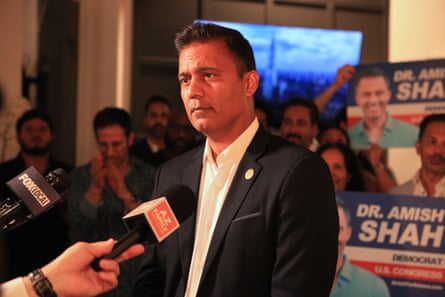
Since Trump’s election a decade ago, Republicans’ hold on the district has slipped, though the party still maintains a voter registration advantage. The seat is open, after Republican congressman David Schweikert opted to not seek a ninth term.
“These are your McCain-type voters,” said Matt Grodsky, a Democratic political strategist referring to the late Arizona senator and 2008 Republican presidential nominee, John McCain. They’re business owners, hold college degrees and relatively tuned in to politics.
Given the current dissatisfaction with the Trump agenda and no incumbent with built-in name ID, Grodsky said circumstances are ripe for a change in this onetime Republican stronghold.
“If there’s going to be a swing,” he said, “it should be this cycle.”
With a median income of $102,000, 33% of residents holding a bachelor’s degree and 22% with an advanced degree, voters in the district lean conservative, but don’t fit comfortably in Trump’s Make America Great Again (Maga) movement , said Mike Noble, founder of Noble Predictive Insights, a nonpartisan pollster based in Arizona.
Voters here helped deliver a slew of recent Democratic victories, including a succession of Democrats to the state’s two Senate seats, a slight tilt to Joe Biden in 2020, and a slate of top statewide officials in 2022 when voters rejected Maga-aligned candidates. But Schweikert managed to hold on, albeit narrowly.
More cracks appeared in 2024, when UN Ambassador Nikki Haley won nearly 25% of the district’s vote in the state’s presidential primary – even though Trump had already clinched the Republican nomination.
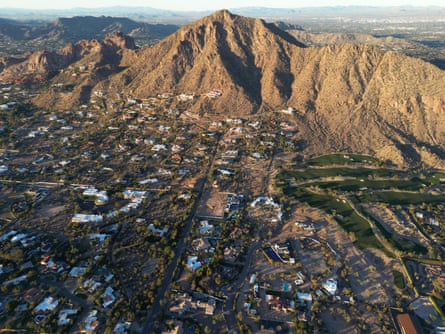
Photograph: Shafiq Rehman/Getty Images
Months later, while Trump easily won a second term from Arizona voters, the victory margin in the district was 3% compared with 5.5% statewide.
“We’re watching a bit of a political revolution play out in slow motion,” said Stan Barnes, a political consultant and former Republican state senator.
The shift comes from voters like Greg Edmunds who was a Republican for most of his life, backing candidates such as McCain and George W Bush. Trump’s ascension in the party changed all that; he is now a registered independent.
In the battle for Congress, Edmunds said Feely’s well-publicized embrace of Trump – amplified by the pro-Shah campaign – makes the choice an easy one. He will vote for Shah to help block Trump’s agenda.
“We just can’t have a rubber-stamp Congress,” the Scottsdale resident said. “I can’t vote for someone like that.”
In September, as Trump’s approval ratings slipped nationwide, the influential Cook Political Report changed its rating of the Feely-Shah race from “toss-up” to “leans Democrat”.
Feely supporters say the district is still conservative at heart, and voters ultimately are motivated by a desire to keep taxes low and make prices more affordable. That makes Feely a good fit for the district, said Adam Kwasman, a Republican and member of the Scottsdale city council. An early backer of Feely, Kwasman likened his demeanor to that of former Arizona governor Doug Ducey: pro-business, genial and decidedly not a flame thrower.
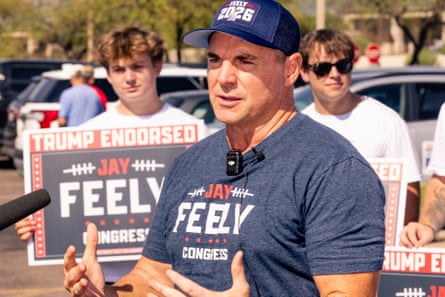
“The Shah campaign is grasping at straws if they think the Republican nominee for Congress is a problem,” Kwasman said, pointing to the district’s preference for conservatives and downplaying the constant reminders of Trump’s backing of Feely.
Feely, who Trump not only endorsed but also encouraged to drop his campaign in a neighboring district to run in congressional district one, has leaned hard on his football ties, hosting regular “huddles” with his team and peppering roadsides with campaign signs with a football motif.
His opponent, Shah, has football ties of his own. He was on the sidelines as a team doctor for the New York Jets during Feely’s stint there as a kicker. The two never met, but the coincidence has made for a fun bit of common ground in a race where the two candidates disagree sharply on key issues from healthcare and datacenters to tariffs and congressional accountability.
Feely’s campaign, with hefty support from Turning Point Action, has sought to portray Shah as a socialist, posting signs that link the Democrat to Senator Bernie Sanders.
Shah, who won the party’s nomination again this year after a nasty primary battle against a rival backed by the Democratic Congressional Campaign Committee, firmly rejects the socialist label. Meanwhile, his campaign has touted an endorsement from former state house speaker Rusty Bowers, a Republican who resisted pressure from Trump to overturn the results of the 2020 election in Arizona.
Independents will be key to who prevails in the 3 November election. After Republicans, independents are the second biggest voting bloc in the district, as well as the state. Democrats are in third place.
For Cindy Cummens, her choice is clear: Shah. She likes that, during his time as a state lawmaker, Shah worked with Republicans, often to the dismay of his Democratic colleagues.
“I’m tired of one side voting only one way, whether it’s Democrats or Republicans,” she said, adding that bipartisan cooperation could resolve issues such as high prices, from gas to groceries.

No Labels, a small start-up party that is trying to claim the independent lane, endorsed Shah for his willingness to work across the political aisle, said Paul Johnson, the No Labels chairman.
To qualify, Shah had to sign a pledge to uphold the US constitution, effectively vowing to abide by the rule of law. No Labels invited Feely to sign the pledge, but did not receive a response.
Since the July primary, Feely has backed away from his earlier enthusiasm to highlight the president’s support. His campaign signs and website no longer tout the endorsement and he did not attend Trump’s mid-October visit to Arizona. However, he was the only Arizona official or candidate to speak at the Republican party’s midterm convention in Texas last month, an event many Republicans in competitive races skipped.
Earlier this month, Feely said he was grateful to have the backing of former Senator Kyrsten Sinema, an Arizona Democrat-turned-independent. Though she has not publicly endorsed his campaign, Feely pointed to her support as a sign that he can appeal to voters of all stripes.
Barnes, the political consultant, called the Republican’s de-emphasis of Trump a savvy move that follows a time-honored tradition of shifting to the middle after winning the party’s base in the primary.
“He can’t win solely by being the Trump candidate,” Barnes said, noting that Shah, too, has struck a more centrist tone.
Shah had previously supported a universal, single-payer health care system, but now instead says he wants to add a public option to the mix of other insurance plans to ensure all Americans are covered.
Although not an issue the candidates have spent time openly debating, abortion – a major topic in the 2024 race – could be decisive in this tight race. Two years ago, district voters strongly supported a statewide ballot measure that ensured abortion rights in Arizona, with 64.8% in favor.
Reproductive Freedom for All has targeted the district, pumping a six-figure investment into messaging that highlights Feely’s anti-abortion stance and promoting Shah’s “very solid” support for reproductive rights.
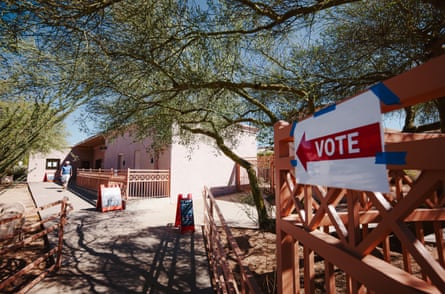
In 2024, Shah helped collect voter signatures to put abortion rights on the ballot. Feely voted against the initiative, and says abortion policy should be a matter of local, not federal, control.
“The bottom line is what the federal government does on abortion can wipe out the gains we made by amending our state constitution to lock in a fundamental right to abortion,” said Athena Salman, director of Arizona campaigns for Reproductive Rights.
Protecting reproductive rights resonates with Donna and Henry Male, both of whom are voting for Shah.
“Womens’ rights are absolutely top of my list,” Donna Hale said. She worries about the future facing her 28-year-old daughter, especially with two years left in Trump’s term.
Henry Male dropped his lifelong Republican registration after Trump’s first term, but was frustrated with the party’s opposition to abortion long before then.
Male said he didn’t know much about Shah, but considered the Democrat his only option this year: “There’s not a chance in hell I’ll support Jay Feely.”














Comments