
 German (DE)
  English (US)
  Spanish (ES)
  French (FR)
  Hindi (IN)
  Italian (IT)
  Russian (RU)
  2 weeks ago
When Daniel Biss addressed his supporters after clinching the Democratic nomination in Illinois’s ninth congressional district this past March, he did something politicians rarely do: he paid homage to a lobby group.
“This victory belongs to J Street,” Biss declared.
The reference was to the “pro-Israel, pro-peace, pro-democracy” advocacy organization, the longtime underdog rival to Capitol Hill powerhouse Aipac. While both groups support a majority Jewish homeland in the state of Israel and favor American security assistance, J Street also backs the creation of a Palestinian state and opposes Israel’s occupation of the West Bank and Gaza. Biss, facing intense competition from progressive, anti-Zionist journalist Kat Abughazaleh and avowedly pro-Israel state senator Laura Fine, had embraced J Street-style centrism and emerged triumphant.
In some respects, this would appear to be the moment J Street was built for. Senior leaders say its staff has grown by 50% in the last five years, and both its budget and the number of individual donors – many disillusioned former Aipac supporters – have doubled. J Street raised $1.3m in June, its biggest monthly haul ever, according to its vice-president of political and digital strategy, Tali deGroot, and it expects to spend at least $13m in this election cycle, up from $9m in 2022.
That’s a far cry from the hundreds of millions Aipac will pump into this year’s races. But while Aipac, which was founded in 1954, often disguises political donations via innocuous sounding front groups – a strategy that tends to backfire when exposed and worse, can play into antisemitic caricatures of a shadowy cabal secretly manipulating US politics – J Street is “ridiculously committed to transparency”, deGroot said. She added that the group only raises money for candidates who publicly affiliate with it. Meanwhile, since 7 October 2023, a growing list of elected officials, including senators Amy Klobuchar, Chris Coons and Jack Reed, has sought J Street’s endorsement, some no doubt hoping to distance themselves from Aipac while maintaining a connection to the American Jewish community.
Nonetheless, the limits of J Street’s approach were amply demonstrated not long after Biss’s triumph, when a parade of J Street endorsees – Sharif Street of Pennsylvania, Tom Malinowski and Sue Altman of New Jersey, Antonio Reynoso and Dan Goldman of New York, and Diana DeGette of Colorado – were defeated by progressive challengers with more pro-Palestinian positions. (DeGette and Goldman also received help from Aipac-aligned donors.) And in the Michigan senate primary, the group’s favored candidate, Mallory McMorrow, dropped out in July after failing to gain traction with voters. It should be said that while J Street didn’t endorse Goldman opponent Brad Lander, who identifies as a liberal Zionist, it did give its official seal of “approval” to his candidacy – an example of a nuanced approach that arguably dampens its effectiveness.
J Street’s penchant for playing to the middle was again on vivid display earlier this month, when nearly half of the House Democratic caucus – including numerous J Street endorsees – voted to cut off aid to Israel. The group, which had opposed the amendment brought by Republican Thomas Massie, issued a press release that called it an “overly broad and poorly drafted political stunt”, while simultaneously hailing it for “sending a strong message … that it is time for a fundamentally different American approach to the US-Israel relationship and the region”.
While this delicate dance may be resonating with establishment Democrats and liberal donors, the Democratic electorate as a whole is rapidly moving left when it comes to Israel and is increasingly sensitive to signs of waffling. At the same time, the two-state solution the group has long championed seems increasingly remote, with nearly four in five Jewish Israelis now opposing Palestinian statehood. Given this picture, the question arises: is J Street’s brand of liberal Zionism still viable at all?
J Street was founded nearly two decades ago by Jeremy Ben-Ami, a former domestic policy adviser to Bill Clinton, who had become convinced that one of the chief obstacles to peace in the Middle East was the influence of Aipac and other hardline pro-Israel lobby groups. He had watched how the organization used campaign donations, congressional junkets and other tools of persuasion to cajole and discipline lawmakers into lining up behind Israeli government policies, however misguided and counter to US interests they might sometimes be.
Aipac was widely assumed to represent the views of the Jewish mainstream, but Ben-Ami, a seasoned political insider, knew how to read a poll: the vast majority of American Jews were, and still are, liberal Democrats who generally favored a more balanced approach to the issue.
J Street’s primary goals were twofold: to ensure that the views of this constituency were better represented in the corridors of power, and to offer political cover to lawmakers – and a newly elected Barack Obama – who might occasionally take a position contrary to Israel’s preferences.
Ben-Ami may have thought his personal background would lend him some credibility on the Israeli right: his family fled Russia for Palestine in the late 19th century, and his father, Yitshaq, an acolyte of Revisionist Zionist leader Vladimir “Ze’ev” Jabotinsky, was a key figure in the Irgun, a far-right paramilitary group (though he appears not to have taken part in the terror attacks committed by the organization, such as the King David Hotel bombing).
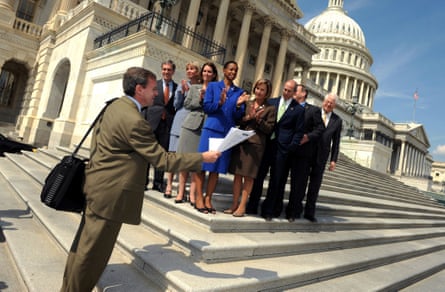
But the American Jewish establishment responded to his initiative with indignation. He and his colleagues were denounced as enemies of Israel, kapos, self-hating Jews and dupes. When the group sought membership in the mainstream Conference of Presidents of Major Jewish Organizations, a coalition of dozens of Jewish groups, the bid was decisively rejected.
But the destruction of Gaza following the Hamas attacks of 7 October 2023 – and Israeli military action in Lebanon, Iran and elsewhere – have shattered many longstanding paradigms, including the political calculus around US-Israel relations. Aipac has rapidly become the most toxic brand on Capitol Hill. Israel’s standing among American voters has plummeted. Eight in 10 Democrats hold an unfavorable view of Israel, according to recent polling. “You rarely see a shift in public opinion this rapid,” noted Democratic pollster Adam Carlson. “The closest thing I can think of is gay marriage, and that [took] almost a decade. This is happening over the course of two or three years.”
During a lunchtime interview at a Peruvian restaurant near his DC office, Ben-Ami, 64, was surprisingly sanguine about the progressive wave that swept away his favored candidates in New York City just days before. Though many of the insurgents held views far to the left of his own – for instance, accusing Israel of committing apartheid and genocide, and calling for a full military embargo – Ben-Ami nonetheless termed their victories “epic” and “the biggest moment of change” since J Street’s launch.
“The Democratic establishment has failed miserably,” he said. “So do I think we need a breath of fresh air? Do we need some energy? Do we need some kick-ass young people who understand how to use the media? Absolutely. It’s a little bit frightening, but really exciting at the same time, because I think we have a chance to redefine the parameters of American policy, the US-Israel relationship, and the relationship of the American Jewish community to Israel.”
For J Street’s critics on the left, the group has missed the moment. Beth Miller, political director of Jewish Voice for Peace (JVP) Action – which unlike J Street supports Palestinian refugees’ right of return and the boycott, divestment and sanctions movement (BDS) – had measured praise for J Street’s original mission. “The idea was to create a counterforce to Aipac, and that was desperately needed at the time,” she said. “It created an opening for members of Congress to be more critical of the Israeli government.” But over the years, she added, the Democratic mainstream has moved sharply to the left, “and J Street has not really kept up”.
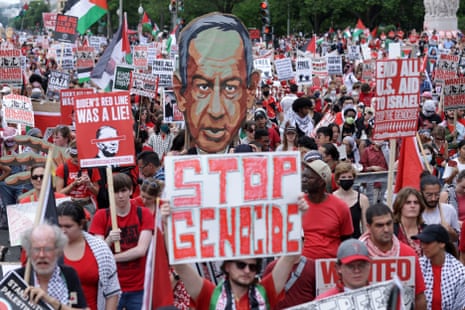
Yousef Munayyer, head of the Palestine/Israel program at the Arab Center Washington DC, agreed. Before the war in Gaza, he noted, a primary goal of J Street was to insulate politicians from pressure from more staunchly Zionist groups. “But with big, bad Aipac now being as toxic as it is,” he said, “they’re not really as susceptible to that attack as they used to be.”
After 7 October and the war on Gaza that followed, J Street’s penchant for triangulation appears to have dampened engagement among its younger cohort. In 2016, the student program J Street U comprised a reported 60 chapters around the country; today the group’s director Erin Beiner declines to disclose the number of chapters, speaking instead of “more than 50 campuses” where the group is “active”. Many former members have drifted toward more leftwing organizations such as JVP and IfNotNow, which was co-founded by onetime J Street U leaders.
Internal upheaval has also been an issue. In November 2023, as the civilian bloodshed and suffering in Gaza grew, a group of younger staff members presented an internal letter demanding J Street call for a ceasefire. Ben-Ami heard them out, and declined to do so, prompting a handful of resignations. “The rhetoric was constantly like, ‘Oh, you know, we’ve got to build up power, rise to the moment,’” recalled Marisa Edmondson, a former member of the communications team. “But this was the moment, and we didn’t fucking do a single thing. We sat on our butts.”
Some staff members were also frustrated by J Street’s reluctance to call Israel’s actions a “genocide”. In August 2025, after much hesitation, Ben-Ami issued a statement that might be read either as a thoughtful attempt at nuance or a masterclass in equivocation. While explaining that he would not use the word due to his ancestors’ experience in the Holocaust, he nonetheless said he would no longer object to others using it with regard to Israel. “I simply won’t defend the indefensible.” It was another example of what, to the group, is an effort to keep a big tent working toward the same aims but to critics represents a striking lack of moral conviction.
That kind of answer “doesn’t satisfy anybody”, Munayyer said. “I mean, maybe it satisfies some donors. But does the average voter feel that that’s really a sincere answer? I don’t think so, not after what people saw.”
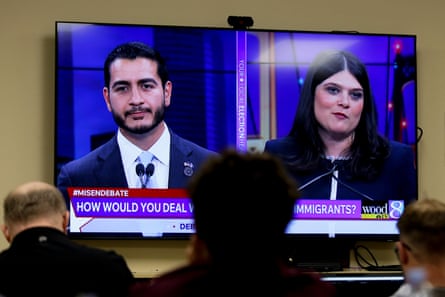
To some, the Michigan primary, which is scheduled for 4 August, has already exposed the fading relevance of J Street’s style of politics. Neither one of Michigan’s remaining Democratic senate candidates – Abdul El-Sayed, who has accused Israel of committing genocide, nor Haley Stevens, who has denounced Benjamin Netanyahu but has claimed that Israel “comes to me in my dreams” – have sought J Street’s endorsement. El-Sayed is supported by JVP Action, while Stevens has been boosted by millions in outside advertising linked to Aipac. The middle path represented by McMorrow, who J Street fundraised for, was roundly rejected by voters. “To be the voice of ‘maybe we can make things just a little bit better, not horribly worse,’ it doesn’t get people going: ‘Yeah! Where do I sign up?!’” noted a longtime observer who was involved in the establishment of the lobby group and asked to remain anonymous to preserve personal relationships.
“The middle lane is just not a viable path forward when people are this angry and upset,” agreed Adam Carlson, adding that the Goldilocks-style positioning moderate Democrats have long favored is increasingly seen by liberal voters, especially when it comes to Palestine, as “a moral barrier to entry”.
Jamaal Bowman was elected to Congress in 2022 with J Street’s support, but during the following cycle, the group withdrew its endorsement, in part over use of the term genocide. Bowman points to a heavily redrawn district and a flood of Aipac money (then the most ever spent on a congressional primary) as the chief reasons for his subsequent defeat, but he admitted the J Street snub didn’t help.
Ironically, Bowman said he first began to question J Street’s stance during a junket to Israel with Ben-Ami. As he learned about the rapid growth of West Bank settlements, he concluded that a two-state solution was no longer in the cards. “We’re lying to the American people and we’re lying to ourselves,” he said. “And that became my frustration with Jeremy and J Street when I was in Congress, because they were always trying to thread this impossible needle.”
Bowman says his battle with Aipac has become a badge of honor. When we spoke, he was on the way to Missouri to campaign with Cori Bush, who is hoping to retake the seat she lost in 2024 due in part to massive spending by Aipac. “People want authenticity, they want conviction,” he said. “And so, if you’re towing the line or unclear, then what are we doing? People can smell that on you.”
Even J Street’s detractors would have to acknowledge that Ben-Ami has built a formidable organization. At least 60% of congressional Democrats now carry the group’s endorsement, compared with just 22% in 2012. And Ben-Ami says despite ongoing attacks from the right (Israeli ambassador to the US Yechiel Leiter recently called J Street “a cancer”), the American Jewish electorate is increasingly open to his message. “There are people who’ve been in Aipac or other groups who are coming now to the realization that they were wrong,” he noted. “I find that the pitch to them becomes easier.”
When it comes to concrete accomplishments, the picture is a bit fuzzier. Perhaps the organization’s greatest success, the Iran nuclear deal – which J Street supported by providing cover for Obama and other officials when Aipac sought to scuttle the accord – lasted just three years before Trump pulled out. The population of West Bank settlers has nearly doubled since J Street’s founding. Israel has destroyed Gaza and Jewish settlers are hoping to move in with government encouragement.
Given these catastrophic developments, I asked Ben-Ami why observers shouldn’t conclude that J Street has failed in the ways that matter most. Bringing peace to the Middle East was never the group’s objective, he said. “J Street exists to change American policy. That’s it. I’m hopeful, really hopeful, that a change in American policy will have an impact on what’s happening in Israel. But everything we do has to be calibrated to impact our targets, American policymakers.”
Still, he acknowledged, “there has to be a shift in Israeli politics for J Street’s politics to be viable much longer. And I think that’s a message that Israelis haven’t really processed.”
Israeli elections later this year might change that. Yashar, the new party founded by former IDF chief of staff Gadi Eisenkot, who appeals to a growing segment of the Israeli center, overtook Likud in one recent poll. But Ben-Ami is under no illusion that a new prime minister would instantly revive the prospect of peace. “I think that a leader like an Eisenkot, whom people respect across the political spectrum, has an opportunity,” he said. “Whether that leader takes the opportunity, I don’t know. But what I’d like to see J Street in the United States do is open up the doorway.”
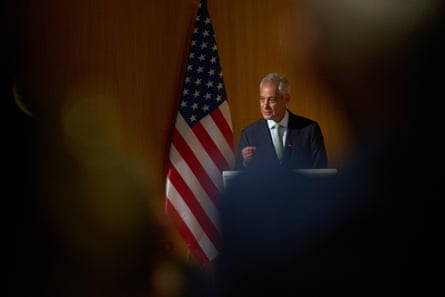
Shortly after our interview, former Obama chief of staff and likely 2028 presidential candidate Rahm Emanuel delivered a tough-love speech at Tel Aviv University denouncing Israeli leadership, describing the country as a pariah state, declaring the days of “blank check” US support to be over, and calling for sanctions against individuals who persecute Palestinians and companies and banks that enable settlement building. (Interestingly, Emanuel’s father, like Ben-Ami’s, was a member of the Irgun.)
For anyone doubting J Street’s continued relevance, it was noteworthy to hear Emanuel touting a “23-state solution”, which couples Palestinian sovereignty with normalized relations between Israel and the region’s Arab states. The idea of a comprehensive regional framework is not new; it was first proposed by the Arab League in 2002. But the “23-state solution” framing was borrowed directly from Ben-Ami, who debuted the term two years ago and with whom Emanuel has been in regular discussions.
Will it fly? Who knows. But Ben-Ami remains undaunted. “As long as I see a pathway, we’ll continue to advocate to move towards that path,” he said. “You know, instead of heading off the cliff.”
















Comments