
 German (DE)
  English (US)
  Spanish (ES)
  French (FR)
  Hindi (IN)
  Italian (IT)
  Russian (RU)
  3 weeks ago
On a cool winter night in Los Angeles, dozens gathered to protest the Trump administration’s attacks on the arts and the recent federal immigration raids in southern California. But these protestors didn’t carry signs or chant in front of a government building – they recited poems such as Antifa Tea Party and Love in Times of Fascism. They performed anti-fascist improv to a small but lively crowd at The Glendale Room, a library-themed theater, as part of the monthly show Unquiet: A Night of Creative Resistance.
“If you’ve got talent or skills as a communicator, you can move people,” Chris Kessler, a writer and poet, said after performing at Unquiet. “I really believe that we need to be moving people toward a stronger sense of collectivism in the face of fascism.”
The Unquiet series, organized by Sara Candela, a poet, is part of a larger movement in which artists, writers and theater groups across the country are creating work in response to the Trump administration’s attacks on arts and their communities. Over a November weekend, the Fall of Freedom series featured over 700 exhibitions, performances and public events across the US, including artists in San Francisco performing live remediations of ICE detainments and a dance protest at the Kennedy Center, the cultural institution where Trump cut “woke programming” and recently announced was closing for renovations. This is on top of the administration cancelling around 560 arts grants last year, totaling over $27m in funding cuts. Many performers say now is the time to produce work that shows artistic freedom will not be suppressed.
“Trump has really gone after a lot of institutions that we thought might be impervious to this form of disruption, like the Kennedy Center and the Smithsonian,” said Lynn Nottage, a two-time Pulitzer Prize-winning playwright, one of the artists behind Fall of Freedom. “And that served as warning shots to other large performing spaces and theaters across the country.”
Pushing through fear
During the first Trump administration, Azo Safo performed and wrote sketch comedy that wasn’t inherently political because she didn’t feel an “existential threat” to her family’s safety like she does now. But last fall, Safo broke away from her comfort zone to hold Artful Resistance, a staged reading in Los Angeles of several short plays from fellow artists about fascist dystopian futures, ICE raids and abortion.
“If I’m being honest, even now I’m scared because of how the Trump administration talks about antifa and the way they paint anyone who does activism like us,” Safo said, referring to how the White House has designated antifa and other protesters as “domestic terrorists”. “But I knew it was important to speak out now, more than any other time. We wanted this to bring the community together.”
Even artists and activists whose work doesn’t directly criticize the Trump administration are feeling the heat. Writer, director and theater educator Anthony Meindl’s sold-out climate change play, The Year We Disappeared, weaves together time travel, teenage angst, Frankenstein and climate scientist James Hansen’s 1988 Senate testimony about global warming. As the play gears up for another run in Los Angeles this year, Meindl has been warned by fellow climate change writers to expect hate mail and death threats as his work reaches wider audiences.
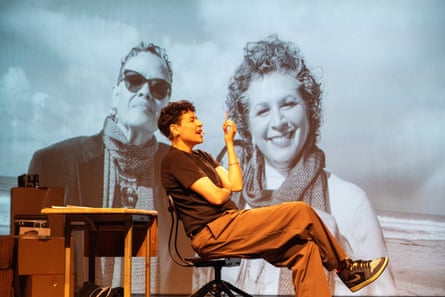
It’s a scary time to be writing about the climate, when Trump is “gutting meteorology and science”, he said, referring to how Trump cut 600 Weather Service jobs, among other funding cuts, in his first six months in office last year. “But also, I don’t think that’s going to deter me from helping people understand where we’re at when it comes to climate change.”
For some performers and theater companies, resistance has always been part of their work. Iymen Chehade, a playwright, actor and professor, founded Uprising Theater in 2013 in Chicago after Columbia College removed his Palestinian-Israeli conflict class for showing the Oscar-nominated 2011 documentary, Five Broken Cameras, about protests in a West Bank village. Last summer, the theater company secured its own performance space and cafe, where Chehade, as executive director, continues to screen Palestinian films and will soon hold live shows. “It hit me how easy it was to take my platform from me,” he said. “Combining the academic with art has the potential to resonate with what I’ve always tried to do, which is, essentially, to create an opportunity for Palestinians to tell their narrative on their own terms.”
For immigrants and some audiences of color, attending shows can come with a lot of risk. In Manhattan, the Clemente Soto Vélez Cultural & Education Center, which houses the theater company Latin American Theater Experiment Associates (Teatro Latea), has safety protocols in place for patrons who could be targeted by ICE. Meanwhile, audiences continue to show up.
“People understand that showing up is not neutral anymore, that attendance itself can become not only support, but affirming cultural survival,” said Libertad O. Guerra, Clemente’s executive director. “The volatility right now is more about risk and risk calculus, obviously, but attendance itself has become a form of civic support.”
Theater as resistance
The modern roots of theater as resistance can be traced to a movement called the Theater of the Oppressed, pioneered by Augusto Boal, a Brazilian artist and activist, during the country’s military dictatorship in the late 1960s. In 1971, the regime targeted intellectuals who critiqued the government, including Boal, who was eventually kidnapped, tortured and exiled to Argentina and imprisoned.
In exile, Boal applied the principles in Paulo Freire’s book Pedagogy of the Oppressed to theater. In Boal’s 1973 book, Theater of the Oppressed, he outlined his theory on how to best use theater to inspire social and political change. One of his key points was the audience being more than spectators – advocating for them to be “spec-actors” who can comment on the action and jump onstage to perform.
In modern productions, M. Candace Christensen, an associate professor of social work at the University of Michigan, said the genre lives on in liberating and transforming oppression in communities.
“It’s a way of embodying the rehearsal for the organizing that you’re trying to accomplish,” they said. “It can make it so that it’s not as frightening or traumatic as it might be when you’re in the midst of experiencing that oppression.”
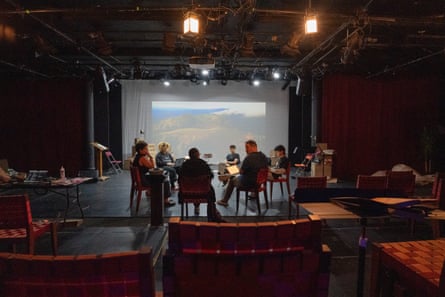
One of the most renowned examples of resistance theater happened during the Aids crisis in the 1980s. Larry Kramer, the The Normal Heart playwright and activist, founded the Aids Coalition to Unleash Power (Act Up), in which demonstrators performed “die-ins”, where protesters lay down as if they were dead to represent how many Aids deaths occurred, and “kiss-ins”, where LGBTQ+ protesters kissed to stand up against discrimination based on sexual orientation. The group’s work successfully pushed for more HIV and Aids research and worked to alleviate the stigma against the LGBTQ+ community.
Today, many cities have theaters that host community-based Theater of the Oppressed workshops, using Boal’s teachings to analyze social issues and encourage activism – from the Theater of the Oppressed theater in New York City to Peet’s Theater in Berkeley, California.
“There’s a lot of time spent on building that trust and comfort with each other in the workshops,” Christiansen said. “People get motivated. They get excited about not only seeing issues that they’re experiencing but also being invited to the table to come up with solutions to the issue. It centers the people who are experiencing the problem.”
More resistance theater is on the way
Candela said the response to Unquiet has been very positive, with a nearly sold-out second show and a third one on the theme of devotion planned for this month. “Different writers can come in and give their interpretation of the theme, but it’ll always be about resistance and unquiet to give voice to that darkness,” Candela said.
Nottage hopes to get even more participation in the next Fall (or Spring) of Freedom event, as resistance against the Trump administration is building across the country. She noted that larger theater companies’ programming is often determined a year or several years in advance, so audiences may have to wait to see the Trump administration’s influence on future works. But Christensen remained optimistic that shows about resisting the status quo will always find a stage.
“It’s a very hard time for artists who want to lean into issues around social justice, equity, historically marginalized communities and find support for that,” they said. “Theater of the Oppressed was born in times of oppression, and it will continue to operate, regardless of what type of support exists.”












Comments