
 German (DE)
  English (US)
  Spanish (ES)
  French (FR)
  Hindi (IN)
  Italian (IT)
  Russian (RU)
  2 weeks ago
Harry Farley,Political correspondentand Henry Zeffman,Chief Political Correspondent

 Future Publishing via Getty Images
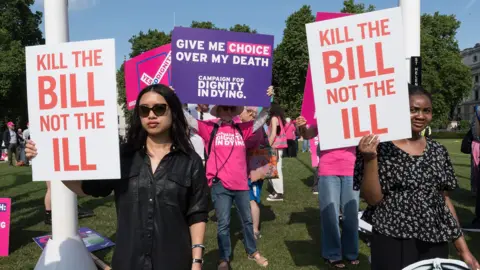
Demonstrators on both sides campaigned in the weeks leading up to the historic Commons vote back in June
It is now "very, very difficult" to see how the assisted dying bill could become law this year, a leading backer of the change has told BBC News.
Lord Falconer said the legislation - which has been backed by MPs - has "absolutely no hope" of passing without a "fundamental change" in the House of Lords' approach.
The former justice secretary is threatening an unprecedented use of the Parliament Act to override peers' objections if it is not passed before the King's Speech in May.
The rarely used powers would set up a constitutional clash over what is a highly sensitive issue.
 HoC via PA Media
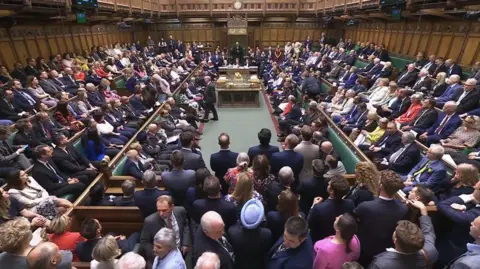
The Terminally Ill Adults Bill passed in the House of Commons with a backing of 314 votes to 291 last summer
Assisted dying was not in Labour's election manifesto and is not a government-led bill. It was introduced into Parliament by backbench Labour MP Kim Leadbeater.
Opponents believe the legislation is unsafe, particularly for vulnerable people, and needs extensive amending before it could become law.
A government source said many ministers now believed the bill would not pass through the Lords and hoped a compromise could be brokered.
They suggested a Royal Commission could be formed to examine some of the practical questions raised by Leadbeater's proposal.
The source said using the Parliament Act for a private member's bill would be deeply controversial.
"The prime minister will need to step in before it gets to that stage," the government source said.
A source close to Labour MPs and peers opposed to the Bill said the threat of using the Parliament Act "is the act of a bully who knows they are losing the argument".
They said that because the proposed legislation would have to be identical it would mean forcing a flawed bill into law with no ability to change it.
Lord Falconer insisted the Parliament Act was an "established part of our constitution" and peers should not block the bill given elected MPs had approved it.
Typically bills brought by backbench MPs, called Private Members' Bills, fall unless they are passed by both the Commons and the Lords in one parliamentary session.
A session ends when Parliament is prorogued, and a new one begins with a King's Speech – which is expected in May.
Peers in the House of Lords have tabled a huge number of amendments to the bill covering subjects including:
- Explicitly removing pregnant women from eligibility for an assisted death
- Restricting assisted deaths to cases where a person's suffering cannot be relieved by treatment
- Changes to how a person's capacity to request an assisted death is assessed
- requiring background checks on close relatives of those requesting an assisted death
- Lifting the minimum age to 25
- Doubling the period of reflection between assessments
Unlike in the House of Commons, peers generally debate every amendment tabled, meaning the bill's progress has been far slower in the House of Lords.
Former Downing Street adviser, and opponent of the bill, Nikki Da Costa denied accusations that a group of peers were using delaying tactics to block it.
She said they were "doing their best to patch the holes" in an "unsafe, deficient bill which has no electoral mandate".
She accused Lord Falconer of wanting the Lords "to stop doing work and just wave it through".
Lord Falconer said a "minority" of peers were "filibustering" - or delaying the bill. - and urged them to "stop all this smoke and mirrors and focus on making the bill better".
Leadbeater told Radio 5Live Breakfast: "I welcome refinements to the bill but what we've seen sadly, is a very clear attempt to talk the bill out."
She said MPs in the Commons had voted on the bill "after deep soul searching" and were "extremely cross that the unelected in the chamber are trying to block it in this way".
The House of Lords has yet to hold a formal vote on the bill as a whole, meaning it is difficult to say if peers support the proposed law.
However, supporters of the bill believe they have the backing of the majority.
The Parliament Act allows for a bill that has been passed by the Commons but rejected by the Lords to return in a new parliamentary session.
If an identical bill passes the Commons a second time, the Lords cannot block it again and the legislation will become law at the end of that second session even without the Lords' approval.
The powers have only been used seven times since 1911.
There are also several hurdles supporters would need to overcome.
Someone willing to bring the exact same bill would need to be drawn high up in the ballot of MPs able to bring a Private Members Bill.
Asked if it was now impossible for the bill to pass, Lord Falconer told BBC News: "It's very very difficult, it's not impossible if the Lords were to change the way that they were dealing with it."
"I've seen no sign so far that there's going to be a change," he added. "But if it goes on like this it has absolutely no hope whatsoever of getting out of the Lords."
Pressed on the controversy of using the Parliament Act to prevent the Lords from blocking the bill a second time, Lord Falconer said: "The issue about assisted dying is very controversial, but ultimately somebody in our constitution has got to decide whether the country should make the change.
"The people who should decide it should be the elected representatives in the Commons. If they make up their mind but are blocked in giving effect to that decision by a small number of peers then the constitutional answer is the Parliament Act."
Lord Falconer has written to all peers on Wednesday evening setting out a number of amendments he will table, aimed at addressing concerns such as around those with eating disorders becoming eligible for an assisted death, and toughening restrictions on advertising for the service.
A source close to Labour MPs and peers opposed to the bill told BBC News: "People need to be very clear, using the Parliament Act to force this through would mean that none of the known issues with the bill would be fixed.
"Every MP who voted to force it though would bear responsibility for the inevitable suffering and deaths of vulnerable people."
















Comments