
 German (DE)
  English (US)
  Spanish (ES)
  French (FR)
  Hindi (IN)
  Italian (IT)
  Russian (RU)
  3 weeks ago
In an era of overlapping crises, corruption is no longer a side issue – it is a structural threat to achievinginternational equality and even freedom itself. Each year, Transparency International’s Corruption Perceptions Index, a league table of 182 countries, is greeted with predictable theatrics: praise where it flatters power, condemnation where it can be weaponised, and hollow promises of reform that quietly expire once attention moves on. Instead of a moment of reckoning, it is ignored by those with the power to act.
As this newspaper reported, last week’s table showed a “worrying trend” of backsliding and a picture of “democratic institutions being eroded by political donations, cash for access and state targeting of campaigners and journalists”.
Transparency International’s latest index lands at a moment of global democratic decay, and its findings are grim: more than a decade of stagnationwith most states making little or no progress against public-sector corruption. The UK slid to its lowest score since 2012.
Yet if this is about perception, some perceptions appear remarkably forgiving. The US slips modestly to 64, despite political upheaval and institutional strain. Israel drops two points to 62 even as it faces scrutiny over allegations of genocide and covert entanglement in other sovereign states. Reputation in global politics is sticky; power and influence tempers decline and the baseline for what counts as corruption sometimes shifts to accommodate geopolitical sympathies.
But the danger lies deeper than national rankings. As geopolitical rivalry, war and climate breakdown place unprecedented strain on the western international order, the need for principled leadership has never been greater, yet the world’s most powerful state is moving in the opposite direction.
For three decades, anti-corruption efforts have rested uneasily on the assumption that the US would act as anchor and enforcer. As the world’s largest economy, nerve centre of global finance and home to institutions whose rules ripple across borders, US laws on money laundering, sanctions, corporate transparency and foreign bribery have shaped global governance. When Washington takes corruption seriously, others follow. When it does not, the damage is global.
Across legal, diplomatic and financial domains, decisions taken under Donald Trump have been criticised as weakening safeguards that took decades to build. The fight against corruption can no longer be outsourced to the US – the rest of the world must lead.
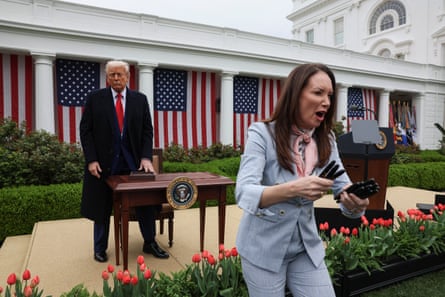
A central concern is selective enforcement. Sanctions, anti-money-laundering tools and anti-bribery laws were designed to constrain abuse of power and protect the public interest. Yet critics argue that, under Trump, these instruments have been used as political leverage: applied harshly to adversaries, relaxed for allies and recalibrated to reward loyalty.
Economic sanctions have drawn particular criticism from UN experts, economists and humanitarian agencies. While framed as pressure on elites, sanctions have repeatedly devastated civilian economies, deepened poverty, restricted access to medicine and finance, and weakened state capacity – often in countries targeted for resources or geopolitical defiance. In such contexts, corruption does not disappear; it mutates, thriving in scarcity, hidden markets and discretionary power.
At the same time, alarm is growing over attacks on international accountability mechanisms. Judges and prosecutors associated with the international criminal court have faced threats, sanctions or vilification. Second vice-president Reine Adélaïde Sophie Alapini Gansou (Benin), Judge Solomy Balungi Bossa (Uganda), Judge Luz del Carmen Ibáñez Carranza (Peru) and Judge Beti Hohler (Slovenia) all follow the earlier designation of the prosecutor Karim AA Khan KC.
In addition, UN mandate-holders such as Francesca Albanese, special rapporteur on human rights in the Palestinian territories, have been targeted for pursuing investigations that challenge powerful state interests.
The US even imposed sanctions on a Brazilian supreme court justice, Alexandre de Moraes, overseeing the trial of former president Jair Bolsonaro, accusing the judge of authorising arbitrary pretrial detentions and suppressing freedom of expression. Whatever your politics, this signals a dangerous precedent: using state power to intimidate those tasked with upholding international law.
Corruption today is not only about envelopes of cash. It is about power: who is shielded, who is sacrificed and who is allowed to act with impunity. When beneficial ownership rules are delayed, foreign bribery enforcement is weakened, or “golden visa”-style residency schemes are sold without robust safeguards, the signal to global markets is unmistakable. Illicit wealth adapts quickly: kleptocrats look for permissive jurisdictions, pliant regulators and political cover.
Concerns have also been raised about opaque relationships between political power, private interests and foreign policy, particularly in relation to Israel. Claims that the Epstein files may have been used to exert influence over politicians point to a more serious issue ; when transparency is lacking and accountability is weak, public trust begins to erode.
Anti-corruption frameworks exist precisely to prevent systems from becoming vulnerable to blackmail, coercion or capture, regardless of whether specific claims are substantiated.
Washington is incapable of acting as a credible steward of global anti-corruption norms, leadership must become distributed. Several actors are well placed to step forward: the EU, with its regulatory reach, anti-money laundering directives and market size, can enforce transparency standards extraterritorially, if it applies them consistently, including to its own financial centres. Canada or the Nordic countries’ commitments to transparency, aid-linked governance reforms and independent judiciaries give them moral and institutional credibility.
African, Caribbean and Latin American coalitions, regions historically targeted by extractive corruption and coercive sanctions, have a powerful stake in reshaping the agenda toward development-centred, rather than punitive, anti-corruption. International institutions and civil society, organisations such as Transparency International, UN special rapporteurs, journalists and independent prosecutors must hold the line when states falter.
What is needed is not a new hegemon, but a normative coalition, one that insists anti-corruption law serves the public good, not geopolitical convenience; that enforcement is impartial, not retaliatory; and that transparency applies upward, not only to the weak.
This won’t be free. Those who defend international law, expose illicit finance or impunity will face political pressure, funding cuts and intimidation – particularly from the Trump administration. But retreat is the greater risk.
When anti-corruption becomes a weapon rather than a principle, it ceases to protect and instead deepens inequality, instability and mistrust.
The world has reached a juncture where waiting for Trump to exit is not an option. Under his administration, the US has weakened core anti-corruption safeguards, politicised sanctions and enforcement, attacked judges and watchdogs, and blurred the line between public authority and private interest.
The credibility of the global anti-corruption project now depends on whether others are willing to lead, collectively, consistently and with the courage to apply the rules even when powerful actors object. Because when the centre abdicates responsibility, the margins must become the guardians of integrity.













Comments