
 German (DE)
  English (US)
  Spanish (ES)
  French (FR)
  Hindi (IN)
  Italian (IT)
  Russian (RU)
  2 weeks ago
The sharks can smell blood in the water. After a decade in eerie command of the Republican party, with primary voters in his cult-like thrall and down-ballot elected officials feeling they have no choice – and often no inclination – to diverge from him, Donald Trump suddenly seems not quite in control of his own political machine.
Fractures have emerged in the Maga coalition; Trump’s approval is sinking; the Democrats, long anemic and risk-averse in the opposition, showed signs of life in elections last month; and the cumulative effect of a series of long-running scandals, most particularly the Epstein affair, seem to have alienated core components of the Trump faithful. Trump has faced some rebukes from a once largely compliant federal judiciary: his personal attorney, Alina Habba, was recently declared ineligible to serve in the US attorney role Trump had appointed her to, and his signature tariffs seem likely to be struck down by a conservative supreme court majority.
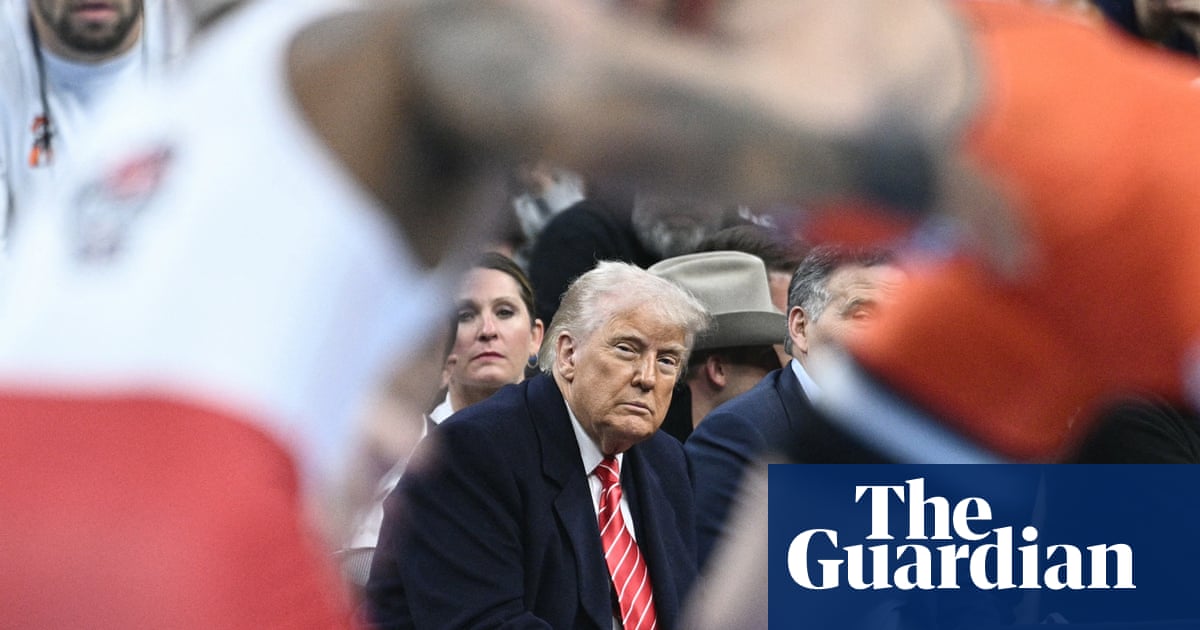
Trump himself, meanwhile, is unfocused, losing his signature humor and charisma, and showing his age. In recent photos he looks pale, exhausted; he seems to have struggled to keep his eyes open in front of cameras. Trump seems more interested in the construction of his oversized ballroom than in the work of policy. His advisers – the scheming group of frauds, racists, opportunists and swindlers who surround him in his second term – are evidently running the show, and they do not always see eye to eye. The old man won’t be around forever; Republicans are beginning to imagine what the country – and more importantly, their own careers – will look like without him.
Is this how the Trump era in American politics ends – not with a bang, but with a whimper? It would be overstating the case, and speaking far too soon, to say that Trump has become a lame duck, or that the Republican party is moving on from the identity that he gave it. But the signals of his waning influence are everywhere.
For one thing, more and more Republicans seem willing to break with Trump – something that would have been unthinkable for them, and a kind of career suicide, just a few months ago. While Trump was able to compel Republicans in the Texas state legislature to draw new congressional district maps with just a command (an effort that is now facing an uphill battle in the courts), Republicans in Indiana are resisting Trump’s push to have them do the same, with one GOP legislator saying that she “will not cave” on redistricting even as she announced a pipe bomb threat had been called into her house.
Other signs are beginning to stir. Trump, with his typically casual relationship to the truth, has insisted that the economy is booming as a result of his ill-conceived tariff program. “Costs are way down,” he said, falsely, in a long 10 November interview with Fox’s Laura Ingraham. But Ingraham pushed back – rare for a Fox host – and soon, other right-wing mouthpieces were, too; weary of repeating the Biden administration’s 2024 mistake of projecting a sunnier picture of the economy than that reflected by consumer sentiment, and perhaps chastened by the sweeping victories of 2025 Democratic candidates who ran on messages of affordability. Soon, both JD Vance and Ben Shapiro were telling a different story on the economy. “When President Trump says things are becoming more affordable, people don’t believe that,” Shapiro said. Vance asked voters for “patience”: “We get it and we hear you, and we know that there’s a lot of work to do.”
It’s a low bar, to be able to merely contradict or disagree with the president. Nevertheless, it is noticeable that more and more Republicans are clearing it; many of them have spent the better part of their careers, at this point, praising the emperor’s new clothes.
A few are going further. Among the most damaging scandals of the Trump era is the slow drip of revelations about the depth of friendship between Trump and Jeffrey Epstein, the dead financier and pedophile, and the accumulation of documents both from Trump to Epstein and by Epstein about Trump that suggest that Trump, in Epstein’s parlance, “knew about the girls”. The Epstein saga, after all, had been a major fixture of the paranoid conspiracies in the far-right media ecosystem, whose podcasts, Discords, and YouTube channels helped drive Trump to victory in 2024. Those conspiracy-minded communities once viewed Trump as a quasi-messianic figure – as in QAnon, the pandemic-era viral sensation that posited Trump as the leader of a vast, secret effort to undermine a cabal of powerful pedophiles. But these same groups have begun to turn on Trump as the newly revealed documents from the Epstein estate – and the Trump administration’s efforts to repress them – have made this fantasy harder to maintain. The politicians who swept into office on the strength of the QAnon theory are taking note. Majorie Taylor Greene, an ambitious Georgia congresswoman and onetime conspiracy theorist, broke with Trump publicly over the Epstein issue; soon after he declared her an enemy, she announced that she would be leaving congress in January.
She won’t be the last. As Republicans continue to face strong headwinds from anti-Trump sentiment going into 2026, and as Trump himself dwindles in popularity, accumulates liabilities, and proves unwilling to compromise on his demands or reward loyal Republicans, it is likely that more and more GOP representatives will be looking for the exits. Meanwhile, Maga has begun to eat its own, with infighting over Epstein, antisemitism and economics slowly beginning to turn Trump’s operatives against each other as they jockey for position. The Trump era is not over – far from it – but we may be seeing the beginning of its next phase: what is likely to be a bleak, bloody, and belligerent battle of succession.
-
Moira Donegan is a Guardian US columnist











Comments