
 German (DE)
  English (US)
  Spanish (ES)
  French (FR)
  Hindi (IN)
  Italian (IT)
  Russian (RU)
  3 weeks ago
Leslie Simon and Marc Bender had arrived in Havana for a 10-day holiday, despite their president’s repeated threats of military action against Cuba.
The two retired union lawyers from Los Angeles flew in via Miami sporting badges reading “ICE OUT!” and shared a somewhat negative opinion of the US’s past.
“The history of America is a fucking abomination,” said Bender, ordering a Cristal, the Cuban lager.
They were more positive about Cuba. “We’ve been once before and we saw some things,” said Bender. “We love Cuba.”
Simon, 67, and Bender, 70, are rare tourists in a time of extreme stress. On Friday, Donald Trump extended already intense sanctions on the island, targeting foreign companies doing business with Havana. He also threatened to place the US’s huge aircraft carrier, the Abraham Lincoln, “100 yards offshore”.
For the last two weeks, US surveillance aircraft have been circling the island, in an echo of what happened in Venezuela before the 3 January abduction of Nicolás Maduro.
The success of that operation led Washington to impose a full oil blockade on Cuba, with the stated aim of felling the nearly seven-decade-old communist regime. Trump has repeatedly hinted the island would be his next target.
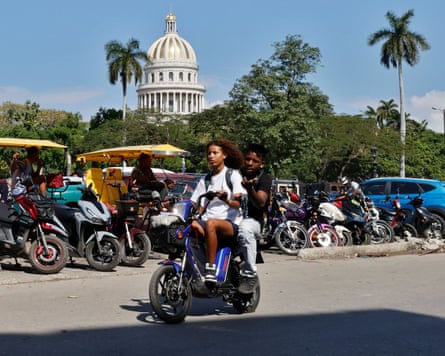
Nonetheless, there is still a trickle of intrepid visitors. Ever since Fidel Castro opened up communist Cuba to tourists in the 1990s, the island has been a hugely popular destination – if not for Americans, whose government has discouraged its citizens from visiting.
In 2018, nearly 5 million tourists came, and the sector was one of the Cuban government’s most important earners.
But numbers have been dropping precipitously since the imposition of the oil blockade. In March there were just 35,561 visitors, according to the Cuban statistics office, of whom many would be emigrant Cubans visiting family.
“You could argue the number of ‘leisure tourists’ would be between 20,000 and 25,000, when in March 2025 the number would have been about 170,000 to 180,000,” said Jim Hepple, of Aruba-based consulting company Tourism Analytics.
On a recent Tuesday, a group of Germans was being shown mangos, mameys and papayas in a market in the Vedado neighbourhood of Havana.
“We booked long ago,” said Nicole, the CEO of a social enterprise in Trier. “And we’ve worked hard all year, and wanted our holiday. So far, everything is good. There is lots to see. We trust in God.”
If God is looking down on communist Cuba, however, it doesn’t show. As Washington had hoped, its oil blockade has devastated the country’s already parlous economy. The estimated 300,000 people who work in tourism are collateral damage.
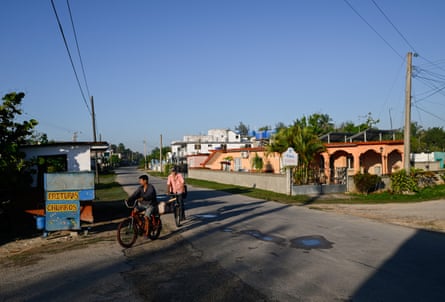
The blockade deprived airlines of the ability to refuel, causing package holiday operators from Canada, Spain and Russia to pull out, along with many scheduled carriers. As the last planes flew in February, holidaymakers wrote of hotel staff crying as they were waved off.
A former hotel bartender, who lost his work earlier this year, was cutting wood near the shrine to Cuba’s patron saint, La Virgen de la Caridad del Cobre. He shook his head at the situation. “What do I have for breakfast?” he asked. “What do I eat for lunch?”
Some in the tourist industry argue that it is still a good time for foreigners to visit, despite advice from many embassies against all but essential travel.
Katya Bleszynska, one of the authors of Lonely Planet’s guide to Cuba, said: “I think it’s an amazing time to come. There are really good local businesses and private hotels that really want your business. Just make sure you plan and manage your expectations.”
But others were more wary. Alissa Scheer, a German influencer who offers upbeat tours of Havana’s nightlife, winced when asked if she was encouraging visitors. “When I first arrived, I loved the spontaneity,” she said. “You could meet up with a friend and it would turn into a whole night out. That’s still there, but it is far less.”
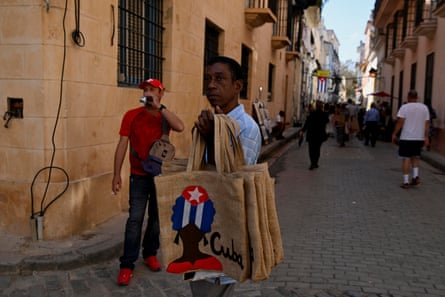
Nonetheless, Simon and Bender, the retired California lawyers, were looking forward to journeying into the countryside, before returning to Havana for the May Day celebrations. The trip they are on – the “Cuba May Day Revolutionary Tour” – was organised by a tour company called Young Pioneer.
Bender discovered the company online. “At first I thought it was North Korean and thought: ‘Wow, that’s cool,’ but it turns out they just run tours there,” he said.
Asked if they are worried Trump would order a military assault while they were in Cuba, Bender was sanguine: “If he hits us, he hits us.”
They are used to seeing their political dreams shattered on holiday – they honeymooned as observers during the Nicaraguan elections in 1990, when the leftist Sandinistas were thrown out of power.










Comments