
 German (DE)
  English (US)
  Spanish (ES)
  French (FR)
  Hindi (IN)
  Italian (IT)
  Russian (RU)
  3 weeks ago
Only 40 miles north of Philadelphia, Bucks county has gained a reputation as the “swingiest” county in the swing state of Pennsylvania and one of the most pivotal political bellwethers in the country.
Party registration in the county is almost evenly split among Democrats and Republicans. Joe Biden won it in 2020, Donald Trump triumphed there in 2024. November’s elections there were local – but a hot race for county sheriff drew much wider attention as a microcosm for America’s contentious debate around immigration policy – and the result signaled a shake-up in how the county approaches enforcement.
In the second Trump administration, incumbent sheriff Frederick Harran, a Republican, had joined many other conservative law enforcement officials across the nation and signed an agreement to work with the federal Immigration and Custom Enforcement (ICE) agency.
Those controversial arrangements, known as 287 (g) agreements, allow local and state officials to cooperate on enforcing federal immigration law to varying degrees.
The 287(g) so-called Task Force Model that Harran, 61, signed up to granted his officers the authority to question people they encountered about their immigration status and to carry out immigration-related arrests during traffic stops.
But the ties are set to be short-lived.
Danny Ceisler, a 33-year-old army veteran who worked at the Pentagon and for Pennsylvania Democratic governor Josh Shapiro’s administration, stood against Harran as a Democrat for sheriff. In his campaign, he pledged to terminate the partnership with ICE.
And Ceisler won, not even narrowly. His 23,000 extra votes was an 11% victory over Harran, who had been a law enforcement officer for more than three decades.
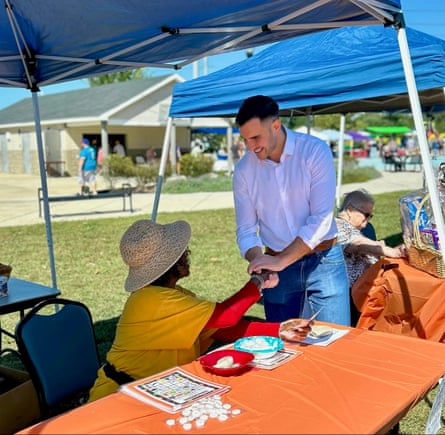
“I felt the office was prioritizing some kind of Trumpian politics and not the actual public safety needs of the county,” Ceisler said in an interview with the Guardian last month in Bristol, a township in south-eastern Bucks county.
He went on: “There’s convincing evidence to show that when local law enforcement starts performing immigration enforcement, it hurts public safety. First you take deputies away from their core responsibilities in order to do ICE work. But more importantly, you terrify immigrant communities who [you] rely on to report crime.”
In Bucks county, home to more than half a million people, 70,000 of them foreign-born, the agreement between the outgoing leadership and federal immigration enforcement was met with some strong criticism. Community advocates rallied outside the county’s courthouse and the county’s commissioners argued that Harran had no authority to sign the agreement.
The American Civil Liberties Union (ACLU) of Pennsylvania also filed a lawsuit against Harran, alleging that such 287(g) agreements “open the door to harmful and insidious racial profiling” and “other civil rights violations”.
In October, however, a ruling upheld the agreement between the Bucks county sheriff’s office and ICE. Then just a few weeks later, Harran was ousted by voters.
“I don’t regret doing it,” Harran said when asked about the agreement with ICE. “I think some people got caught in the national hysteria, a lot of people that don’t like Donald Trump and they can’t see the forest through the trees and that’s a shame because with the new sheriff you’re going to have a lot of problems in Bucks county,” he added.
But Ceisler’s victory was not an isolated case in the recent election and instead reflected a broader momentum for Democrats in Bucks county. Voters there elected their first Democratic party district attorney since 1965. In an area where certain books were banned and pride flags in classrooms were forbidden by the authorities, Democrats secured a majority on the school district board, saying people were becoming fatigued with the distracting so-called culture wars, local media reported. The Democratic victories were notable in a congressional district that has been represented by Republican congressman Brian Fitzpatrick since 2017.
And the mini blue wave in the county rippled out from other waves, such as Abigail Spanberger flipping the governorship of Virginia as a moderate Democrat, Mikie Sherrill winning New Jersey’s governor office easily in the end and democratic socialist Zohran Mamdani making history as the first Muslim man elected mayor of New York City.
“People were choosing between: do they like what Donald Trump is doing with ICE? Or do they want to see it happening in Bucks county?” said Ceisler, whose term starts in January.
He added: “And in a county that Donald Trump won just a year ago, we are now sending a message to law enforcement all over the country that partnering with ICE is a losing proposition.”
Harran said the Task Force Model “wasn’t fully implemented” in Bucks county while he waited for the resolution of the lawsuit against him. He also said that 17 of his officers “have received training” through the program already. When asked how many immigrants have been detained by officers who received the training, Harran said the number was “very minimal” but did not specify.
While Ceisler reiterated he can’t stop ICE from operating in Bucks county once he becomes sheriff, he said he can keep those 17 officers trained through the Task Force Model from participating in immigration work.
The 287 (g) program was established by Congress in 1996 under Bill Clinton and it was largely discontinued by the Obama administration in 2012 due to concerns about racial profiling following a federal investigation into the Maricopa county sheriff’s office in Arizona.
The Trump administration revived the Task Force Model in January and more than 600 agreements have been signed with local or state agencies in 34 states. In Pennsylvania alone, 49 agencies have signed an agreement with ICE, according to federal data.
Most immigrants in Bucks county live in concentrated areas throughout the region, according to Heidi Roux, director of The Welcome Project, an organization that works closely with vulnerable communities across the state.
In the lower part of Bucks county, in close proximity to Philadelphia, most immigrants are of Latin American descent. Trump visited the area for a staged campaign event in 2024, during which he made fries and served pre-screened customers at a drive-through McDonald’s window in Feasterville. The lower part of Bucks county is also home to thousands of Ukrainians who fled the Russian invasion in 2022.
The county seat, Doylestown, is in the county’s central region, where the immigrant community is mixed between Asian and Latino. Despite increasing urbanization, the upper part of Bucks county is still a vibrant farming community that heavily depends on the immigrant labor force.
“When the 287 (g) program [Task Force Model] was signed, the immigrant community interpreted it as ‘you don’t trust law enforcement, you don’t call law enforcement,’” said Roux, inside the Margaret Grundy memorial library in Bristol.
“We have heard of immigrants who are domestic violence victims who are afraid to call the police because there is fear that they might end up being deported, too. Imagine you have to consider your physical safety as much as your immigration status and that’s why calling 911 is sometimes now an act of extreme courage,” she said.











Comments