
 German (DE)
  English (US)
  Spanish (ES)
  French (FR)
  Hindi (IN)
  Italian (IT)
  Russian (RU)
  2 weeks ago
On the first day of the fall semester at California State University, Northridge, student organizers holding “Hot People Vote” signs wheeled a bright pink wagon outside the student union. They offered “no strings attached” donuts, heart-shaped sunglasses and voting information for the November general election. Even though it was 105F outside, dozens of people stopped by to chat with the Donuts + Democracy volunteers and register to vote.
One student told organizer Dzian Tran that she didn’t plan to vote because she was disillusioned with politics. Tran chatted with her about how civic engagement is important to democracy and how some elections are won by a margin of only 400 votes. As she thanked Tran, the student held her phone up to a QR code to get more information about voting.
About 50 million young people are eligible to vote in 2026, but nearly half are either not registered or civically engaged, according to US Census Bureau data. After young people shifted right for Donald Trump in 2024, Democratic-aligned groups have been eager to capture gen Z voters who may be disaffected by politics. From bringing politicians, celebrities and donuts to campuses to hosting tailgating events, happy hours and street parties, a crop of youth-led and youth-focused organizations are employing fresh tactics to meet gen Z where they are – and luring them in with fun.
Heather Haggarty, who runs Democracy + Donuts with her daughter, said traditional voter engagement strategies such as postcards, clipboards and phone-banking fail with young voters. When her two gen Z children suggested taking donuts to a university voter registration event a few years ago, she ended up speaking to more than 100 kids in 90 minutes. Haggarty said the deep-fried snack is akin to “breaking bread”, making zoomers more willing to talk and connect.
“Young kids aren’t apathetic,” she said. “They care. But voting isn’t easy and traditional voter engagement can feel transactional and alienating.”
‘From a quinceañera in Texas to a block party in Philly’
While Republicans invested more than $1bn to target young voters from 2020 to 2025, Democrats haven’t historically backed campus organizing and young organizers, said Haggerty. It’s often left up to young people to inspire and educate their peers.
Since 2021, the Keep Arizona Blue Student Coalition, or Keep AZ Blue, has registered about 15,000 students at high schools and colleges. “We engage people online where young people are most, on campus and at community events and coffee shops and other hangout spots,” said Jacob Marson, the group’s 22-year-old executive director. “As football starts up, we’re going to bring elected officials to tailgates along with energy drinks and donuts – these are conversation starters.”
Marson’s team has found that community colleges have been largely ignored by organizers in the past. When they show up on those campuses, whether in rural areas or Maricopa county (the fourth-most populous US county), they have “amazing conversations”, Marson said. Last year, Keep AZ Blue brought the Arizona representative Lorena Austin to Mesa Community College, and earlier this year they introduced Arizona’s attorney general, Kris Mayes, to students at Arizona State University.
“I think some young voters took a chance on Trump, but it’s clear they’re ready to come home and support our Democratic candidates,” Marson said. “They’ve seen the policies of a Republican-controlled House, Senate and presidency. I am fully confident that young voters are ready to elect Democrats across the state.”
Although research has shown that 43% of zoomers do not identify with a political party, they are twice as likely to move left in recent years. And while young people face the most obstacles to voting of any age group, once gen Z is registered to vote, they vote at close to the turnout rates of those over age 30.
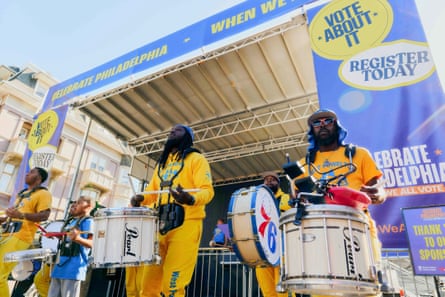
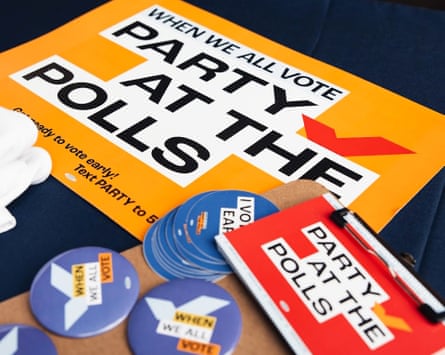
Youth-focused organizations understand that gen Z voters swing elections. The non-partisan voter organization When We All Vote, founded by Michelle Obama, hosted more than 500 Party at the Polls events throughout the US in 2024. This year, they are scaling up to 5,000 events with a goal of reaching an estimated 20 million gen Z voters. They are particularly focusing on Black and brown communities in the aftermath of the gutting of the Voting Rights Act and other suppression efforts.
“It could be anything from a quinceañera in Texas to a block party in Philly to smaller cookouts and barbecues,” said senior adviser Kalisha Dessources Figures. “We’re meeting communities where they are with what looks like joy and celebration to them.”
The organization recently brought Love Island USA winner Serena Page to the University of Houston for a conversation on college, dating and civic engagement that was attended by hundreds of students who received free giveaways such as tooth gems and custom merch.
HeadCount is another organization mixing voter registration efforts with joy. This year, they have teamed up with celebrities such as Ilana Glazer, Harry Styles and Bob the Drag Queen to encourage gen Z to take action for chances to win tickets and VIP experiences at concerts, sporting events and music festivals.
All of this outreach might be helping: some primaries this year have already seen increased turnout among zoomers. In El Paso’s primary, the youth turnout nearly tripled compared to 2022. In Michigan, Democratic Senate candidate Abdul El-Sayed received almost 60% of the vote in key counties where college-aged voters live, and some experts believe the youth vote was likely responsible for his close primary win. California, meanwhile, has added nearly 2 million more gen Z-aged registered voters since 2022, and more than two-thirds of 18- to 29-year-olds say they are inclined to support progressive candidates in the state.
Harnessing anger and frustration
Some youth-led organizations are also rallying young people to get more involved in activism, organizing their peers and building political power for their generation.
At the recent Voters of Tomorrow summit in Raleigh, North Carolina, hundreds of young people turned out to hear from progressive politicians such as the Tennessee representative Justin Pearson and North Carolina representative Jordan Lopez. Attendees also participated in trainings and workshops on peer-to-peer organizing and building political power online.
“We’re working to make sure young people know what’s at stake, but we’re also working with candidates to make sure they are making promises that they can actually deliver on,” said Santiago Mayer, the founder and executive director of Voters of Tomorrow (VOT). “We’ve seen in New York and New Jersey and Virginia and Michigan – young people are looking for candidates who are talking about the issues they need addressed.”
The gen Z-led organization has more than 11,000 members and chapters in more than 25 states. In addition to campus events, they have hosted happy hours in Iowa and a film festival in North Carolina to engage new voters. “We’re trying to host events where young people can make new friends and come back not just because they agree with the politics, but because they feel it’s a third space where people can find community and have fun,” said Mayer, who founded VOT in 2019 at age 17.
While he said the left was outspent when it came to targeting young voters in 2024, he believes Democrats can win gen Z in the midterms. “Trump lied to them when he said no new wars and that prices would come down,” he said. “Young people do not like being lied to or used, and that’s what Republicans did. They immediately threw us under the bus.”















Comments