
 German (DE)
  English (US)
  Spanish (ES)
  French (FR)
  Hindi (IN)
  Italian (IT)
  Russian (RU)
  3 weeks ago
Two years after North Carolina suffered the worst natural disaster in its history when Hurricane Helene struck the state’s western half, life in the hardest-hit areas appears back to normal. Downtowns are lively, blocked roads have been reopened and rivers are flowing below their banks.
But the telltale evidence of the disaster’s expensive impacts can still be seen – from “for rent” signs in storefronts whose businesses never came back to debris from the storm still lurking in some waterways. And in the race for North Carolina’s US Senate seat, it’s almost as if the hurricane never left.
With the Republican senator Thom Tillis retiring, Democrats see a rare opportunity in November’s midterms to win a seat in a state that has repeatedly rejected the party’s candidates in recent elections, but which could this year decide the balance of power in the Senate for the remainder of Donald Trump’s presidency.
Whether they like it or not, the two frontrunners to succeed Tillis are tied to North Carolina’s recovery from a catastrophe that killed at least 107 people and caused nearly $60bn in damage. Roy Cooper, the Democratic nominee, was governor when Helene arrived as a tropical storm over the state’s western half in September 2024, and his opponent, former Republican National Committee chair Michael Whatley, has accused him of mishandling the recovery in the months before he left office.
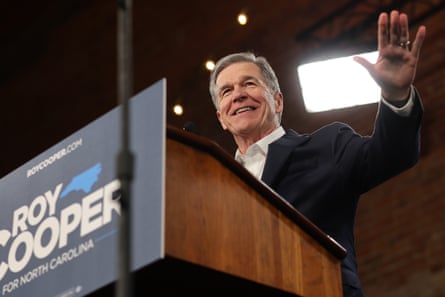
Cooper has his own counterattack against Whatley, courtesy of Trump. When the US president visited the state shortly after returning to office, he said Whatley would be “in charge of making sure everything goes well” with the recovery. That’s led to Whatley being known in the state’s press as the Hurricane Helene “recovery czar”, a title the Republican’s campaign said he was never given, but which Cooper has wielded to argue that his opponent is the one letting North Carolinians down.
“I don’t think it’s to anybody’s political benefit to be tapped as the person who was in charge of Helene recovery – Democrat, Republican, Green, Libertarian – doesn’t matter,” said Christopher Cooper, a political science professor at Western Carolina University. “People … in western North Carolina are fairly united that there wasn’t enough done and that Helene relief has been more of a failure than a victory. The question is who they blame for that.”
Blame game
The debate has national implications in a state that has been a heartbreaker for Democrats for nearly two decades. Though its candidates have come close, no Democrat has won a US Senate election in North Carolina, or carried it at the presidential level, since 2008. The GOP’s dominance of the state legislature has meanwhile allowed the party to rewrite its laws and draw congressional maps to its advantage, over the objections of the Democratic governor, Josh Stein.
This year, Democratic party leaders have put North Carolina among the small group of red states where they’re hoping to win US Senate seats, and recent polls have shown Cooper leading Whatley. Western North Carolina is generally a Republican area, with none of its congressional districts in Democratic hands and the party carrying few of its counties in presidential years.
In 2024, Trump seized on the devastation in the region to accuse Joe Biden’s administration of bungling the disaster response. Trump ended up winning North Carolina by 51%.
The state’s return to national political prominence in the midterms has reinvigorated questions over how the storm recovery was handled, as North Carolinians weigh which candidate would better champion the needs of the region in Washington.
“I’m a Cooper man. I’ve met him several times,” said Aaron Haynie, a Democrat who serves as mayor of Marshall. “I feel like his interest for North Carolina and its citizens is probably personal. I think his personal thoughts on that would be much greater than Whatley’s will.”
A riverside town of 961 residents, Marshall suffered terribly when Helene hit and the French Broad River climbed 27ft above flood level, nearly to the windows of the town’s second-story buildings. The flood water took with it the town hall and the post office, and inundated the historic courthouse, rendering it unusable.
Today, Marshall’s main street is distinctly artsy, with a thrift store, a retailer selling high-end bicycles, and another advertising arcade games and cassette tapes. But it’s not the same.
Across the street from Zuma Coffee, a longstanding cafe situated right in the center of the main drag, the courthouse that used to drive so much business remains shuttered. The county plans to vacate it for good, in favor of a new complex to be built on high ground elsewhere, with money from the state general assembly and the Federal Emergency Management Agency (Fema).
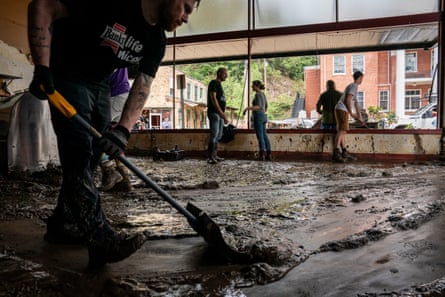

With so many locals losing their homes or employers, the nine-to-five economy that once sustained Zuma Coffee has now been replaced by visitors who show up after work or on the weekend, Joel Friedman, its owner, said. Sales at the cafe have recovered, but his margins are smaller due to inflation, while his employees are struggling to afford higher healthcare premiums after Congress let temporary federal subsidies expire.
As for the Senate election, “I don’t have a lot of hope for it, to be honest with you,” Friedman said. “I think we have an administration right now that’s rogue, and is going to do what they want to do, and living in a state with a Democrat governor is not very helpful right now.”
Matthew Wechtel, a Republican commissioner in Madison county, of which Marshall is the seat, said he wasn’t aware of Whatley specifically helping his area, but that Cooper deserved no credit for helping the town bounce back. Though the then governor visited Marshall about two weeks after the hurricane, Wechtel accused him of being a “no-show”.
“I don’t think Governor Cooper did much at all for Madison county, or for western North Carolina, when it came to storm recovery,” said Wechtel. “I think most of the stuff that came down came from the general assembly … and Governor Cooper just got out of the way and let it happen.”
A town rocked by catastrophe
A mountainous two dozen miles south of Marshall is the town of Canton, where Helene added grievous insult to economic injury that had been accumulating for years. Tropical Storm Fred flooded the town in 2021, and two years later, 1,100 jobs disappeared when a paper mill that had operated for more than a century closed. Then Helene came through and put Canton underwater.
“Everything was flooded. We lost homes, businesses, things that we had rebuilt from ’21, gone again,” recalled Zeb Smathers, the town’s Democratic mayor.
The multiple catastrophes have made him familiar with dealing with Fema, the federal emergency agency he said was slow in responding to Tropical Storm Fred, but more swift when Helene hit. In the early part of his second term, Trump mulled doing away with Fema altogether, and appointed Whatley to the Fema Council Review Board, which evaluated the agency’s operations and earlier this year released a report proposing shifting disaster response into the hands of state and local governments.
Pointing to Whatley’s position on the Fema review board, DJ Griffin, a spokesperson for Whatley’s campaign, said: “If you look very, very, very, very closely, you’ll notice there’s no czar in that description. Not a czar of any sort.”
Griffin said that Whatley had collaborated with Republican members of the state’s federal delegation to bring North Carolina $10.75bn in hurricane relief. “But the job is not yet done and Michael [Whatley] will continue speaking with local leaders about what they need help with,” he added.
A spokesperson for Cooper’s campaign argued that those federal dollars covered only about 15% of the damage from the storm, while the governor signed two bills allocating more than $877m in state funds to hurricane relief before leaving office. “DC insider Michael Whatley has completely failed in his role as federal recovery czar,” the spokesperson said.
Smathers said Canton’s recovery was hampered by Kristi Noem, Trump’s first homeland security secretary, who required she personally approve all spending over $100,000 by agencies such as Fema. But the pace has improved under the new secretary, Markwayne Mullin.
As for Whatley, Smathers said he’s never heard from him. “He wasn’t named the recovery sidekick. He was named the recovery czar,” Smathers said. “His leadership and presence has been absent.”
Brandon Rogers, a Republican county commissioner, complimented Cooper’s response to the storm, remembering the then governor calling to ask if he needed anything shortly after Helene came through, and then arranging for water, food and insulin to be delivered on helicopters.
But for Rogers, a conservative who opposes abortion, the former governor won’t be getting his vote in November. “As far as Whatley’s concerned, I think he would do a great job,” he said.
Rogers recalled pointing out their disagreements when Cooper came to Canton. “I appreciate you bringing the check,” he remembered telling Cooper during the visit. “However, a lot of our other politics may not line up.”
The two ended up laughing about it, Rogers said. “That doesn’t mean we couldn’t work together.”













Comments