
 German (DE)
 English (US)
 Spanish (ES)
 French (FR)
 Hindi (IN)
 Italian (IT)
 Russian (RU)
 59 minutes ago
Fires from lithium-ion batteries, which power ebikes and scooters, have become regular occurrences in New York, causing deaths and fear among residents, but the city has failed to build infrastructure that could reduce the threat.
New York has seen a dramatic uptick this year in fires from the batteries. In 2025, there were 292 fires, 51 injuries and one death, according to the New York fire department (FDNY). This year, there have already been more than 400 fires, 83 injuries and 12 deaths.
In late October, four members of a family, including an 11-year-old boy, died in a fire caused by a battery in an ebike that was in the pathway to an exit of an 11th floor apartment in a public housing building in the Bronx.
Then recently in a fire at a home in Brooklyn, six people died and nine were injured, including three firefighters and two police officers. Investigators discovered lithium-ion batteries at the scene but have not determined whether they caused the fire, the city council speaker, Julie Menin, said in a statement.
“The presence of lithium-ion batteries at the scene is a serious concern, and more must be done to encourage and mandate safe storage practices. Enough is enough,” Menin stated.
London and Toronto have also recently seen a dramatic increase in lithium-ion battery fires, which are often caused by overcharging and defective or damaged batteries.
Some of that trend is simply because ebikes, often used by food delivery workers and commuters, have become more popular.
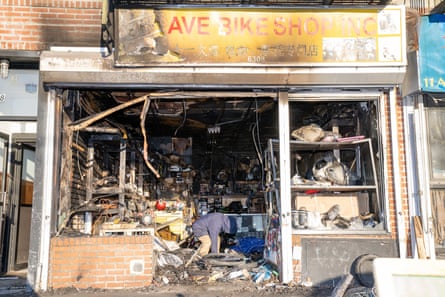
But in New York, the city has not executed its plan to build outdoor charging stations which would prevent people from plugging in the batteries in their apartments, where an overheated or defective battery poses a greater risk, experts say.
“There is a ton of red tape around this sort of new technology, and while it’s well intended to not let something new roll out too quickly, I think in this case, it is time to do something quickly,” said Laura Kavanagh, former commissioner of the FDNY.
In 2025, there were 2.2m ebikes imported into the United States, according to Light Electric Vehicle Association, double the number from just three years earlier.
In response to the increased usage and related increase in fires, the New York City department of transportation conducted a 2024 pilot in which it hired companies to offer battery-swapping cabinets where delivery workers could exchange exhausted batteries for charged ones.
The riders did more than 12,000 swaps over six months, and among participants, there was a 35% reduction in charging batteries at home, according to the city.
Following its success, the city announced that it would install 25 charging sites but not until 2027. The city first needed to “gather feedback on site selection, design and implementation”.
In April, New York mayor Zohran Mamdani asked residents to provide feedback on where they would like the 25 cabinets. The city planned to make them available in 2028, the announcement stated.
In 2023, the city also announced that it received a $25m federal grant to build 173 electric-micromobility charging and storage stations at 53 public housing developments.
“This means that residents will no longer need to charge their ebikes in their apartments, what we find to be extremely dangerous,” Mayor Eric Adams said at the time.
At the time, the deputy mayor, Meera Joshi, said residents would start “seeing evidence” of the stations in early 2024.
Three years later, none have been built.
Even though the Biden administration allocated the $25m for the infrastructure, the federal government has not actually provided the funds, according to the New York department of transportation.
Asked why the process has moved slowly, a transportation department spokesperson stated in an email: “The city’s strategy to reduce the risk e-bike battery fires focuses on getting unsafe devices off our streets and providing safe and convenient e-bike charging options” and the “outdoor battery swapping cabinets will make charging safer and more accessible for the thousands of delivery workers who rely on these devices to serve New Yorkers. With the public feedback we gathered this summer, we’re finalizing locations for our public e-bike charging program before advancing to the design phase and remain on pace to launch the service in 2028”.
Meanwhile, Popwheels, one of the companies in the successful pilot, has installed about 45 cabinets around the city, according to CEO Baruch Herzfeld.
He wants to install hundreds more around the city but has been stymied by a permitting process that he describes as “ludicrous”. He said it often takes six months for the city to approve one cabinet.
“If I want to put a cabinet that they approve in a parking lot, I have to use an architect to do a drawing, and then they have to come and do an inspection of a drawing of an ebike battery cabinet in the parking lot,” Herzfeld said. “This permitting process is why kids are dying.”
The city also often issues tickets to the owners of properties where Herzfeld has installed the cabinets, he said, for minor infractions like a fire extinguisher not having the proper tags or trash at the site.
Amanda Farinacci, the FDNY deputy commissioner public information, stated in an email that the tickets were not for “minor infractions but instead significant concerns”.
“The FDNY has been very serious partners with the micro-mobility/charging cabinet industry, being very accessible and collaborative to achieve solutions,” Farinacci stated. “We are a public safety agency and our mission is public safety. To conflate our regulatory responsibilities with causing people to charge their batteries indoors is entirely misplaced and inaccurate.”
Kavanagh, who spent a decade at FDNY before leaving in 2024, argued that the department is focusing on “too narrow of a concern”.
“I respect whatever concerns they have about the cabinet as real, but that is asking the wrong question,” said Kavanagh, who now works as a visiting urbanist at New York University. If “a battery failed in that cabinet outside, it is almost certain that would do no more than property damage. You are comparing that to” 10 New Yorkers dying in fires in the last three weeks.
“This is just appreciably worse, and so I think we need to frame it that way,” she added.
The latest fire may spur the city to expedite its approval process. On Friday, Menin announced that the city council would hold an emergency meeting on 20 November to conduct oversight to ensure the city is properly enforcing existing laws and that the public is educated on best fire safety practices and lithium-ion battery storage.
Ebike fires “are something that can cause people to lose their lives as well as their livelihoods”, Mamdani said on MS Now after the Brooklyn fire. “And so, we are really looking at every avenue we have to keep them safe.”




















Comments