
 German (DE)
  English (US)
  Spanish (ES)
  French (FR)
  Hindi (IN)
  Italian (IT)
  Russian (RU)
  3 weeks ago
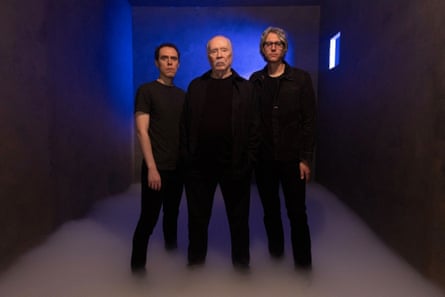
In 2024, John Carpenter had a dream that sounds like one of his movies: it involved a portal to the underworld beneath a disused church, monstrous demons and people being turned inside out. “I woke up and thought: wow! What an elaborate story,” he says. “I rarely have cinematic dreams, but this was one of them.” He liked it so much that he has turned it into a graphic novel, Cathedral, with an accompanying soundtrack. “It seemed to fit this heavy metal groove that we were starting on, and it worked out pretty well.”
Most people would consider this a nightmare rather than a dream, I suggest. “No. Nightmares, for me, are personal – something that happened to me,” he replies. “Usually my nightmares are, I’m directing a movie and no one will listen to me. No one will follow my directions. Seriously, that’s what I wake up from.”
It doesn’t take a Freudian analyst to unpack that one. Carpenter’s film career effectively wound down at the end of the 20th century, after 25 years of defiantly making movies his own way – often tense, terrifying, violent, gory movies. He is the epitome of the stubbornly independent film-maker, who demands complete creative control, who goes further than Hollywood studios would usually dare and whose name above the title is a seal of cult quality. “‘Don’t tell me what to do’ is John Carpenter’s credo!” he tells me. Few of his movies were commercial hits at the time, though, and a great many were the opposite, including his final two movies, 2001’s Ghosts of Mars and 2010’s The Ward.
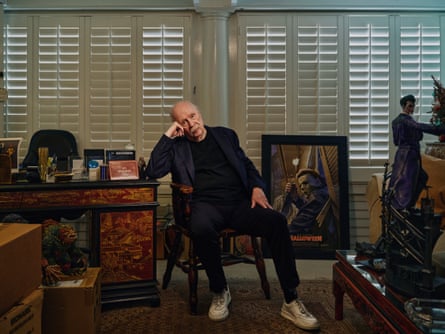
Does he miss making movies? “Yes and no,” he says. He is talking on a video call from his home in the Hollywood Hills and, despite his reputation as an uncompromising grouch, the 78-year-old is in good spirits and good health. “It’s really weird. Yes, because I’ve always loved cinema and the process. But no, working in the studio system in Hollywood is very difficult.”
He seems to have managed pretty well, I suggest. “You have to fight to do that. That’s the unfortunate thing. And that takes a little bit out of you, as a person, every time it has to happen,” he says. “There’s a reason why directors come out of the other end looking as if they’ve been in a war. Because they have been: it’s a creative war. And so there are a lot of drunks who are directors, that’s one way of coping, or taking other drugs. Anyway, we won’t get into all that.”
Was that ever you? I ask.
“No, no, no, let’s not,” he waves off the question. “I’m not going to tell you all my secrets.”
Carpenter may have lost battles, but he won the war. Many of his films are considered classics: Halloween, The Thing, Assault on Precinct 13, The Fog, Escape from New York. And Carpenter’s film-making style continues to cast a long shadow – not only over horror and sci-fi movies, but also mainstream television, especially anything set in the 80s or with the look of that era (Stranger Things, say, or the current Widow’s Bay), and even philosophical culture-mongers such as Adam Curtis and Slavoj Žižek. Musicians also bow to him: his spare, synth-driven scores have been namechecked by many, from Portishead to Daft Punk, Trent Reznor to Hans Zimmer.
Carpenter seems unaware of all this. When I tell him there is almost a paragraph of his Wikipedia entry listing film-makers who have cited him as an influence – Guillermo del Toro, Quentin Tarantino, Edgar Wright, James Cameron (who worked for Carpenter once) – he seems genuinely oblivious, pained even. “What does that mean to me? I can’t do anything about that. It’s wonderful, I think it’s fantastic, I don’t know why. If you were gonna emulate a director, you’d emulate somebody whose movies aren’t panned.” It sounds as if he is not online much then? “No! I rebelled against mobile phones. I rebelled against computers. I can’t do that, I don’t want to do that.”
Carpenter’s rebellious streak goes way back, and is inseparable from his art. His father was a music teacher and an orchestra violinist. In 1953, when John was five, the family relocated from northern New York when his dad got a teaching job at Western Kentucky University. “It was the Jim Crow south in the 1950s. Boy, were we fish out of water,” Carpenter says. “Everything I know about evil I learned in that small town of Bowling Green, Kentucky.”
His father had encouraged John to learn violin too. “You’re walking to school in the morning and you have a violin under your arm; these country boys in Kentucky decided I was great to beat up. I was a mark for violence with my violin, which made me hate it all the more.”
Classical music’s loss would ultimately be synthwave’s gain, but Carpenter was also just the right age to hook into the 60s counterculture. He rebelled against everything, he says: the town he grew up in, the Vietnam war, the system, “all forms of authority”. But he came to love and appreciate his father. “He told me early on: just create something, whether it’s music, writing, painting; whatever it is, create. And here I am, still doing it.”
His mother regularly took him to the movies. “She gave me the gift of fantasy, and my father gave me a rigorous approach to creating.” Seeing the sci-fi movie Forbidden Planet when he was eight was a transformative experience: “I remember walking out and thinking: I’m gonna be a movie director.”
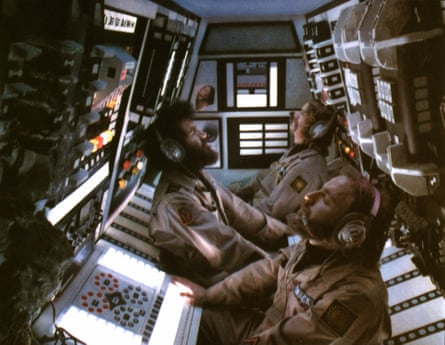
While near-contemporaries such as Francis Ford Coppola and Martin Scorsese were taking over Hollywood through the front door, Carpenter operated on the genre sidelines. His 1974 debut, Dark Star, was a lo-fi hippy parody of Kubrick’s 2001: A Space Odyssey, which saw space travel less as a symphonic leap into the future and more as a grotty flatshare: boring, unhygienic and fractious. It was made on a shoestring, with egg cartons for spaceship interiors and an inflatable beach ball for an alien, but the movie did reasonably well, alerting Hollywood to the fact he could produce results on a small budget.
It all came together with Halloween, in 1978. Led by a then unknown Jamie Lee Curtis and made for $325,000, it grossed over $70m. It opened the floodgates for highly profitable low-budget horror films and is often cited as the foundational slasher movie. Carpenter makes no such claims. “I put in what I thought was the summation of all the horror that I had seen. I wanted to use the audience, manipulate them like a ride at a carnival and have them scream, jump, not knowing where the thing is. Is it a man? Is it not a man?”
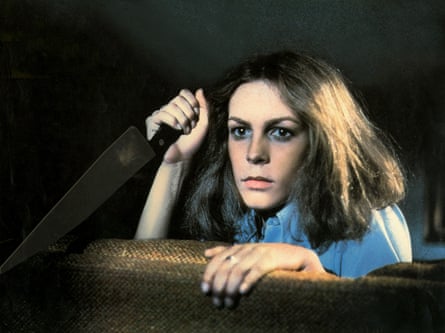
Halloween was an assault on cosy smalltown domesticity: the horror wasn’t confined to a haunted house or a gothic castle; it was in your neighbourhood, in your home, preying on you and your children. “That’s the whole opening,” Carpenter says, “when it pulls back with this little kid with a knife in his hand [young Michael Myers, the future slasher] and it reveals we’re in the suburbs. That’s the whole idea.”
Inevitably, the studio wanted Carpenter to repeat the trick with a sequel, especially since Halloween left the fate of its anti-hero open-ended. “I didn’t think there was any story left,” he says. “But they – meaning Universal Pictures and the producers – were gonna do it whether I wanted to or not. So what are you gonna do?” Carpenter wrote, but did not direct, Halloween 2, and after that: “They took it out of my hands, but they had to pay me every time they made a movie. I sit on the couch and a cheque arrives in my hand. What’s wrong with that? I have to admit, with all the rebellion in the world, I am a happy capitalist.”
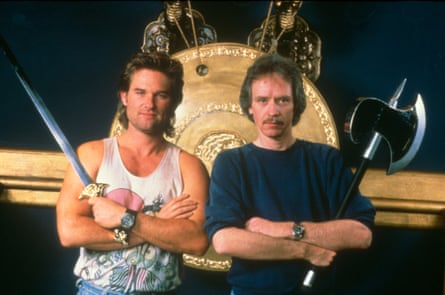
Nevertheless, Carpenter continued to stick it to the man, puncturing his era’s cheery certainties and self-congratulation, ridiculing authority figures, standing up for the underclass. It’s there in Assault on Precinct 13, where racial, gender and law-enforcement hierarchies are upended during a relentless night-time siege. It’s there in Escape from New York, where Kurt Russell’s snarling anti-hero is forced to rescue Donald Pleasence’s feeble American president, but has zero respect for him. It’s even there in his goofy action comedy Big Trouble In Little China – a movie where the ostensible leading man (Russell again) is actually a klutzy sidekick and the Asian cast are the real action heroes.
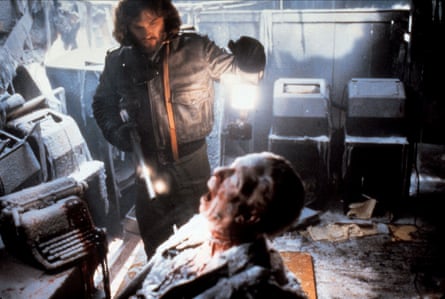
Carpenter was possibly at his most out of step with American sensibilities in the summer of 1982, when he released The Thing – a paranoid sci-fi thriller centred on a shape-shifting alien picking off members of an Arctic research station, aided by some fantastically disgusting special effects. It is now recognised as a horror masterpiece. Back then, it arrived in cinemas two weeks after Steven Spielberg’s ET the Extra-Terrestrial. The contrast could not have been more jarring.
Carpenter recalls going to see ET that summer: “I remember seeing the boys on their bicycles and the ET wrapped up, and then they go up into the sky magically. And that’s when I threw up.” He’s joking, but only half. “I was like: ‘Come on, don’t do this.’” He’s actually full of admiration for Spielberg, not least for reading the 80s zeitgeist. But he prefers his version: “If you really want to know the truth about alien encounters, I think that my movies are more realistic about what will happen. Think of the settlers who came to the United States and their encounters with the Indians. It didn’t really go so well for the Indians, OK? Our encounters with aliens – I imagine it won’t go so well for us.”
That said, Carpenter did make a relatively feelgood alien story two years later: 1984’s Starman, in which a visiting alien inhabits the body of Karen Allen’s deceased husband, Jeff Bridges (who earned an Oscar nomination for his performance). The result was almost a grownup ET; a tender, comical, road-trip romance. It showed Carpenter’s surprising capacity for sensitive, emotional drama. “I wanted to show I could do it,” he says. “Bicycles taking off and flying – I wasn’t going to go that far, but …”
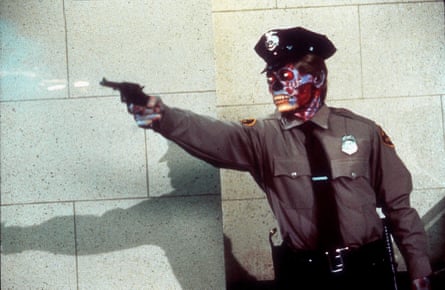
Then there’s They Live, from 1988, which seems to have taken on a life of its own. The story concerns a homeless worker (played by wrestler “Rowdy” Roddy Piper) who discovers some sunglasses that reveal subliminal propaganda messages beneath every advert, magazine and piece of packaging he sees: “Obey”, “Marry and Reproduce”, “Stay Asleep”. Even the dollar bills secretly say: “This is your God.” The glasses also reveal the aliens who walk among us undetected, controlling humanity.
Not exactly subtle, and They Live is by no means his best film (Piper is no Kurt Russell), but it has become part of the culture, endlessly mimicked, turned into memes and even co-opted into a successful clothing brand by the graphic artist Shepard Fairey – the ultimate irony, perhaps. Just last week, pranksters doctored billboards for Meta’s AI glasses They-Live-style, revealing Kylie Jenner to be an alien and the ad’s subliminal slogan to be “We’re always watching”.
Carpenter was specifically targeting the Reagan era in They Live, he says, the hyperconsumerism, but also the inequality – contrasting Piper’s homeless community with the affluent heights of 80s Los Angeles. “It’s a documentary, and it didn’t end. It’s still going on now, even worse.” He stops himself. “You’ll get me ranting here, and that’s not a good thing.” But, almost needless to say, he’s depressed by the state of his country. “Things are bad here. I guess you guys realise that over there?”
Žižek, the Slovenian philosopher, called They Live “one of the forgotten masterpieces of the Hollywood left” in his 2012 documentary The Pervert’s Guide to Ideology, which saw the film as a metaphor for not just consumerism but ideology as a whole: “When you put the glasses on, you see dictatorship in democracy. It’s the invisible order which sustains your apparent freedom.”
“I don’t know if I’d go that far,” says Carpenter (he has never heard of Žižek, and asks me to send him the clip). “It’s actually democracy under pressure from the dictator. I’m a real sucker for American values. There’s a lot of people like me and we’re constantly fighting, but we’re doing it within the system. I vote. That’s the only power I have. I’m not a rich guy like these guys. And I keep believing that we’ll fight them off one day. We’re all going to be like Roddy Piper, we’re going to give ’em the finger at the end there.”
Of course, voting is not the only power Carpenter has; his cinema is a textbook lesson in how beliefs and values can be transmitted through popular culture, even when they are in opposition to the beliefs of those who control that culture. But he is happy for others to take up the fight these days. He didn’t realise how much film-making was taking out of him until he stopped doing it, he says. “I was exhausted, and then I took this extended vacation and I got happier the more I was away from the thing I love. I thought: what’s going on here? I was addicted to moviemaking and I needed rehab. So I had to get away from it.”
Since then, he has toured the world playing his film music, with his son Cody and his godson, Daniel Davies, as well as recording new material. He has no regrets. “I’ve had great experiences with actors. I loved working with Sam Neill [who led Carpenter’s 1994 mind-bender In The Mouth of Madness], Jeff Bridges, Kurt, and my leading ladies have been great. I love them all. I’ve had a fantastic time. Now I’m playing music. I mean, it doesn’t get better than this. It really doesn’t.”
Most of his days are spent at a leisurely pace, he says. “Basketball, the news and video games. That’s John’s entertainment. Then I go to have long, beautiful sleeps – and dream.”
John Carpenter’s new album, Cathedral, is released on 7 August on Sacred Bones Records. His first graphic novel is released on 4 August4 via Storm King Comics















Comments