
 German (DE)
  English (US)
  Spanish (ES)
  French (FR)
  Hindi (IN)
  Italian (IT)
  Russian (RU)
  2 weeks ago
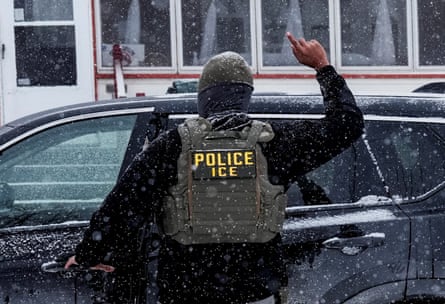
As hundreds of masked and armed US federal agents besieged the streets of Minneapolis, turning the midwestern city into the frontline of the Trump administration’s unprecedented crackdown on immigration, the independent photographer John Abernathy was documenting one of the protests that had become a daily occurrence when Immigration and Customs Enforcement tackled him.
A photograph of him on the ground, pepper spray running down his face, captured the violence with which ICE agents had for weeks treated immigrants and the thousands of US citizens who had come to their defence. It was also a stark reminder that journalists were not immune to the agency’s aggressive tactics.
The US Press Freedom Tracker documented an increasingly volatile climate for journalists across the country in 2025, reporting 32 arrests and 170 assaults, most of them during protests. And things are no better this year.
Journalists who are themselves immigrants have at times also become targets of the hardline policy. Estefany Rodríguez, a Colombian reporter covering immigration for a Spanish-language outlet in Nashville, Tennessee, was arrested in March and held in ICE detention centres in Louisiana and Alabama for two weeks, before a judge ordered her release. Rodríguez had reported on immigration arrests at a local courthouse a day before agents surrounded her car, which was marked with her outlet’s logo, and arrested her.
It was journalists such as Abernathy and Rodríguez who inspired a multi-outlet investigation, involving staff from two dozen newsrooms in 16 countries and coordinated by Forbidden Stories. The project details the secretive deals the Trump administration has struck with third countries, mostly in Africa and Latin America, to take in deportees the US is unable to send to their countries of origin.
In Georgia, ICE agents arrested Mario Guevara, an Emmy award-winning journalist from El Salvador. He had lived in Atlanta for nearly two decades, running an independent Spanish-language outlet and documenting immigration enforcement operations on TikTok. Guevara was covering a “No Kings” protest in June 2025 at the time of his arrest. He spent more than 100 days in detention, mostly in isolation. “They didn’t want me to hear the stories of other fellow prisoners and that’s why they locked me up alone,” he told Forbidden Stories.
Guevara was deported to El Salvador last October, while his wife and children remain in the US. He has continued to report on US immigration enforcement from there and remains convinced he was targeted because of his journalism.
“ICE had a personal campaign against me,” he said, noting that agents repeatedly asked him why he insisted on documenting their activities when he was not a US citizen. “ICE arrested and deported me because of my journalistic work, I’m sure.”
A spokesperson for the Department of Homeland Security rejected Guevara’s claims, saying allegations he was “arrested by ICE or isolated while in detention because he is a journalist are completely FALSE”. The spokesperson said Guevara was arrested by local authorities for obstruction of law enforcement and deported because an immigration judge had issued a final order of removal more than a decade earlier.
“If you come to our country and break our laws, we will arrest you and you will NEVER return,” the spokesperson said.
Journalists reporting on the impact of the Trump administration’s third-country removal policy have also faced the hostility of some of those countries’ authorities, particularly in countries where press freedom is already severely restricted.
Show more
In Cameroon’s capital, Yaoundé, last February, four journalists, including three who were on assignment for the Associated Press, were briefly detained while reporting at a state-run compound where African migrants recently deported from the US were being held. The journalists were accused of criminal trespassing and had their equipment and phones confiscated for a week. During questioning, authorities warned them they would be “crushed” and “disappear[ed] without a trace”, one of the group told the Committee to Protect Journalists.
Nalova Akua, one of the journalists detained in Cameroon, told Forbidden Stories he believed they had been targeted because they were exposing the impact of a collaboration with the US government that Cameroonian officials would prefer to keep out of public view.
Abernathy tossed his camera to another photographer as agents tackled him to the ground in the hope of saving the photographs he had taken, he previously told the Guardian.
“It deserves to be seen, what’s going on around here,” he said.











Comments