
 German (DE)
  English (US)
  Spanish (ES)
  French (FR)
  Hindi (IN)
  Italian (IT)
  Russian (RU)
  3 weeks ago
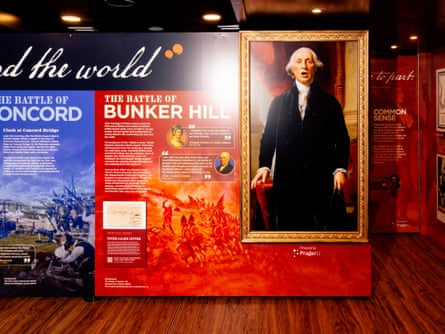
George Washington greets you as you enter the truck. The great man, dressed elegantly in a black velvet coat and white cravat, stares out from the 1796 Lansdowne portrait, the lifesize image of America’s first president painted during his final year in office.
As you step towards the painting, something strange happens. Washington’s outstretched arm begins to move. His lips part. And lo and behold, the legend is talking to you!
“My name is George Washington, you may have heard of me.”
Not the most portentous opening line from such a towering figure, perhaps. But as he continues speaking, this AI Washington warms to his patriotic theme. He looks directly at you as if addressing the troops, and says: “Are you willing to pledge your lives, your fortunes and your sacred honor for the American cause? The fate of country, the fate of liberty, is in your hands.”
No pressure then.
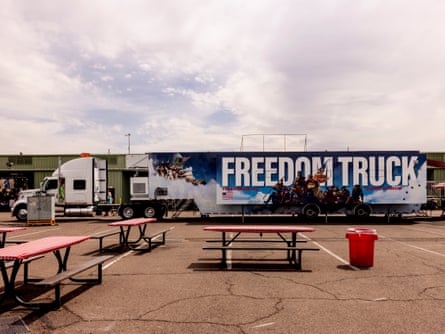
Nothing much is left to the imagination in Donald Trump’s traveling paean to American greatness. Six so-called “Freedom Trucks” – gargantuan double-wide 18-wheelers – are fanning out through the 48 contiguous states in the run-up to the country’s 250th birthday on 4 July, each loaded with interactive quizzes, facsimiles of historic documents and a “wall of American heroes” honoring figures from Mark Twain and Elvis Presley to Ronald Reagan, Billy Graham and Aretha Franklin.
“Welcome Patriots!” is scrawled on the outside of the semi. Almost an entire flank is taken up by Emanuel Leutze’s epic painting of Washington crossing the Delaware River. The commander-in-chief of the Continental Army stands tall and proud above the icy waters, gazing unflinchingly forwards, as if urging the truck to drive victoriously on through the clogged, smoggy interstates of the heartland.
The Freedom Trucks, officially categorised as “mobile museums”, are a centerpiece of Trump’s very, well, Trumpian marking of the semiquincentennial. As much an expression of the current president’s personal passions as he approaches 80 as an homage to the country’s achievements as it turns 250, other highlights in the anniversary bonanza include a UFC cage fight outside the White House, an IndyCar race around the capital, and the erection of a 250ft-tall “Arc de Trump” beside the Potomac River.
The Freedom Truck I visit has been pitched inside the Maricopa county fairground in Phoenix, Arizona. It’s a Friday afternoon and Phoenician families are coming out to play, parents tearing their children away from the perilous combination of stomach-churning rides and deep-fried Oreos for a quick dose of patriotic edification.
Most of the exhibit is devoted to the founding of the nation and the glory of defeating the tyrannous British king, with more recent history treated in cursory fashion. The classic events of the Revolutionary war are namechecked: the first shots fired at Lexington and Concord, the Battle of Bunker Hill, the Declaration of Independence on 4 July 1776, the bitter winter at Valley Forge, the war’s end at the treaty of Paris in 1783 and the writing of the US constitution four years later.
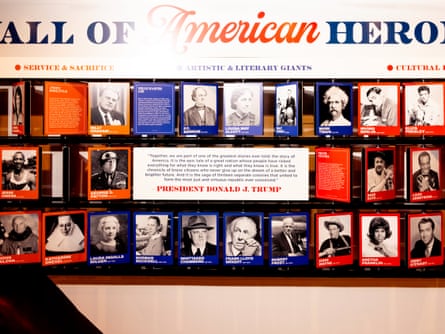
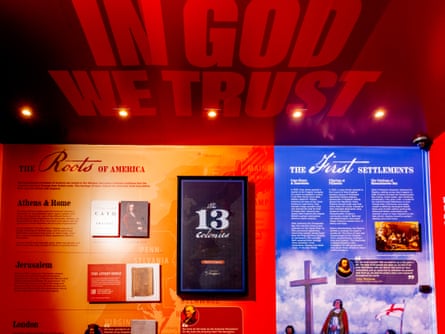
Notably, America is depicted as a white Christian nation. Several Black luminaries are mentioned: among the 50 American heroes are Frederick Douglass, Martin Luther King and Rosa Parks. But the prevailing wind blowing through the truck is towards the white men who led the charge to nationhood, with minor roles granted to their women dutifully holding the fort back home, and on God as the source of the country’s greatness. AI Washington says that “our rights are a gift from God”. One placard states boldly: “The truth that each person is made in the image and likeness of God is the basis of human equality.”
Another placard makes the point overtly: “The foundational principles of America are rooted in the Western and Judeo-Christian traditions … that shaped the American mind.”
Arguably the most brazen aspect hits you at the exit: the roadshow is bookended with a video featuring Trump himself.
Washington to open, Trump as closer. At least Trump had the humility to order it that way round, which was not a given. The 47th and 45th president has regularly claimed superiority over all his predecessors, Washington and Abraham Lincoln included.
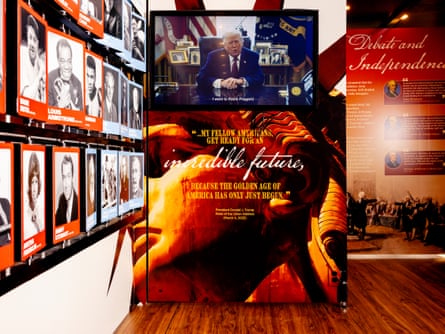
In the video we find Trump sitting at his Oval Office desk. He waxes lyrical about the founding fathers – “incredible people, they were” – and hails America as “the greatest force for freedom, justice, equality and prosperity in the history of the world”.
A nearby board quotes Trump’s State of the Union address last year: “My fellow Americans, get ready for an incredible future, because the golden age of America has only just begun.”
The implication is unmistakable. The man who launched his first bid for the presidency by descending a golden escalator, who has sloshed gold paint all over the White House, not to mention the Aurelian hue he has coloured his own skin, would like us to believe that he, and he alone, is the channel through which America’s so-called “Judeo-Christian” lineage now flows, and that he, and he alone, should be credited for all its future greatness.
The “museum” done, visitors stumble out of the truck into the eye-squinting blaze of an Arizona day. The truck is parked on the edge of the fairground, underneath a Chair-O-Planes ride from which young amusement-goers emit high-pitched screams.
Across the road, a large shed is packed with farm animals in the fair’s agricultural show. The gates of the shed are open, and the acrid odor of goats wafts across the Freedom Truck, along with an occasional mournful bleat.
In his video tail-ending the exhibition, Trump invites visitors to join him in making the 250th anniversary “a year we will never forget”. That much he has already achieved, and we’re only four months in.
The US is back at war. Its president has threatened to destroy an entire civilisation, posted AI images of himself as Jesus and survived his third assassination attempt, while on the domestic front federal officers have killed American citizens at point-blank range. Quite the year to be celebrating American greatness.
That this milestone falls at such a volatile juncture for the country is not lost on Maricopa county visitors to the Freedom Truck. The one thing that seems to unite them as they talk to the Guardian is appreciation of the truck’s glowing portrayal of the heroic struggle for independence. The appeal to the inalienable rights of life, liberty and the pursuit of happiness clearly still speaks profoundly to these Americans.
When it comes to the present day manifestation of those values, however, the consensus is shattered.
Darin Stordahl, 53 and wearing a stars and stripes T-shirt, tells me that he loved the truck’s story of America. It filled him with pride that the founders had “the cojones to declare independence”.
What would he say in reply to AI Washington’s challenge to us: would he be willing to pledge his life to the American cause?
“I did,” he says, explaining that he served as a radio operator in the 1990 Gulf war. He was injured on duty and is now living on a veteran’s disability pay.
What about the current war with Iran?
“I don’t agree with it,” he snaps, flaring up. “It wasn’t planned properly, it’s just Trump going off on his own with Israel.”
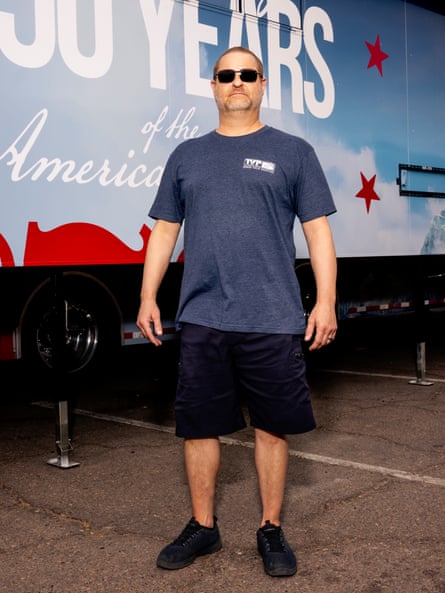
As America prepares to mark the 250th anniversary of the ousting of the British monarchy, how does he view the direction of the country under its current head?
“Trump is trying to be a king. The ‘Arc de Trump’. That’s so like a king.”
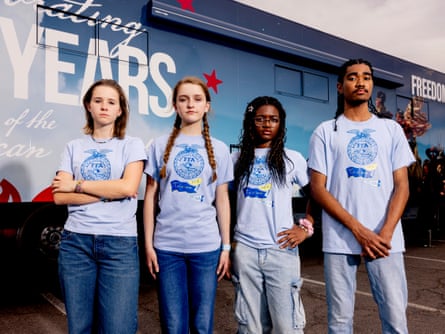
Aaliyah Hunt, 15, has come to the fairground with her youth organization, FFA (formerly Future Farmers of America). When I ask her to review her visit to the truck, she says: “I was calm until the end.”
It was the Trump video that shook her up. Why so?
“Am I allowed to say?” she asks.
An African American teenager feeling the need to ask permission before commenting on an exhibition on American freedom speaks volumes. I point out the irony, and the floodgates open.
“Trump isn’t a good image for America right now,” she says. “He’s disgusting. He shouldn’t be representing the country.”
On the other side of the rift is Amy, 68. She shares with me only her first name because, she says, she was a Tea Party activist back in the day and Barack Obama’s IRS came after her. Now she doesn’t trust the government, Trump or no Trump.
Amy loved the Freedom Truck. It was balanced and accurate, she says. And she loved Trump’s words at the end. The idea that he is trying to turn himself into a modern George III? “That’s bullshit,” she says. “If he was a king they wouldn’t have impeached and indicted him like they did.”
For Amy, there couldn’t be a better year than this to hail the glory of America. “It’s pretty awesome what’s going on right now,” she says. “The Iranians will be freed. I just wish Trump would be given the power he deserves. Then he could drive out all the criminals.”
The prize for most memorable take on the exhibit goes to Shavonne Updike, 41. A member of the Church of Jesus Christ of Latter-day Saints, she is wearing a long, flowing linen dress that blends in with the American revolution-era theme inside the truck. She came with her five children, who include two-year-old twins whom she dressed in picnic table shirts and tiny stars and stripes cowboy boots. Updike has them in a stroller masquerading as a Volkswagen van with the licence plate: “God. Family. Country.”
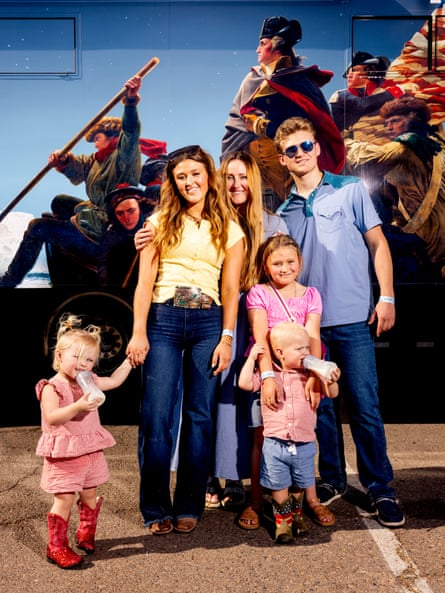
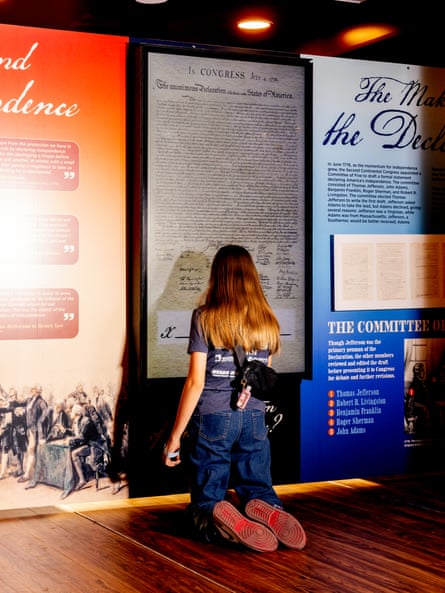
She tells me that the exhibit reinforced her belief that America has a direct line to God. She leads me inside the truck to a facsimile of the Declaration of Independence.
“That document is inspired by God,” she says. “He gave it to provide for our nation, so ours could be the best in the world.”
Victory against the British was a miracle. “There was no way we should have won that war. God had a hand in it.”
The country is back at war now, I say.
“Yes, and God is still looking out for us.”
Updike says that she doesn’t approve of everything Trump does or says. But then, “God doesn’t work only through perfect people. Bright lights cast big shadows.”
I ask her whether she thinks it coincidental that Trump is president at the point that America celebrates its 250th birthday.
“It is God, without a doubt,” she says.
What does she mean?
“I believe that our president was put there for a divinely appointed reason. I believe that he, and only he, is in that position to do the things he needs to do. He is beholden.”
For someone who is disdainful of academic elites and displays little interest in books, Trump is surprisingly obsessed with American history.
His fixation began towards the end of his first term when he created the 1776 Commission. It was a thinly veiled response to the 1619 Project, the New York Times’ reframing of the American story that placed slavery and its legacy at the core.
In the second term, Trump’s preoccupation has only deepened. He is doing all he can to push back what he regards as a negative, “un-American” telling of the US narrative.
He has used his executive powers to rattle the Smithsonian, revived Confederate names and statues, and claimed that he is restoring “truth and sanity to American history” by purging it of “race-centered ideology”.
The culmination of all this fulminating is Freedom 250, the “public-private” partnership he set up under the auspices of the National Park Foundation to mark the semiquincentennial. It was not enough for this president that Congress had already established America250, the bipartisan commission that for the past decade has been planning its own multimillion-dollar celebrations.
Being Trump, his intervention has kicked up a storm. Questions have been raised about the money that has poured into the venture from Palantir, Oracle and Amazon, among other corporations. It hasn’t helped that Trump has predictably turned the anniversary into a pay-to-play bonanza, with donors who contribute more than $1m being offered access to the president at a special “private Freedom 250 thank you reception”.
As for the Freedom Trucks, Democratic Congress members have demanded to know which private donors are bankrolling the exercise, complaining that the $14m in federal funds allocated to them amounts to “Christian nationalism on the taxpayer dime”. (The Trump administration has insisted it is duty-bound to keep donors anonymous.)
What is likely to be most enduring – and most controversial – about the roadshow is its dominant tone in representing America as a God-given force for freedom led by Judeo-Christian white men. The glorification of a predominantly white America turbocharged by faith runs through much of Trump’s second term, from his attack on diversity, equity and inclusion (DEI) to his courting of evangelical Christians and his warmongering alliance with Israel.
Certainly there are aspects of the country’s founding documents that reflected the conventions of the time. “All men are created equal,” the Declaration of Independence says, and they are “endowed by their Creator with certain unalienable Rights.”
But it is also certain that the founders intended the country to have no official religion and that they wanted to prevent their fledgling nation from developing into a religious state. There is no mention of Christianity in the US constitution, and its first amendment expressly forbids Congress from passing any laws that establish religion.
That Trump should sidestep such inconvenient truths and elevate the religious element of America’s creation out of all proportion is not coincidental, suggested Kristin Du Mez, a historian and chronicler of white evangelism in her book Jesus and John Wayne. For Du Mez, Trump’s emphasis is utterly in tune with the proclivities of so many other authoritarian-leaning leaders.
“This is textbook,” she said. “Invoking history and a mythical past is always critical in shoring up an authoritarian movement. ‘Something has been lost and needs to be redeemed or regained, and I am the person to do it.’ That was Trump’s instinct from day one, to proclaim that he would re-establish American greatness: Make America Great Again.”
Visitors might find it puzzling that an entity called PragerU has its logo splattered liberally all over the inside of these Freedom Trucks.
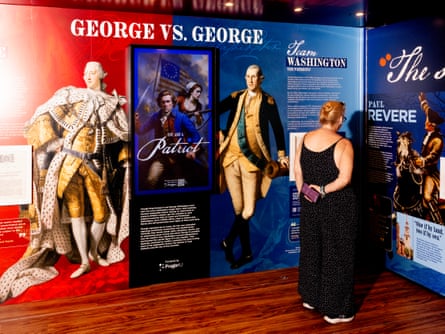
Take that facsimile of the Declaration of Independence. It is interactive, and you are invited to sign it alongside the founding fathers. Right beneath where you sign it says: “Powered by PragerU.” Trump in his video thanks PragerU, without explaining who or what it is.
PragerU is part rightwing education non-profit, part media outlet. It is not a university, despite the “U”. Over the past 15 years it has quietly grown into a prolific video publisher, with more than 30 million unique viewers drawn to its YouTube channel each quarter.
Founded by a conservative talkshow host, Dennis Prager, the bulk of its content is directed unambiguously at young Americans. The mission: to bring a message of aggressive capitalism and Judeo-Christian nationalism – what it calls “wholesome, patriotic education” – into American kids’ lives.
It is certainly succeeding. PragerU’s classroom materials have been approved by a dozen states for use in public schools, Arizona among them.
Trump contracted out the non-profit to curate his roadshow. In turn, PragerU drew on the advice of Hillsdale College, a pioneer in revisionist history seen through a Christian lens, whose president, Dr Larry Arnn, chaired Trump’s 1776 Commission.
You can feel the power of PragerU’s storytelling inside the Freedom Truck. There’s a grabby quiz that asks you: “Are you a Loyalist or a Patriot?” The 10 questions are anodyne enough. One asks whether you see the Boston Tea Party rebellion as a “bold action against unjust taxes” (patriot) or “vandalism and destruction of property” (loyalist).
At the bottom there’s a QR code that encourages you to “discover more fun and quizzes at PragerU”. The code links to PragerU’s website page Capitalism 101. “Sign up to learn why capitalism is the greatest and fairest economic system ever known,” it says. “Capitalism gave us great prosperity, yet why is it so misunderstood and even demonized?”
Adulation of capitalism is not the only trait that PragerU has in common with Trump. They also share a revulsion towards affirmative action, the left’s efforts to improve DEI and government intervention to help improve people’s lives (PragerU has a video titled How the Government Made You Fat). They mutually resist the idea of injecting balance into America’s story by confronting the terror and death that was inflicted on millions of Native Americans and enslaved people over centuries.
The Trump-PragerU compact is evident inside the truck. Slavery makes an entry, though it is presented as a sort of wrinkle in America’s perfect design that was ironed out in time, rather than the brutal mass crime that took years of bloody struggle to eradicate and whose consequences still loom large over the country.
A placard titled The Promise of Liberty notes that in the original draft of the declaration Thomas Jefferson called the slave trade a “cruel war against human nature itself”. What it doesn’t say is that in his lifetime Jefferson owned 607 enslaved people.
Native Americans, the genocide of whom was the country’s original sin, get barely a look in. A carefully chosen passage of the Northwest Ordinance, which provided for the westward expansion of the US, is cited: “The utmost good faith shall always be observed towards the Indians; their lands and property shall never be taken from them without their consent.”
That promise was roundly broken, but that’s not mentioned either.
Nor is there a single reference to the large swathes of the country that were acquired from Spanish colonies and Mexico through the Mexican-American and Spanish-American wars, and were Spanish speaking. The omission has a special resonance in Maricopa county, which has a population that is almost one-third Hispanic American and where one in five people speak Spanish at home.
Such omissions might matter less were the six Freedom Trucks not so closely targeted on American children. Many of their scheduled stops are youth-centric: fairgrounds like here in Arizona, high schools, community centres, universities.
That raises concerns for Tiya Miles, a history professor at Harvard University. She looks at Trump and PragerU’s rewriting of the American story to elevate the heroic chapters and demote the darker ones and fears it will not help young Americans make sense of the increasingly dystopian world they live in.
“This sounds a little more like a fantasy truck than a freedom truck,” she said. “A false positive – that is a positive portrayal of the past devoid of context and complexity – will not serve anyone’s best interests in the end.”
What would she offer as an alternative to what she sees as the slanted projection of “American greatness” of the Freedom Trucks?
“I would propose a theme of American goodness,” she said. It would strive towards human freedom and equality, “rooted in our flawed but nevertheless inspiring founding documents and modelled by those who fought for justice in the past”.















Comments