
 German (DE)
  English (US)
  Spanish (ES)
  French (FR)
  Hindi (IN)
  Italian (IT)
  Russian (RU)
  2 weeks ago
Good morning, and a very happy 250th birthday to the United States of America. If you prefer to celebrate with cage fighting on the White House lawn, an IndyCar rally through the streets of Washington DC, or simply by watching the president do his lonely bop to YMCA at a sparsely attended state fair, so much the better.
It takes a special kind of someone to make the semiquincentennial birthday of a nation of 349 million people, from a whole variety of backgrounds, all about himself. But he wouldn’t be the only one centred on a very particular (white, male, Christian-centric) view of how the nation came to be.
Remembrance is a political act, and I wanted to know what the 250th means to all Americans. So I booked a transatlantic call with Melissa Hellmann, senior reporter on the race and equity team for Guardian US. We spoke about how the communities she reports on feel about this birthday season, and the brutal history and present rollback of rights that runs directly counter to America’s founding principle that all are created equal.
But first the headlines.
Five big stories
-
UK news | Women from Black and Asian backgrounds are less likely than their white counterparts to receive an epidural while giving birth, research has revealed.
-
Ukraine | Ukraine and Russia have promised fresh assaults after Moscow launched a huge barrage on Kyiv, killing at least 27 people, tearing open apartment buildings and sending tens of thousands of people to shelters.
-
UK news | Criminal investigators in the UK say they have uncovered a “truly international network” of organised drug-facilitated sexual assault in which victims are sedated before being raped and sexually assaulted.
-
UK politics | Keir Starmer has formally apologised for the British state’s role in past forced adoptions after decades of campaigning by mothers and children affected.
-
World news | A rescue team pulled a 43-year-old security guard alive from a collapsed basement, ending an operation that became a symbol of hope after the devastation of twin earthquakes that struck Venezuela.
In depth: ‘The executive branch is ignoring history that tells the full story of America’
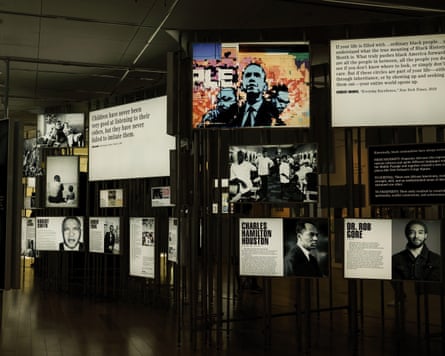
Melissa lives in Philadelphia, where the Declaration of Independence, drafted by Thomas Jefferson, was adopted by representatives of the 13 colonies seeking freedom from the British empire on 4 July 1776.
One of many landmarks across the city is the President’s House, where the first US President, George Washington, resided when Philadelphia was the capital in 1790s – along with nine enslaved people who worked as staff there, under specific conditions which would ensure they remained slaves even after Pennsylvania’s Gradual Abolition Act was passed, setting terms for their freedom. Their lives were, until recently, acknowledged on information plaques.
But, as Melissa reported earlier this year, following Trump’s executive order titled Restoring Truth and Sanity to American History, in January the National Park Service used hand tools to pry off these plaques and, while the city of Philadelphia challenged the edict through the court, for now those information panels remain in storage.
As tourists flock to this national memorial ahead of 4 July, Melissa tells me what they see: “There are printed out pieces of paper taped up, I believe by local activists, that say: ‘This is where these plaques used to be, and this is why they’re important’.”
“A lot of people just feel that’s a slap in the face because for years activists fought to have those plaques displayed in the first place, and they say that the executive branch is basically ignoring this entire part of history that tells the full story of America”.
Reclaiming the whitewash, only not that
Those guerilla explainers at the President’s House are a neat example of how many Americans have endeavoured to wrest back the telling of their nation’s story this year as the Trump administration presents a sanitised version of patriotic – mainly white and male – heroes via the official White House series of events called Freedom 250.
The centrepiece of Freedom 250 is a fleet of 18-wheeler mobile museums, or “Freedom Trucks”, travelling across the country in the run up to 4 July, offering a homage to American achievement. They are particularly notable for their absence of any critical examination of race, slavery or civil rights.
It’s what Princeton professor Eddie Glaude Jr describes in a recent Guardian interview as “active forgetting”.
“What has to happen here in order to protect the innocence of the country? Black folks have to be disappeared. We have to be made to play minor parts in the story.”
“I hear a lot of people talking about this paradox of America being found at a time when there was enslavement, and then the censorship around that with these celebrations,” Melissa tells me. “I’ve been talking with different communities that are trying to highlight that paradox”.
She’s currently working on a story about the contribution of the Gullah Geechee people to the American Revolution. These are descendants of formerly enslaved people in the US south-east, with whom the Guardian is working as part of the Scott Trust’s restorative justice programme. You can read more about our Cotton Capital work here.
“These were people who fought for the freedom of the nation even though they were denied that themselves, so they feel it’s really important to highlight the stories of people who were the unsung heroes in the American Revolution.”
Elsewhere, Melissa nods to the Museum of Fine Arts in Boston which has been working with Indigenous creators to interrogate what nationhood means and which symbols are celebrated. One juxtaposition is how the Mohawk Nation remembers George Washington as “Town Destroyer”, while many others recognise him as a founding father.
A sense of anticlimax?
Aside from the Presidential hoopla, this birthday season finds the United States in a pessimistic mood: three in five believe the country’s best days are behind it, while seven-in-10 are dissatisfied with the way democracy is working in their country, according to a poll by Pew Research Centre.
“The celebrations also come at a time when Americans are discontented with the ongoing war with Iran,” Melissa adds. “A recent poll showed that a majority of Americans think that the war has negatively affected our interests.”
“There’s been a lot of pomp and circumstance around [the 250th], but then as it’s actually approached, it’s been pretty anti-climatic,” she sums up.
“That’s also because we are in the midst of a record-setting heatwave,” Melissa reminds me, with forecasters predicting rising temperatures and high humidity across swathes of central and eastern US ahead of the Fourth of July weekend. “So a lot of the celebrations are either being delayed or they’re being massively amended.”
A country going backwards
The backdrop for the 250th, Melissa explains, is the gutting of the Voting Rights Act – when right wing supreme court justices dismantled what campaigners believe to be one of the main tools that protects minority voters from racial discrimination; alongside the cancellation of temporary protected status for Syrians and Haitians, with other country protections set to expire later this year; and the ongoing surveillance and violent aggression of ICE.
Queer families in New York told the Guardian about the dissonance of celebrating this birthday at a moment when access to trans healthcare is being severely curtailed and June pride parades across the country were subject to heavy policing and arrests.
“But we do also have wins,” Melissa reminds us: “the supreme court upheld birthright citizenship on Tuesday,” she says. That ruling affirmed that nearly all people born on US soil are American citizens, although Trump immediately threatened to abolish the right through Congress after the decision.
Politically, in some states, people are also feeling a sense of progress. “There’s a lot of excitement about recent wins for Democratic socialists in the New York congressional primaries in June, while in Colorado, a Democratic socialist defeated a House incumbent in the primary there”.
But more than anything, she says, there is a quiet determination to continue the conversation beyond this holiday weekend, “to ensure that the full story of America is told, including the parts that the Trump administration would rather leave out.”
What else we’ve been reading

-
“Here is a trade deal that looks more lethal than Covid, yet which has been subject to almost zero democratic scrutiny.” Aditya Chakrabortty on excoriating form taking apart Starmer’s bogus deal on medical imports. Libby
-
Paula Cocozza has written powerfully about one women’s descent into far-right politics from the perspective of her daughter. Patrick
-
Our Science Weekly hosts ponder the latest experiments with lab-made DNA and whether we are closer to building life from scratch. Libby
World Cup 2026
On the pitch
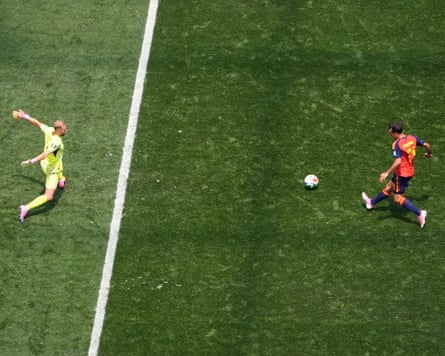
Spain 3-0 Austria | Spain beat Austria and cruised into the last 16 after playing their best football at this World Cup.
Portugal 2-1 Croatia | Portugal will face Spain on Monday after Gonçalo Ramos’s goal and Cristiano Ronaldo’s earlier penalty kick, and a VAR drama, capped a wild finish against Croatia.
after newsletter promotion
Switzerland 2-0 Algeria | Switzerland are through to the last 16 after a comfortable win against Algeria, they will now face either Ghana or Colombia next Tuesday.
Off the pitch
England | Thomas Tuchel says England will be at a “huge” disadvantage in the high altitude of Mexico City on Sunday when they face Mexico in the last 16 of the World Cup as he lamented a Fifa rule that has shut down one possible acclimatisation plan.
Cape Verde | Earlier in his career, Sidny Lopes Cabral used bin bags for curtains as he made his way through the lower leagues of Dutch football. Now he is preparing to face Lionel Messi’s Argentina in the game of his life.
France | While Kylian Mbappé may have scored the majority of France’s goals, the country is falling in love with the man creating many of them: Michael Olise. Raphaël Jucobin has written about the London-born attacker’s winning style.
Today’s Fixtures
Australia v Egypt, 7pm on BBC
Argentina v Cape Verde, 11pm on ITV
Colombia v Ghana, 2:30am on ITV
Sport
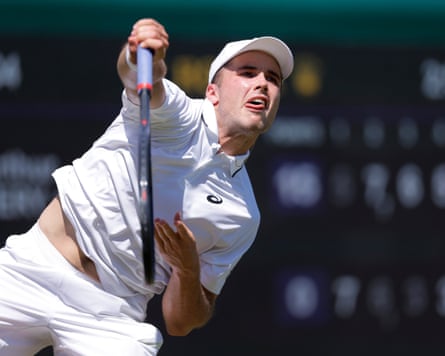
Tennis | Arthur Fery defeated Otto Virtanen 5-7, 7-6 (3), 6-3, 6-3, while Madison Keys beat Katie Swan 6-1, 6-4 in the second round at Wimbledon.
Something for the weekend
Our critics’ roundup of the best things to watch, read, play and listen to right now
Film
Birds of War | ★★★☆☆
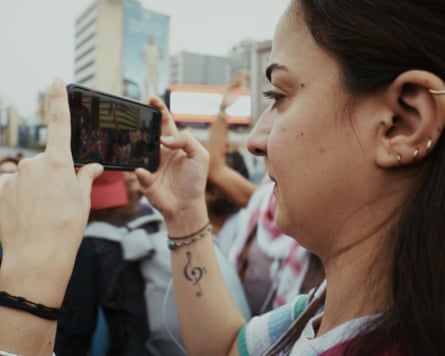
Politics is to some degree set aside here in favour of matters of the heart; this is a story of romantic love among the ruins. London-based Lebanese journalist Janay Boulos, while working for the BBC’s Arabic service, fell in love from afar in 2016 with Syrian activist and photojournalist Abd Alkader Habak. He, during the Assad regime, was putting his life in danger to supply her with dramatic footage from his home town of Idlib and later Aleppo. Habak was himself to make international headlines in 2017 by getting photographed carrying an injured child to safety. Inevitably, there are some contrivances. At all events, it’s a genuine story with humanity and charm. Peter Bradshaw
Music
Madonna: Confessions II | ★★★★☆
Confessions II was inspired by Madonna’s 2023 Celebration tour, a rampage through her back catalogue – with staging that recreated the videos for old hits including Don’t Tell Me and Human Nature – that apparently set the singer thinking about her past. Certainly, Confessions II is rich with references to Madonna’s history, and not only the album from which it borrows its title and its initial structure, a sequence of house-influenced tracks that segue into each other like a DJ mix. But if it’s not quite as good as Confessions on a Dance Floor, it’s unequivocally Madonna’s best album since Confessions on a Dance Floor, which you suspect will be more than enough for her fans, and might even beckon back some apostates: an accommodation with her past that bodes well for her future. Alexis Petridis
TV
Elle | ★★★☆☆
It’s 25 years since you became a bona fide film star. In the intervening quarter of a century you have stayed a respected actor and become a powerhouse producer. An appetite grows for teen-led dramas that for reasons of nostalgia or muscled ice-hockey players appeal to the generation or two above. You are Reese Witherspoon. What do you do? Take down the Legally Blonde IP, dust it off and make a small-screen prequel to the box office hit that became a cult classic, of course! In a world that needs all the harmless escapism it can get, Elle gets the job done. But it could, given its pedigree and its writing at the peaks, have been so much more. It’s bend and SNAP, not give up halfway. Lucy Mangan
Theatre
Calendar Girls: The Musical | ★★★★☆
One of the great qualities of Calendar Girls is its ordinariness. It takes place in a landscape of Morrisons supermarkets, hospital waiting rooms and traffic jams. The year is marked by carol concerts and cake competitions. Only here, in the fictional Yorkshire Dales village of Knapely, would Cheshire seem snooty and crazy paving seem outre. Another great quality is its understanding of community. Sure, it makes fun of the jam-and-knitting conservatism of the Women’s Institute, but deep down it is wiser than that. That is why it is a special thrill to see Paul Robinson’s superb production performed in the round, as it will be when it tours from Scarborough to Keswick’s Theatre by the Lake and Bolton Octagon. When these women suffer grief, neglect and failure, we are right there with them. When they achieve the impossible, we are part of their joy. Mark Fisher
The front pages
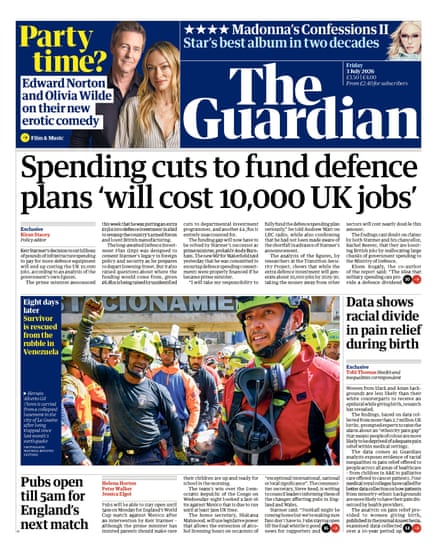
“Spending cuts to fund defence plans ‘will cost 10,000 UK jobs”, is the Guardian’s front page today. The Times leads with “Burnham: Manifesto allows some taxes to rise”, the i Paper has “Labour failed to prepare for power before winning landslide, admits McSweeney”, and the Telegraph says “Change law to kick out rapist, No10 told”.
The FT splashes “OpenAI seeks political buy-in with plan to hand Washington a 5% stake”. On the World Cup, the Mirror has “Mexican rave”, the Mail leads on “England’s big all-nighter”, and the Sun’s take is “Tequila sunrise”.
The Latest

229,000 excess deaths: the cost of US-UK trade deal?
The NHS will divert billions of pounds from essential services to pay for new medicines, under the terms of the US-UK trade deal agreed in December, which could lead to more than 200,000 excess deaths, analysis has found. Ministers have defended the deal as a way of helping British drug exports avoid US tariffs and giving patients access to vital medication, but critics accuse the Labour party of caving into pressure from Donald Trump. Lucy Hough speaks to columnist Aditya Chakrabortty.
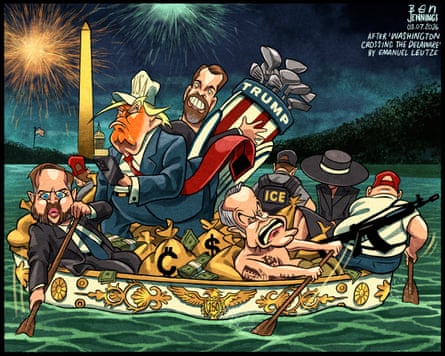
Cartoon of the day | Ben Jennings
The Upside
A bit of good news to remind you that the world’s not all bad
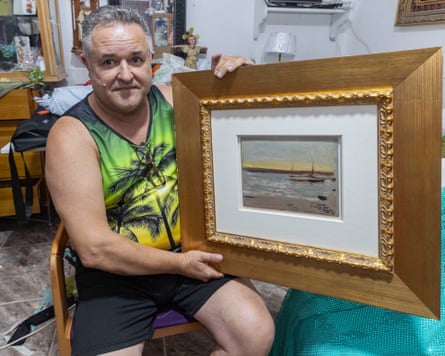
Sun screen, shorts and a good book are usually top of the list when packing for a summer holiday. But for one family in Seville, they regularly bring a valuable picture by the artist Joaquín Sorolla with them to admire on their breaks. Over the weekend, disaster struck: they accidentally left the picture leaning on a wall when packing for the beach and drove away. When they realised what had happened, the painting had gone. The Guardian’s Madrid correspondent Sam Jones has written about the amazing tale of how it eventually found its way back to them.
Sign up here for a weekly roundup of The Upside, sent to you every Sunday
Bored at work?
And finally, the Guardian’s puzzles are here to keep you entertained throughout the day. Until tomorrow.













Comments