
 German (DE)
 English (US)
 Spanish (ES)
 French (FR)
 Hindi (IN)
 Italian (IT)
 Russian (RU)
 1 ora fa
Perhaps the least surprising revelation about the future Donald J Trump presidential library is that it will apparently contain next to no books. If the AI-generated video Trump posted in March, depicting the structure that will arise in Miami, Florida when he leaves office, is any guide, it will be a huge skyscraper, emblazoned with the Trump name in block capitals – a second Trump Tower. It will feature a giant, Saddam-style statue of him, in gold, naturally, and have space for a ballroom, an auditorium and an Air Force One 747 jet in the foyer – but not, it seems, for a book, save for the handful glimpsed on the shelves of a faux recreation of the Oval Office. “I don’t believe in building libraries or museums,” the president said, declaring instead he wants the new building to operate as a hotel.
In fairness to the current president, it’s not as if the libraries of his 14 predecessors going back to Herbert Hoover – the first for whom such an institution was formally established – contain only books. On the contrary, as a new book, POTUS: Icons, Artifacts, and History That Shaped the American Presidency, vividly illustrates, these buildings function as repositories for myriad gifts, souvenirs and office paraphernalia that, taken together, represent an idiosyncratic record of not only the men who held the most powerful office in the modern world, but the office itself and, indeed, the country it serves. Think of it as a history of the American presidency in 800,000 objects.
Every one of them tells a story. Sometimes it’s a tale of the particular individual who sat at the fabled Resolute desk. The little wooden sign announcing that “The buck stops here”, placed there by Harry Truman, captures his sense of personal responsibility, the dutiful, modest successor to the more flamboyant Franklin D Roosevelt. That at least was the latter’s public image: the reality that most Americans were not allowed to glimpse is also illustrated here, in the form of a pair of heavy steel leg braces. Roosevelt was paralysed from the waist down by polio, but disguised the fact when he appeared to walk, thanks to those braces, a cane, the arm of a companion – and a compliant press corps.
Sometimes these objects flatter. Here’s the saxophone presented to Bill Clinton by Václav Havel and used for an impromptu jam in a Prague jazz club: when, as a presidential candidate, Clinton had played the sax on late-night TV, it acted as wordless confirmation that a new generation was ready to take the torch from the cohort of second world war-era leaders that had occupied the Oval Office in an unbroken run until then. And here’s the modish pillbox hat worn by Jackie Kennedy which, along with her husband’s hatlessness and suave, Rat Pack style, had similarly signalled that a new generation had arrived in Washington more than three decades earlier.
Occasionally these objects are less cues for nostalgia than exhibits for the prosecution. Behold the reel-to-reel tape machine that was part of the elaborate – and secret – White House recording system used by Richard Nixon and whose existence, once revealed, played a major role in the president’s eventual resignation in disgrace in the Watergate scandal.
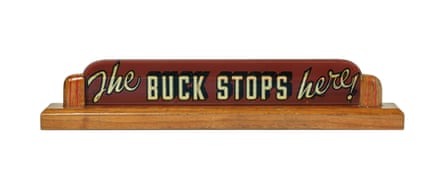
Many of the items stored in the presidential libraries say less about the character of those 14 men than about the epochal decisions that came to define them. The safety plug of the atomic bomb dropped on Nagasaki in 1945 stops you short, a reminder that the decision to unleash such destruction on that Japanese city and, earlier, on Hiroshima, came down to a single man. The buck really did stop with Truman. The commemorative ping-pong bats featuring the faces of Nixon and Mao Zedong testify to the significance of Nixon’s most enduring act of diplomacy, his opening to communist China – the act for which he would have been remembered, had he not undone his own reputation.
Again, some of them survive now as unexpected entries in the credit column for the presidents involved. It’s striking to see the text of a resolution of gratitude, enshrined as a scroll in an intricately decorated box, that was presented to Hoover from an infant Soviet Union in 1923, thanking him for his administration’s help in feeding millions during the famine that struck Russia in the preceding two years. It’s a reminder that US-Soviet relations were not always cold – and that, whatever diplomatic motives might have been in play, Republican presidents once believed in humanitarian aid.
Contrastingly, George W Bush will not be thrilled to see again the gift given to him in 2005 by Vladimir Putin – a silver horseshoe, inlaid with jewels – which can’t help but recall the credulous warmth Bush had shown the then new Russian leader a few years earlier. “I looked the man in the eye,” Bush had said. “I found him to be very straightforward and trustworthy … I was able to get a sense of his soul.”
There are, too, souvenirs of the events that arose from no presidential decision, but that shook these men and their country: the X-ray showing the would-be assassin’s bullet that lodged in the lung of Ronald Reagan; the bullhorn wielded to such effect by the younger Bush amid the smouldering devastation of 9/11; the telegram from Mamie Till, pleading to Dwight Eisenhower for justice after the racist murder, what she called the “beastly lynching”, of her 14-year-old son, Emmett.
And, of course, these objects work as miniature time capsules, instantly evoking eras now long gone. That’s particularly true in the realm of technology, whether it be Lyndon Johnson’s clunky, if bespoke, TV remote control or Barack Obama’s customised BlackBerry, both of which would have been state of the art at the time and which now appear to be exactly what they are: museum pieces.
Such is the nature of the American presidency, an object of urgent fascination in its own time – and then, almost in an instant, history.
POTUS by Peter Adams is published by Abrams. To support the Guardian, order your copy at guardianbookshop.com. Delivery charges may apply.
Desk telephone, Richard Nixon
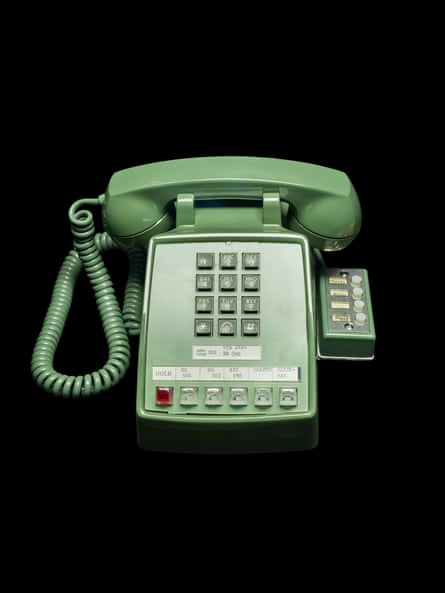
This phone was used by President Nixon in the Oval Office on 20 July 1969, to speak to astronauts on the Moon.
Leg braces, Franklin D Roosevelt
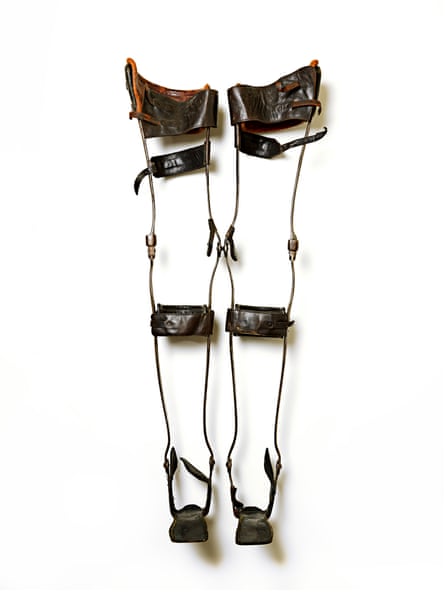
After polio paralysed Roosevelt from the waist down, he could not stand without the use of heavy steel leg braces that were locked at the knee.
Horseshoe, George W Bush
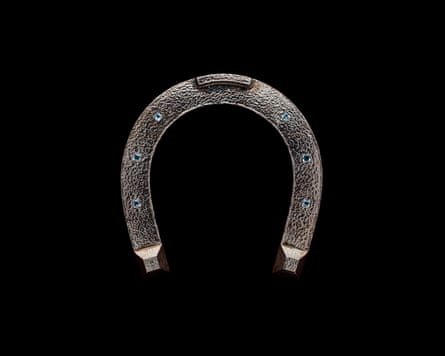
Presented to Bush by Vladimir Putin in Moscow on 8 May 2005, this silver horseshoe inlaid with aquamarine stones was given during the 60th anniversary commemorations of the allied victory in the second world war.
Bullhorn, George W Bush
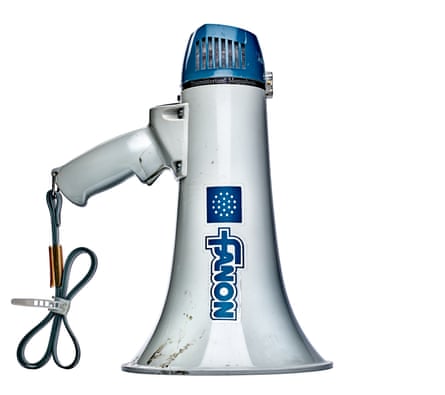
Standing atop a crushed fire truck amid the rubble of the World Trade Center on 14 September 2001, Bush used this bullhorn to deliver an impromptu message that became emblematic of the early national response to 9/11. When a worker shouted, “I can’t hear you,” Bush replied, “I can hear you. The rest of the world hears you. And the people who knocked these buildings down will hear all of us soon.”
BlackBerry smartphone, Barack Obama
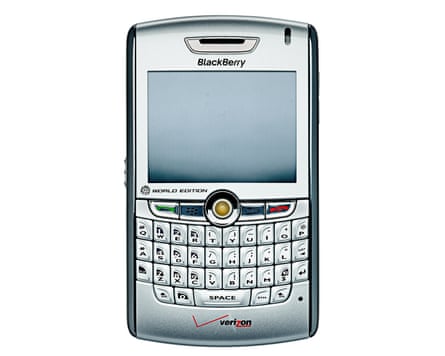
This silver BlackBerry 8830 World Edition from 2009 was modified for Obama to meet strict security standards and was restricted to communicating with a small, approved list of contacts, which included first lady Michelle Obama. The “BarackBerry” became an emblem of Obama’s early efforts to modernise presidential communication.
Tenor saxophone, Bill Clinton
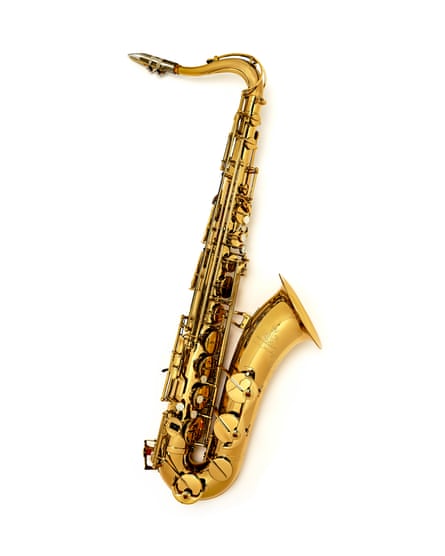
A playwright-president who loved jazz, Václav Havel gave this sax to Clinton in Prague in 1994, where Clinton did an impromptu jam.
Safety plug for ‘Fat Man’ atomic bomb, Harry S Truman
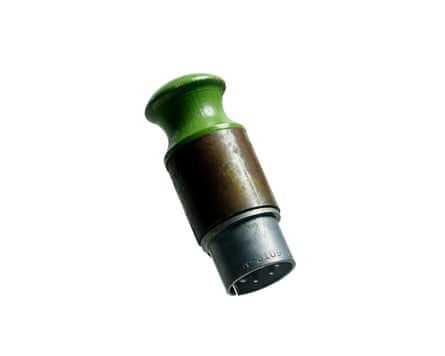
This plug prevented accidental arming of the plutonium bomb, nicknamed Fat Man, en route to its target in Nagasaki, Japan, in August 1945.
Toy stuffed bear, John F Kennedy
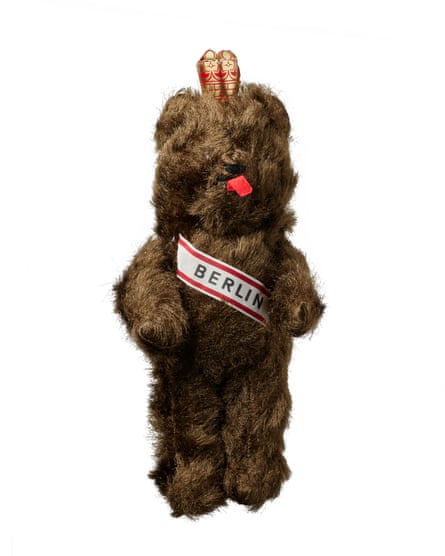
This toy bear was a gift to John F Kennedy Jr from the mayor of West Berlin, Willy Brandt, days after JFK’s “Ich Bin Ein Berliner” speech on 26 June 1963.
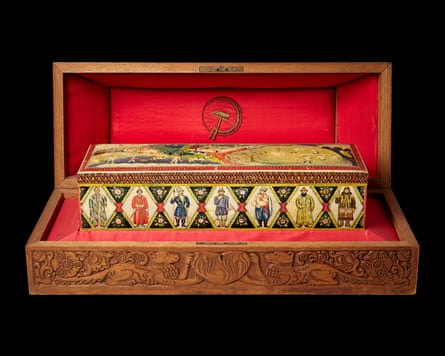
In response to the catastrophic Russian famine of 1921-23, Hoover’s American Relief Administration (ARA) fed millions of starving citizens. Officials within the newly created Soviet Union presented this document, housed in custom boxes, to Hoover as an official thank you.
X-ray, 30 March 1981, Ronald Reagan
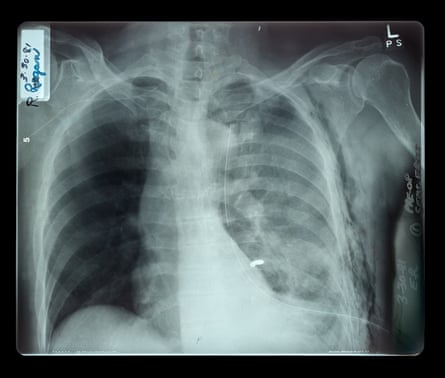
Taken at George Washington University hospital after Reagan was shot by would-be assassin John Hinckley Jr, it shows the bullet lodged in his left lung, inches from his heart.
Portable tape recorder, Richard Nixon
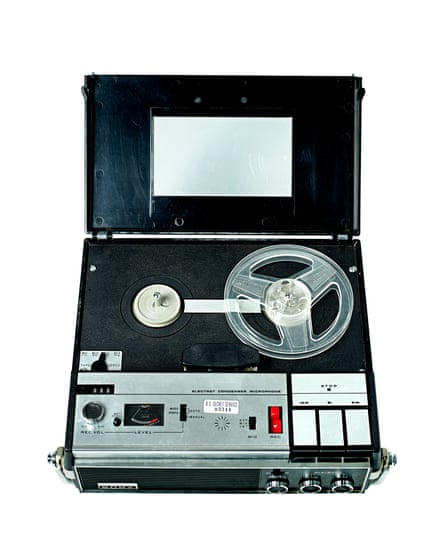
This was the unit used to review the taped conversations made by Nixon’s secret voice-activated recording system. The tapes became central to the Watergate investigation.
Telegram, Mamie Till Bradley to President Dwight D Eisenhower
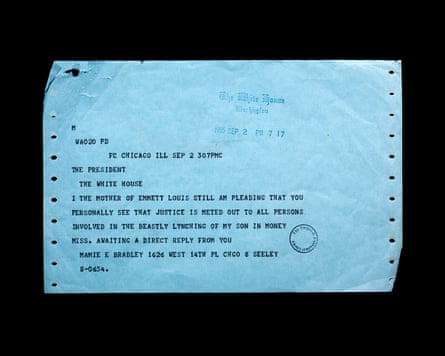
In the days after the murder of her 14-year-old son, Emmett Louis Till, Mamie Till Bradley sent this telegram to the White House pleading for justice. Till had been abducted on 28 August 1955, by Roy Bryant and his half-brother, JW Milam, four days after being accused by Bryant’s wife, Carolyn, of grabbing her and making lewd remarks. Bryant and Milam were arrested and charged but acquitted by an all-white jury. The decision sparked outrage across the country. Decades later, Carolyn Bryant admitted she had fabricated parts of her testimony and that Till had never touched her.
Bear fur gloves, Franklin D Roosevelt
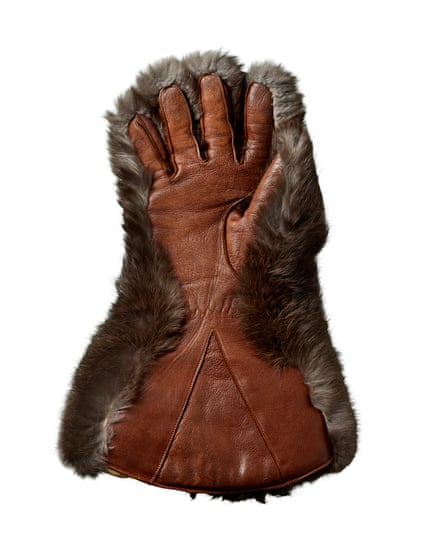
These oversize gloves were a gift from Stalin to Roosevelt during the pivotal allied summit in Yalta near the end of the second world war.
Ballot chads, George W Bush
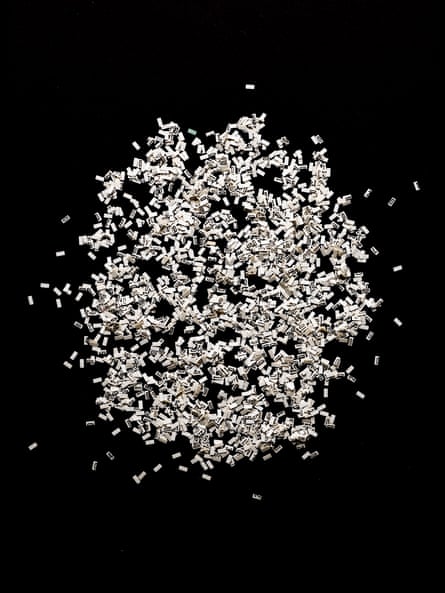
In the 2000 presidential election, Florida’s punch-card voting system produced “hanging”, “dangling”, and “dimpled” ballot chads that made voter intent hard to interpret. Disputes over how to manually count these ballots fuelled legal challenges that culminated in the US Supreme Court decision in Bush v Gore that effectively ended recounts on 12 December, 2000. These loose chads are small-but-telling artifacts of how ballot design and technology shaped the national outcome.
Television remote control, Lyndon B Johnson
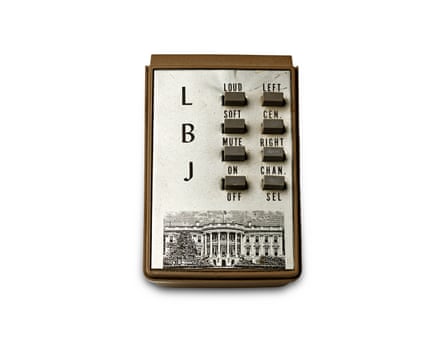
This specially designed remote was used by Johnson to control all three TV sets in the Oval Office – he liked to watch the news bulletins on ABC, CBS and NBC simultaneously.
Pillbox hat, John F Kennedy
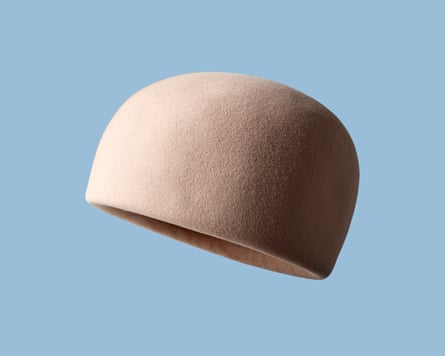
Jacqueline Kennedy set the tone of early-1960s fashion. This hat, by the designer Halston and worn at the 1961 inauguration, instantly made the new first lady a fashion icon.
Electric toothbrush set, Lyndon B Johnson
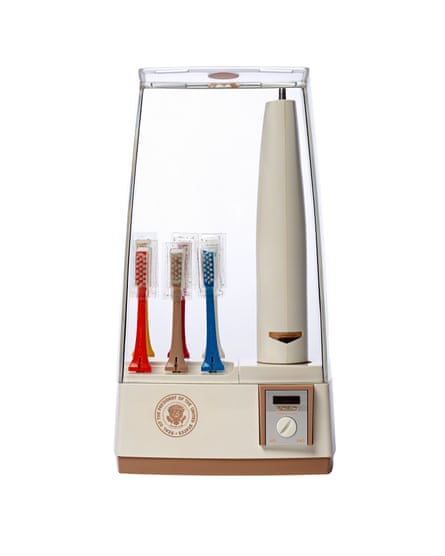
Johnson cultivated a reputation for pressing mementos into people’s hands during their visits to the White House. One of his favourite giveaways was this electric toothbrush set.
Bart Simpson doll, George Bush
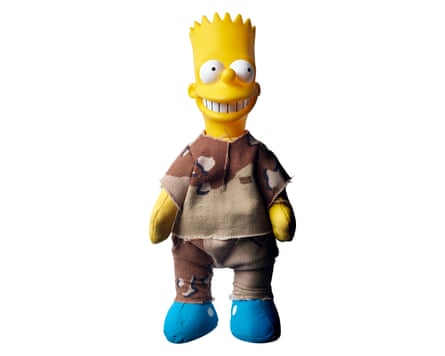
During Operation Desert Storm in 1991, deployed service members leaned on humour and pop culture to boost morale. This doll, dressed in the same desert camouflage worn by US forces, was sent to the president as a lighthearted token by troops stationed in Saudi Arabia.











Commenti