
 German (DE)
  English (US)
  Spanish (ES)
  French (FR)
  Hindi (IN)
  Italian (IT)
  Russian (RU)
  2 weeks ago

 Getty Images
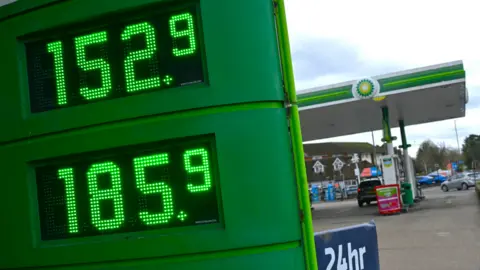
The war in Iran and the effective closure of the Strait of Hormuz - through which around 20% of the world's oil and natural gas flows - has seen rising fuel costs across the globe. The International Energy Agency (IEA) says it is the "largest supply disruption in history".
With the disruption expected to have a lasting impact on prices, governments around the world have introduced measures to limit the impact on consumers and the economy.
The International Monetary Fund (IMF) has also advised countries to consider managing energy demand through measures such as subsidising public transport or working from home, to combat the crisis triggered by the conflict in the Middle East.
Here is a rundown of the measures taken to date.
While most of the UK's electricity is generated through natural gas and renewables, petrol prices have reached an 18-month high due to rising global oil prices, according to motoring organisation the RAC.
The government has said it is primed to step in if there are signs petrol sellers are profiteering from the crisis - something the Petrol Retailers Association has denied is the case.
Meanwhile, low-income households that use heating oil were eligible to access a £53m package announced by the prime minister in March to help with costs.
Airlines UK has said that it is talking to the government about "crucial measures" that would be needed to support the aviation industry in the event of fuel disruption, following a warning from the International Energy Agency (IEA) that jet fuel stocks in Europe would reach a tipping point in June if at least half of its imports from the Middle East were not replaced.
China, the world's largest buyer of oil, has long braced for a supply shock in the Gulf by stockpiling oil.
Over the years, Beijing has taken advantage of lower crude prices and an abundance of supply from Gulf states to build one of the world's largest oil reserves - 900 million barrels, according to some estimates, though this is only amounts to around three months of its imports.
And to keep domestic prices under control, authorities in China have reportedly ordered its oil refineries to stop exporting fuel for the time being.
Regardless, petrol is becoming more expensive in the country, and some Chinese airlines have cut flights as jet fuel prices creep up.
India's oil ministry said on 26 March that it had secured supplies of crude oil for the coming 60 days and urged residents to avoid panic buying.
But the ministry said the "high volumes" of crude oil available "in international markets" had "more than compensated for any disruption".
The nation has also slashed petrol and diesel excises, cutting the duty on petrol from 13 rupees per litre, to three.
The Irish government has announced a package worth €505m (£440m) to support those "most impacted" by rising fuel costs, following significant protests across the country.
The package includes a 10 cent reduction per litre on both diesel and petrol, and a 2.4 cent reduction per litre on marked gas/oil.
Temporary measures to reduce excise duty on petrol, diesel and marked gas oil will be in place until the end of July.
The nation will also postpone an increase on carbon tax until the budget in October, and has said it will announce a fuel subsidy scheme for farmers and fisheries.
In two Australian states, public transport was made free in order to incentivise people not to drive.
Travel on Victoria's trains, trams and buses has been made free until the end of May, after which point fares will be slashed by half until the end of the year.
Commuters in Tasmania will not need to pay for buses, coaches and ferries until the end of June.
Tasmania's transport minister also said that paid-for school buses would be made free, saving those who use them A$20 (£10.40) a week.
Egypt - which relies heavily on imported oil - introduced a raft of temporary measures aimed at bringing fuel consumption down and keeping public finances in check.
Shops, restaurants and cafes were told to close at 21:00 each night until the end of April, while street lights and roadside advertising are being dimmed. Hotels and tourist attractions are exempt.
Non-essential workers have been told to work from home one day a week to lower the number of commutes.
The Egyptian government has raised petrol prices and fares on public transport to limit the impact of the conflict on its public finances. It has also slowed down large, energy-intensive state projects and cut government vehicle fuel allowances by nearly a third.
The Philippines declared a national emergency, with its government offering subsidies to transport drivers, reducing ferry services and implementing a four-day work week for civil servants.
With 98% of its oil imported from the Gulf, the Asian nation has seen the cost of diesel and petrol more than double.
The Filipino government vowed to stockpile a million more barrels of oil, and has not excluded further measures.
"Nothing is off the table," President Ferdinand Marcos said. "We are looking at everything we can do."
Sri Lanka, which has only just emerged from a financial crisis, is another Asian nation that relies heavily on Gulf states for fuel imports.
To conserve fuel, it declared Wednesdays a public holiday for government institutions such as schools and universities.
It also introduced fuel rationing, with drivers limited to 15 litres a week and motorcyclists 5 litres.
The Thai government asked people to take their jackets off as part of measures to cut down on the amount of energy consumed by air conditioning units.
People in Thailand have been told to keep air conditioning at 26-27C, while all government agencies have been told to work from home.
The Asian country is consistently hot and humid, with Bangkok typically reaching 72% humidity in April.
Authorities ordered fuel supply companies to prioritise security institutions, major government projects, key industries and the manufacture of essential goods.
The Ethiopian Oil and Energy Authority's measures saw petrol stations prioritising public transport, as well as restrictions to conserve fuel.
Authorities in the Tigray region, where there are fears of a return to civil war, announced a complete suspension of fuel supplies.
In Myanmar, private vehicles have been allowed to operate on alternate days depending on whether their licence plate is an odd or even number. Electric vehicles are exempt.
The government has also implemented a digitally-monitored fuel rationing system, where purchases are scanned, logged and tracked using a QR code on vehicles.
In Vietnam, the government called on people to "ride bicycles, carpool, use public transport, and restrict personal vehicle use when unnecessary", encouraging citizens to stay at home more to conserve fuel.
The Asian nation has also temporarily rescinded its environmental protection tax on petrol and diesel, which are also exempt from VAT.
Bangladesh was quick to close its universities when the war began, bringing forward holidays to celebrate the end of Ramadan.
The country also started rationing fuel sales for most vehicles. The government has brought in more planned blackouts to limit energy consumption as well.
Slovenia was the first EU member state to implement fuel rationing.
Under the measures, private motorists in Slovenia were restricted to a maximum purchase of 50 litres of fuel per day. Businesses and farmers had a more generous allowance of 200 litres.
South Sudan rationed electricity in its capital, Juba. The main electricity distributor, Jedco, warned that parts of the city would experience daily power cuts on a rotational basis.
The country has some of East Africa's largest oil reserves, but the majority is exported, while it imports the refined product needed for fuel.
According to the International Energy Agency, South Sudan generates 96% of its electricity from oil.














Comments