
 German (DE)
  English (US)
  Spanish (ES)
  French (FR)
  Hindi (IN)
  Italian (IT)
  Russian (RU)
  3 weeks ago
When Donald Trump, said he would “rescue” protesters if Iranian authorities started shooting, Siavash Shirzad believed the US president.
The 38-year-old father had seen protests rise up before, only to be brutally crushed by authorities.
But this was the first time in his life that the president of the United States had promised to help demonstrators. Reassured, Shirzad took to the streets, ignoring his family’s warnings and joining the growing crowds.
Authorities started shooting, but no help came. On 8 January, the internet was shut off and Iran went dark, Shirzad was shot at a protest in Tehran and died of his wounds hours later, leaving behind a 12-year-old son.
“Siavash hoped until the very end that Trump’s help would arrive,” his cousin said, speaking anonymously for fear of repercussions. “We told him: ‘Don’t go, it’s dangerous.’ But he gave a firm answer: ‘Trump said he supports us, I’m going.’”
On Tuesday, Trump urged Iranians to keep protesting and to “take over your institutions”, telling them “help is on its way”, as reports grew that a strike on Iran was imminent. But just a day later, Trump abruptly did an about-face, telling reporters that he had received assurances that Iranian authorities would not execute anyone, walking back from military intervention in Iran, at least temporarily.
In Iran, protesters despaired. Despite Trump’s reassurances, killings of demonstrators continued.
The streets of Tehran were empty, except for pickup trucks with armed security forces patrolling where tens of thousands had marched just days before. Protests continued in provinces outside the capital, but getting an accurate picture of their scale was difficult amid the communications blackout.
“Mass arrests are taking place. As soon as Trump’s attention moves elsewhere, the executions will start,” a resident of Tehran said in messages forwarded to the Guardian via an activist.
Iran doubled down on the prosecution of protesters, with state TV on Thursday airing footage of forced confessions and Iran’s chief justice interrogating detained protesters. Rights groups warned that protesters would probably not receive fair trials and that they had grave concerns over the conditions in which detainees are held.
“Past patterns in Iran demonstrate that periods of widespread unrest are accompanied by heightened abuses inside detention facilities, where these groups are particularly vulnerable to extrajudicial killing, enforced disappearance, torture, and other forms of ill-treatment,” more than 30 rights groups wrote in a joint letter on Thursday.

However, the authorities refrained from executing protesters, most notably cancelling the death sentence of the 26-year-old protester Erfan Soltani and announcing no hangings would take place. Trump seemed pleased, sharing news that Soltani’s execution would not take place.
Iranians in the diaspora felt betrayed. For two weeks they watched a brutal crackdown on the streets of Iran. Messages from family came infrequently, if at all, and Trump’s statement that “help is on the way” seemed their only lifeline.
“As someone living in the diaspora, this feels like a slap in the face,” said Elham, an Iranian living in Sydney. “Iranians have been let down before. This time, there was a sense it was going to be different.”
To many Iranians abroad, Trump’s about-face felt like a victory for the Iranian regime. Instead of helping topple the Iranian government as protesters demanded, he was going to negotiate with them. The comments on Wednesday by the foreign minister, Abbas Araghchi, on Fox News, urging the US to engage in diplomacy only furthered their fears.
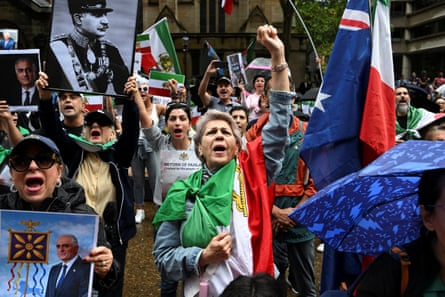
“If Trump gives the regime a lifeline, it will be such a profound betrayal from which ordinary Iranians won’t recover. It will be the end of hope. Many talk of Trump’s unpredictability, but using innocent lives for political theatre is intolerable,” said Elham.
Even as US forces pulled back from bases in the Middle East and indicators of a US strike gathered, it was unclear what Trump planned to do in Iran. Though unprecedented, nationwide protests had not threatened the short-term stability of the Iranian state, which has well-armed and trained security forces.
A strike on Iran could trigger retaliation on Israel and the US, without necessarily shielding protesters from harm. Other Iranian analysts warned that US intervention could further the accusation that protests are foreign-backed, without giving meaningful benefit to the demonstrators’ aims.
Nonetheless, Iranians abroad and inside the country hoped that the world would do something to help, even if they were unsure of what.
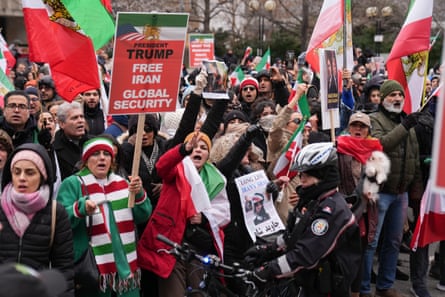
“The people of Iran believed him. They placed their trust in his words. If he fails to act against this brutal regime, that trust will be broken and the people of Iran will not forget who stood with them, and who turned away,” said Azam Jangravi, an Iranian based in Canada whose close friend was killed in protests in Isfahan last week.
Though Trump appeared to walk back from the brink of a strike, the US has said it had not completely ruled out intervention. Trump “has made it clear all options are on the table to stop the slaughter,” the US ambassador to the UN, Mike Waltz, told the UN security council on Thursday.
A US aircraft carrier was heading to the Middle East and military assets were being redeployed to bolster Israeli air defences – two indications that a US strike on Iran was still possible.
In Iran, many protesters feel as if they are in limbo. Cut off from the rest of the world and under the heavy boot of authorities, they are unsure if they should take to the streets again.
“The protests have come to a pause, people are waiting to see what Trump will do,” said Alborz, a Tehran resident, in messages forwarded to the Guardian.









Comments