
 German (DE)
  English (US)
  Spanish (ES)
  French (FR)
  Hindi (IN)
  Italian (IT)
  Russian (RU)
  3 weeks ago
Knocking on strangers’ doors on a warm May afternoon in Trenton, New Jersey, Adam Hamawy did not seem fazed when more than a few went unanswered.
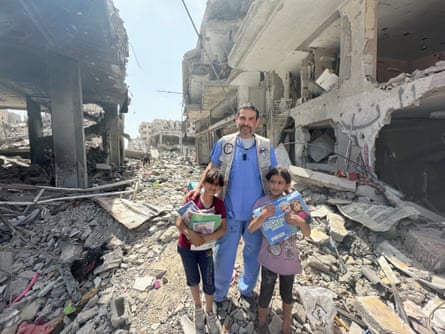
It’s his first time running for office, but this is an area where he has experience. After returning from a medical mission in Gaza in 2024, Hamawy went to Washington to describe the crisis – which he viewed as a US-funded genocide – to lawmakers, only to encounter “too many doors that were closed, that didn’t even want to listen”.
“I could only define it as a genocide, because I saw the bodies of the people that came in,” the veteran army trauma surgeon and political newcomer reflected, while walking between houses. “And it wasn’t an accident. You can’t have an accident, every single day for three years.”
“When the hospital shakes and I see the bodies come in, I’m paying for it with my tax dollars,” he said. “I don’t want my tax dollars doing that.”
One of the few representatives on Capitol Hill who met with him was his own: Bonnie Watson Coleman, who has served New Jersey’s 12th congressional district for more than a decade.
When she announced her retirement in November 2025, after six terms, Hamawy decided it was no longer enough to seek the attention of those elected to serve in Washington – and launched his campaign to join them.
In six months, Hamawy has gone from a political nobody to, deemed by most measures, the frontrunner in a crowded race, endorsed by prominent progressive and Democratic figures including Bernie Sanders, Alexandria Ocasio-Cortez, Ilhan Omar and Tammy Duckworth. His work history has driven him to call for Medicare for All, advocating for sanctions and an arms embargo on Israel, and the abolition of ICE – and to say openly he cannot support Democratic leaders Hakeem Jeffries and Chuck Schumer.
Watson Coleman, the first Black woman to represent New Jersey in Congress, has been a progressive champion on criminal justice reform, health equity and economic opportunity. She was comfortably re-elected in 2024, and whoever wins Tuesday’s Democratic primary in this safely Democratic district will almost certainly succeed her.
Hamawy would break a new ceiling for New Jersey politics in becoming the state’s first Muslim lawmaker to represent the state nationally.
One of the few still-practicing trauma plastic surgeons in the area, he has spent months campaigning across the 12th district, which stretches from Princeton’s leafy boroughs to working-class neighborhoods in Trenton and Plainfield.
He knocked on doors in Trenton earlier this month in a suit jacket with a Jolly Roger pin on the lapel – a reference to the anime One Piece that has become a kind of shorthand in antiwar left spaces, and a fitting emblem for a candidate running as an outsider to the political establishment.
The 12-way race, transformed by the collapse of New Jersey’s once-powerful county-line ballot system, which previously allowed party leaders to heavily influence primaries, includes an assembly member, multiple mayors, a former White House aide and several local officials. Its fractured nature means the threshold for victory may be relatively low.
Yet Hamawy has raised more than $1m – more than anyone else in the field – fueled significantly by small donors in Muslim and Arab American communities. American Priorities, a pro-Palestinian Super Pac, has pledged another $2m in TV advertising on his behalf.
Hamawy covered medical missions during the Bosnian war in the 1990s, and was deployed to Iraq as an army combat surgeon a decade later, as part of the team who saved Duckworth’s life after her Black Hawk helicopter was struck by a rocket-propelled grenade.
On the volunteer medical mission to Gaza in 2024, he spent nearly three weeks trapped there after Israeli forces closed the Rafah border crossing, operating at the European hospital in Khan Younis while the city was bombed around him. Duckworth ultimately helped secure his evacuation after delivering a letter of his to the White House.
“I have never in my career witnessed the level of atrocities and targeting of my medical colleagues as I have in Gaza,” he wrote at the time.
His campaign pitch flows from such experiences. Other than a comprehensive universal healthcare system in the US, and abolishing ICE, he has also called for the cancellation of medical and student debt, the dismantling of the Department of Homeland Security, , and the federal codification of abortion rights.
Foreign and domestic policies do not neatly fall into separate categories, as far as Hamawy is concerned.
“We’re told we don’t have enough money for Medicare for All,” he said, referring to calls for comprehensive universal healthcare coverage. “But at the same time we just started another war. We have plenty of money for the bombs.”
Hamawy was born in Egypt and moved to New Jersey as an infant. He grew up in Plainfield and Old Bridge, New Jersey, before attending the state’s Rutgers University. After a career in the military, he built a surgical practice in Princeton, and remains on call during the campaign.
He is also, when his schedule allows, a painter. His visual art Instagram account, @hamawyart, has 55 followers. The most recent piece – titled Sanctuary Under Occupation – depicts the al-Aqsa mosque, which he painted after a visit to Jerusalem in 2024. “It’s difficult to put into words the depth of emotions stirred by walking through such a place,” he wrote in the caption, “where the sacred and the besieged coexist in constant tension.”
At a May forum hosted by Princeton University’s Young Democratic Socialists of America chapter, Hamawy laid out his platform. “Human rights is my red line,” he told the room. “I would vote against all bills that attack anyone’s rights.”
Hamawy is “blatantly progressive, and you wouldn’t expect a middle-aged vet to resonate with young people”, said Christopher Quire, the chapter’s co-chair, who said he was surprised by how strongly Hamawy connected with the audience. “The students were really focused on what he’s saying.”
Hamawy’s proposed policies and ideas place him well to the left of much of the Democratic establishment. While he has built strong support among younger progressives and antiwar voters, some of his rivals in the race have taken more cautious positions on issues like ICE, reflecting a broader Democratic divide over how far left the party can move on immigration politics without alienating moderates.
When doors do open across the district, voters’ concerns appear varied.
Simran Riar, a 30-year-old city planner who came to the US through asylum, had a Hamawy poster in his apartment window. Duckworth’s endorsement made Hamawy “the most viable” candidate, he said, but what settled it was his “heartfelt” objections to war.
A few blocks away, Trudy Dockery’s main concerns were crime, taxes and affordability. Still undecided, and reading through candidate profiles, she had not made her decision yet.
Craig “CJ” Burnett, creative director at Much Better Studios, a photography and events business in Trenton, said Hamawy was the only candidate from the race to come by.
And Elijah Dixon, an organizer and community development professional who briefly ran for the seat himself before endorsing Hamawy, said domestic frustrations over housing, utilities and healthcare are front of mind for many voters. “People are doing everything right, and yet the future is still slipping away right in front of them,” he said. “The goalpost is constantly being moved.”
But Gaza comes up, too, Dixon added – everywhere: “You can’t go to a town hall or to a community meeting without someone mentioning that.”
One episode has followed Hamawy through his campaign. While his Democratic rivals have mostly avoided emphasizing it, conservative media outlets have put a greater focus on an incident in 1995.
As a medical student in his 20s, Hamawy appeared as a defense witness in the trial of Omar Abdel-Rahman, the so-called “blind sheikh”, who was later convicted of seditious conspiracy tied to the 1993 World Trade Center bombing plot. Hamawy testified about statements he had heard Abdel-Rahman make at religious gatherings.
When the testimony resurfaced earlier this month, Hamawy – who was never accused of wrongdoing – dismissed the criticism as a smear. Abdel-Rahman, he said, was one of the few widely known Muslim religious figures in New Jersey at the time.
Conservative outlets have also highlighted that Hamawy volunteered in Bosnia in 1994 with a charity later shut down for providing logistical support to al-Qaida – though at the time, a US envoy under Bill Clinton had visited the organization’s leadership and praised its humanitarian relief work.
“As a Muslim, they’re always going to find something to attack,” he told reporters. “I’m used to this all my life.”
As he seeks to make his mark on New Jersey’s 12th district, and Washington, Hamawy is trying to explain how his life led him to this moment. His experience, from Gaza to Capitol Hill, has led him to conclude that so many of the people making decisions about wars, healthcare and medical debt answer to interests far removed from the patients and families he has encountered.
Asked how he would define his politics, he paused for only a moment. “My politics is based on my work,” he said.







Comments