
 German (DE)
  English (US)
  Spanish (ES)
  French (FR)
  Hindi (IN)
  Italian (IT)
  Russian (RU)
  2 weeks ago
Donald Trump’s threat to take control of Greenland “one way or the other” has left the territory and its sovereign power Denmark reeling and the rest of Europe scrambling for ways to stop him.
After the shock of the US’s military raid on Venezuela Trump’s ambition to put Greenland next on his hitlist is no longer being seen in Europe as bluster or fantasy, but a serious intention, driven by ideology, neo-imperial expansionism, US thirst for critical minerals, or all of the above.
Trump’s self-confessed disregard for international law is again exposing the painful dilemma caused by Europe’s crippling dependence on the US for military security: do they confront him or appease him, even as his rogue-state actions mirror the Russian invasion of Ukraine they say is illegal?
Soon after the Venezuela raid – which was met with a deafening silence from Europe – the Trump aide Stephen Miller gloated in a CNN interview that “nobody is going to fight the United States” for Greenland.
Is Miller right? In recent days there has been a tonal shift. The leaders of six European powers – France, Germany, Spain, Italy, Poland and the UK – issued a rare joint statement, reaffirming their support for Danish sovereignty and, in effect, warning Trump to keep his hands off Greenland. Greenland belongs to its people, they said: “It is for Denmark and Greenland and them only, to decide on matters concerning Denmark and Greenland.”
But what kind of “fight” these European powers are prepared to mount for Greenland if diplomacy fails is unclear.
At a high-stakes meeting in Washington today, Denmark was seeking to de-escalate the crisis with security promises, while insisting that Greenland is not for sale. Many Greenlanders are ambivalent about Denmark due to its colonial legacy, but the two governments are, for now, in lockstep. The US vice-president, JD Vance, was expected to revive more 19th-century ideas, such as “purchasing” the territory’s secession.
Trump’s justification for sabre-rattling against a faithful Nato ally, supposedly to shield Greenland from alleged future aggression by Russia or China, does not add up, say analysts. US security concerns could be met without annexing Greenland.
Greenland has been a semiautonomous territory since 1979, but as part of Denmark, it is defended by Nato. Trump could demand that the US’s Nato allies tighten protection of the strategically located territory’s external borders.
Existing cold war-era treaties between Denmark and the US for the joint defence of Greenland give Washington a free hand to deploy more troops. It could reopen 16 of the 17 US military bases it previously operated, but then shut down.
A modus vivendi?
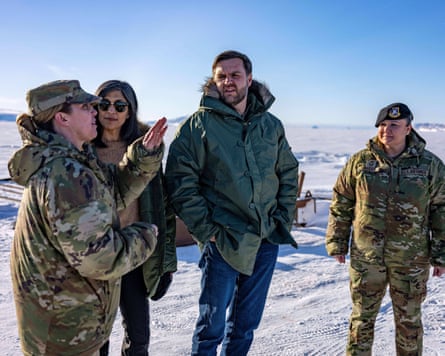
As alarm mounts in Denmark, and in Greenland itself – from where Miranda Bryant’s vivid dispatch describes a fearful mood, with many people wondering whether to flee – we may see the UK play a more active role to defuse this crisis. Keir Starmer’s government hopes to broker a “modus vivendi” with Washington, the Guardian’s diplomatic editor, Patrick Wintour, tells me. Having kept a low profile on Venezuela, Starmer hopes that American security concerns about the entire Arctic region can be addressed under existing treaties, while allaying Denmark’s fears about “ownership”.
Starmer and Trump have spoken twice in the last week about doing more to protect the “high north” from potential Russian incursion. “The view in London is that there is a deal to be done on Greenland,” Patrick said. “The difficulty with this US administration, however, is in identifying precisely what the president’s motives are when he talks about ‘ownership’.”
“Greenland seems to hold some mystical quality for Trump, but does this mean he wants to be able to point at the US map and show that its territory has expanded to take in Greenland? This is what remains unclear.”
Starmer has dispatched his foreign secretary, Yvette Cooper, to Finland and Norway. Ahead of her visit, she made no direct mention of Greenland or the need to repel Trump’s threats but called on “Nato to step up its work in the Arctic to protect Euro-Atlantic interests in the region”. Cooper’s statement also said: “As climate change opens the Arctic, the region will become an ever more critical frontier for Nato.”
“By referencing climate change, melting Arctic ice and the consequent deepening of the threat posed by Russia,” Patrick says, “the UK is acknowledging the validity of Trump’s concerns, but of course not his solution of US occupation.”
However, with Trump apparently ready to destroy Nato for the sake of controlling Greenland, whatever his motives, Europe’s options seem fraught with risk.
But there are strategic cards Europe could play. Robert Habeck, the former vice-chancellor of Germany, argued in the Guardian on Monday that Europe should assert a bit of its own machtpolitik (power politics) and offer Greenland a return to EU membership, along with a massive investment package, to fend off US threats. Greenland left the then European Communities in 1985, to regain control of its fisheries. But if the EU matched Denmark’s annual block grant with billions in new investment, the calculus could change in a radically altered world.
Fabian Zuleeg, chief executive of the European Policy Centre in Brussels, said that Europe could, if it stuck together, show Trump that his dog-eat-dog coercion comes at a cost. He said that Europe must make “not symbolic gestures, but measures that resonate domestically in the US and hurt Trump and his policy choices where it matters most: with his political base. Trade, market access, regulatory cooperation and industrial partnerships all provide leverage.”
For Paris-based columnist Alexander Hurst, Europe’s best course of action is to force “a rupture” with the US, including telling the US to leave its European military bases. “Everything short of actual combat should be considered,” Hurst wrote, “because ‘annexing Greenland’ is a symptom of American fascism, and others will follow.”
To receive the complete version of This Is Europe in your inbox every Wednesday, please subscribe here.












Comments