
 German (DE)
 English (US)
 Spanish (ES)
 French (FR)
 Hindi (IN)
 Italian (IT)
 Russian (RU)
 28 minutes ago
The ad is simple, less than half a minute long, but many say it was the moment the nation took notice of Mississippi’s US Senate race.
In it, the incumbent Republican senator Cindy Hyde-Smith, a cattle farmer, answers a reporter’s question about the rising price of beef: “You know, you have so many proteins to choose from,” she says.
The ad then cuts to a man flipping burgers on a grill. “Pick another protein?” he says. “Shhiiiiii – I’d rather pick another senator instead.”
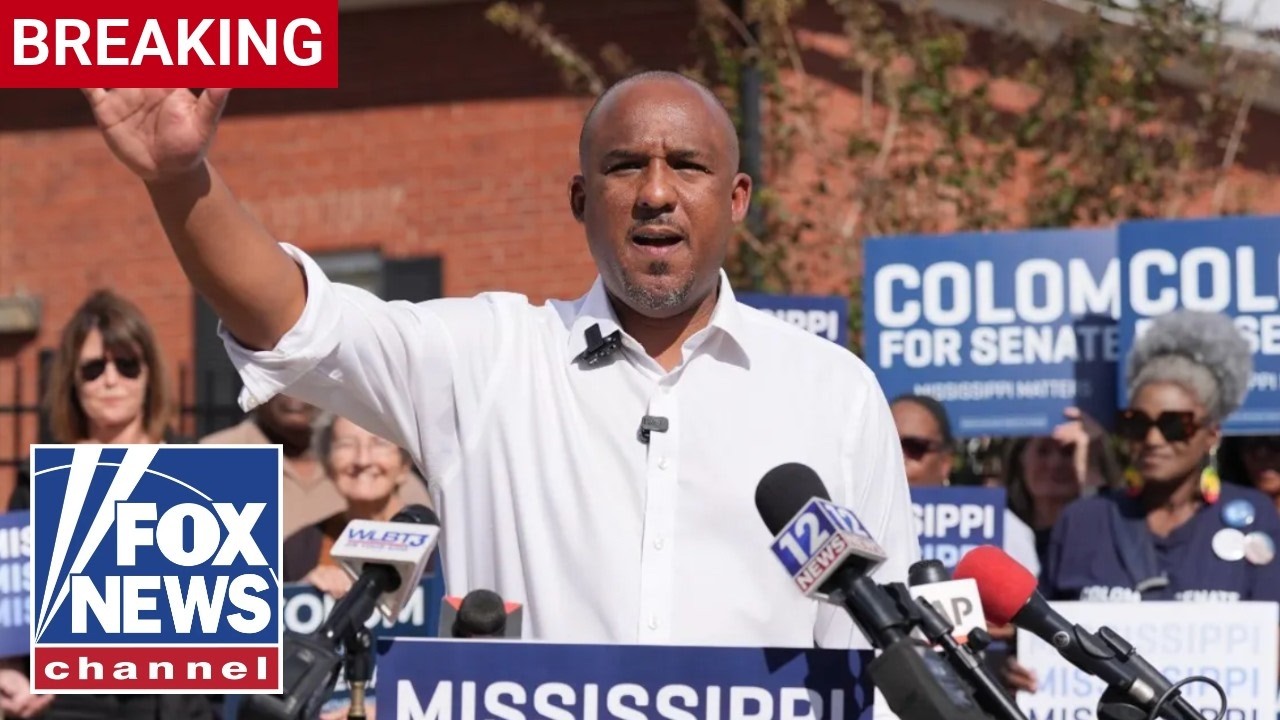
The viral ad was for Hyde-Smith’s Democratic challenger, Scott Colom, who won the Senate seat on Wednesday, becoming the first Democratic senator in Mississippi since 1982 and its first Black senator since the Reconstruction era. His ads were relevant to Mississippians and created memorable slogans – an early ad highlighted the history and progress of the state, while a more recent one spoofed the hit film Sinners, filmed in Mississippi. But his efforts to engage Mississippians didn’t start there.
Colom spent the past year reaching Mississippi residents where they were. From driving a “pick another protein” truck that offered free tacos, to talking to students and alums at college homecomings, to chatting with voters queued to see Donald Trump, Colom campaigned on an idea that’s not novel to Mississippians, but one that the rest of the country is only starting to fully realize: “Mississippi Matters.”
And he did it with little help from the Democratic party.
‘We’re a state that has to matter’
When Colom announced his campaign last year, pundits largely wrote him off as another Democratic challenger with no chance of winning. For much of the campaign cycle, prognosticators labeled the Senate seat as “solid R”, something he said made it more difficult for him to fundraise.
Within three months of launching his campaign, Colom raised about $594,000. In that same period, Hyde-Smith raised nearly $1.1m, including a significant donation from Aipac, the pro-Israel lobbying group. Shortly before the election, Colom had raised about $3.6m, compared with Hyde-Smith’s $5.3m. It’s also hard to unseat an incumbent senator in Mississippi – prior to Colom’s election, it hadn’t been done since 1942.
But this wasn’t Colom’s first uphill battle.
In 2015, he unseated an incumbent who’d held the circuit’s district attorney’s seat for almost three decades. That election made Colom the first Black district attorney for the 16th circuit, a position in which he held a 94% success rate for convictions.
In 2023, Biden nominated Colom, a seventh-generation Mississippian, to serve as a US district court judge for the northern district of Mississippi. Republicans, including the senator Roger Wicker, and Democrats alike supported the nomination. But Hyde-Smith blocked it.
On election day, well before the race was called, Hyde-Smith joked about her decision, saying: “I blocked Scott Colom from being a federal judge, and you blocked him from being a US Senator.”
In the end, Mississippi didn’t block Colom. He knew that to win, he needed Black voter turnout and the support of about a quarter of white voters. And that’s what he did, flipping counties that had been Republican strongholds.
Part of Colom’s campaign success was his ability to talk to voters as people, two Mississippians having a chat, not as someone trying to solicit a vote.
“I don’t do speeches,” Colom said days before the election. “I speak from my heart. I talk about what I care about, I listen to people.”
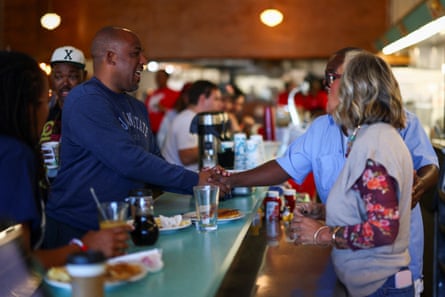
He talked to people at Waffle Houses, chatted them up in barber shops and hair salons, and visited with employees at fast food restaurants and big box stores.
By April, the senator Ralph Warnock was telling national Democrats to pay attention to Colom’s campaign. Instead, they laughed at him. It wasn’t until a month before the election – seeing the impact of “pick another protein” and Colom’s rising popularity outside the state – that the party began seriously infusing cash into the campaign. National leaders such as Kamala Harris, Pete Buttigieg and Cory Booker stumped across the Magnolia state. Colom’s momentum, which had steadily been building for months, crescendoed even more.
after newsletter promotion
“[People have to] understand how much potential and promise we have in Mississippi,” he said. “We’re a state that has to matter, that this country will never reach its potential if it ignores places like Mississippi.”
‘I speak from my heart’
Colom and Hyde-Smith spent the week after the election much differently. Despite Colom maintaining a lead of several thousand votes over Hyde-Smith, the incumbent senator refused to concede. Historic voter turnout, combined with data inaccurately marking voters inactive, left all 82 counties in the state having to count affidavit ballots, a process that took days.
While Hyde-Smith didn’t appear during that time, Colom did. He used the national media attention that he was receiving to highlight local people and businesses.
“I’m glad that the media is getting an opportunity to see our state,” he told reporters. “Go out to talk to some Mississippians – they’re very proud of this moment.” He encouraged journalists to go to local museums and shouted out colleges.
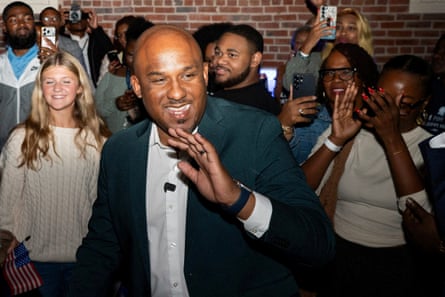
He also used that time to thank voters.
The day after the election, Colom visited Millsaps College, his alma mater, and Tougaloo College, a historically Black college whose students have been active in the fight for voting rights.
At Millsaps, Colom walked out to raucous cheers from the students who gathered on campus to see him. He focused little on the campaign, instead talking to students about his time at Millsaps and the value of an education. The visit also gave him a chance to thank the professor who gave him the confidence to run for office. Colom attended Millsaps to play basketball, but Anne MacMaster, an English professor, asked him to read a passage from Richard Wright, the Mississippi author of the landmark novel Native Son, when he was a sophomore.
“That is the most beautiful reading of Richard Wright I’ve ever heard,” Colom recalled her saying. “You can only read that as a Mississippian that’s understood what those words actually mean.”
MacMaster eventually became his adviser and the reason he double-majored in history and English. Colom, who, days later, would become the next senator from Mississippi, hugged MacMaster. But their interaction had to be brief.
There was a swarm of people, eager to talk to Colom one-on-one.












Comments