
 German (DE)
  English (US)
  Spanish (ES)
  French (FR)
  Hindi (IN)
  Italian (IT)
  Russian (RU)
  2 weeks ago
As mass protests erupted over the past week after an Immigration and Customs Enforcement agent killed Renee Nicole Good, thousands of Americans hoisted signs and marched to thunderous chants of “abolish ICE”.
The mantra has quickly captured the bursting anger and grief of a nation; activists and progressive lawmakers like the representative Ayanna Pressley, and even the conservative commentator Bill Kristol have embraced the demand. Shri Thanedar, a Democratic representative from Michigan, said he plans to introduce the “Abolish ICE act”, a bill that would dismantle the federal agency and its current enforcement authority. For the first time, more US adults now support eliminating ICE than those who oppose it, according to a new Economist/YouGov poll.
It wasn’t just the 7 January shooting of Good, a mother of three and US citizen, in Minneapolis, that has sparked outrage over Donald Trump’s immigration crackdown. In 2025, 32 people died in ICE custody, making it the agency’s deadliest year in two decades. Worksite raids in cities like Los Angeles, Portland and Chicago have led to the arrest of thousands of immigrants without due process and triggered massive protests demanding that federal agents leave their communities and be held accountable for alleged human rights abuses.
To longtime immigrant rights activists, the reckoning may feel familiar.
Juan Prieto, the digital communications manager for the Immigrant Legal Resource Center, said the movement today to end or rein in ICE is “so much realization” of the legwork and learnings laid down by the first iteration of “abolish ICE”. “A lot of directly impacted advocates taught American citizens how to look out for immigrants,” he said.
In the summer of 2018, “abolish ICE” became a rallying cry as thousands took to the streets to protest immigrant family separations under Trump’s first term. Top Democrats, such as 2020 presidential hopefuls and senators Elizabeth Warren and Kirsten Gillibrand, adopted the demand. Just as quickly, though, the momentum spluttered. Party leaders and strategists declared the slogan a divisive, unpopular policy demand that would hurt Democrats’ electoral chances, and it fell from mainstream political discourse even as deportations soared under the Joe Biden presidency. Eight years later, with the country again in the throes of the Trump administration’s immigration crackdowns, activists at the forefront of “abolish ICE” say the campaign set in motion today’s anti-ICE resistance. The movement’s setbacks can also form a blueprint for building a stronger movement.
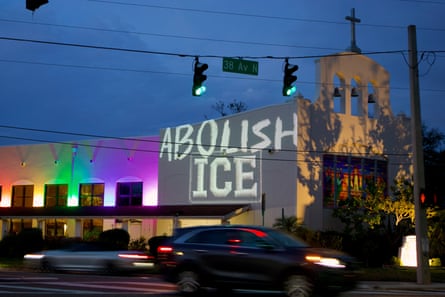
“There are lessons about taking to the streets,” said Jacinta González, a leading immigrant rights organizer for more than 15 years. “But this time around, we’re building community and building a vision about what having a world without ICE can look like.”
The rise of ‘abolish ICE’
The push to abolish ICE has its roots in the police and prison abolition movement that Black scholars like Angela Davis had long advocated for. But the phrase “abolish ICE” became a call to arms seemingly overnight when political strategist Sean McElwee typed it in a tweet that went viral.
“The central assumption of ICE in 2018 is that any undocumented immigrant is inherently a threat,” McElwee wrote in an article for the Nation that same year. “In that way, ICE’s tactics are philosophically aligned with racist thinkers like Richard Spencer and the writers at the white-supremacist journal VDare.”
ICE was created in 2003 as a unit of the brand-new Department of Homeland Security, in response to the 9/11 terrorist attacks. The agency is primarily tasked with locating, detaining and forcibly removing undocumented immigrants. Securing the border and enforcing Trump’s family separation policy are functions of Customs and Border Protection, another federal agency established in 2003.
While it seemed to come out of nowhere, the movement to abolish ICE was built on many years of grassroots organizing led by undocumented immigrants. Anti-ICE organizing started practically as soon as the agency formed, but it gained momentum during the record number of deportations under Barack Obama’s administration, said Amy Gottlieb, an immigrant rights lawyer and activist with the group American Friends Service Committee.
Obama’s policy of deporting “felons, not families”, Gottlieb said, also perpetuated the enduring narrative of “good” and “bad” immigrants – the idea that some are more deserving of citizenship than others – that would drive a wedge among immigrant rights groups. “As we moved into that first Trump administration, I think there was a sense of real anger at how many people were deported,” she said.
González, the head of programs at digital rights non-profit MediaJustice and a founding organizer of the No Tech for Ice campaign, said the early Trump years pulled back the curtains on how ICE operated. “The first Trump administration was a moment when they were very unapologetic about the fact that the cruelty was the point,” said González, who was a senior campaign organizer for the Latinx rights group Mijente at the time. “We saw it as our goal to free people from those types of surveillance and detention and deportation.”
Throughout the sweltering summer months, hundreds of thousands of people demonstrated and camped outside federal detention centers across the country, shutting down facilities in several cities. One woman, Patricia Okoumou, scaled the pedestal of the Statue of Liberty in protest against Trump’s hardline immigration policies.
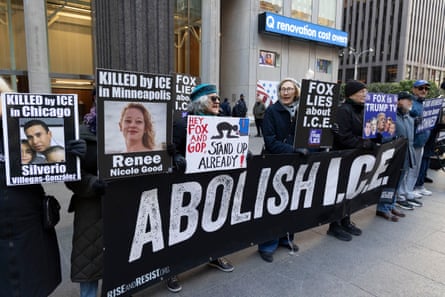
The momentum behind the “abolish ICE” campaign grew so strong that a dozen legislators endorsed the cause. In the 2018 midterm elections, Alexandria Ocasio-Cortez made dismantling ICE a central campaign demand in her upset victory over the representative Joe Crowley. The representative Mark Pocan introduced legislation to eliminate the agency, though it didn’t gain much traction in the House.
“I think our wins against detention centers really started to happen after that point,” said Silky Shah, executive director of Detention Watch Network and author of Unbuild Walls: Why Immigrant Justice Needs Abolition. “I think a lot of that was because new people were entering the fight, new people really understanding the role of ICE in their local communities and the sort of entanglements that existed.”
The fall
Shah said the “abolish ICE” campaign faltered after Biden took office because his administration failed to establish itself as a foil to Republicans on immigration matters.
“The movement didn’t know how to pressure the Biden administration because they didn’t signal they cared to do much about immigration,” Shah said. “People were pushing for some sort of relief, but because of the narrative around the border, Biden shied away from the issue and didn’t put forth much of a pro-immigrant stance.”
Though Biden didn’t conduct the same scale of interior enforcement as Trump did, Shah said, the focus quickly shifted away from fighting deportations to addressing the border crisis. Much of the legislation and policy changes that emerged from the “abolish ICE” movement, she said, was focused on reviewing or replacing the agency rather than shuttering it.
For some who have been fighting the agency’s deportation machine since the beginning, even “abolish ICE” doesn’t fully capture the movement’s goals, given that ridding the agency still leaves behind enforcement mechanisms that allow for the mass detention and deportation of immigrants.
“Abolishing ICE needs to be the floor, not the pinnacle,” Shah said. “Going back to a system with fewer agents and more collaboration with local police is not the solution.”
Prieto, at the Immigrant Legal Resource Center, said the movement struggled against a lack of courage and “political imagination” from the Democratic party. Rather than capitalizing on the popular, unflinching demand to abolish ICE and the deportation apparatus, Prieto said, Democrats ended up capitulating to Republicans as the country moved right. Kamala Harris, who called for a restructuring of ICE ahead of her 2020 presidential bid, adopted a tough-on-immigration stance in her presidential run four years later. Last January, shortly after Trump’s inauguration, 46 House Democrats voted with Republicans for a bill that required the detention of undocumented immigrants charged with theft-related crimes.
“Democrats consistently struggle with utilizing grassroots momentum to actually create tangible change that better reflects the needs of people on the ground,” said Prieto, who was organizing with the California Immigrant Youth Justice Alliance in 2018.
The rise again
Despite the setbacks, Prieto said the 2018 “abolish ICE” campaign laid the groundwork for much of the grassroots resistance against the agency today, including “know your rights” workshops, the many rapid-response groups supporting families targeted by raids, and the growing efforts to close detention facilities across the country.
“ICE losing credibility in the public’s eye, the recognition of how much power there is in showing up, all that is thanks to the work that happened under the first eruption of the ‘abolish ICE’ movement,” Prieto said.
Mantras and chants have shaped the movements of Trump’s second term. But the slogans that mobilized the masses over the past year, such as the “No Kings” and “Hands Off” protests, were expressions engineered by national organizations, rather than organic phrases that took off on social media. Over the past week, fervent calls to abolish ICE found new life because Good’s death sparked a collective outrage reminiscent of that during the immigrant family separations.
González said explicit calls for abolition have not gained as much traction until now because the stakes – the danger of engaging in activism under this administration – are higher. But that doesn’t mean the work has stopped.
“We just witnessed someone lose her life just being a civilian present,” she said, “and you still have people showing up to do the same thing, coming together to make sure people are fed, are still going to school is astounding.”
To capitalize on the current moment of reckoning, Prieto said, the Democratic party has to engage with the demands of protesters and immigrant rights activists to abolish all systems of policing, detention and enforcement – a campaign that does not end with the dismantling of ICE.
“It’s coming to terms with the reality that we’re living in and really having the political imagination necessary to get us out,” Prieto said. “Our opposition has a vision of an authoritarian white nationalist utopia that they’re working day in and day out to accomplish. I don’t think our leaders have that level of progressive envisioning.”











Comments