
 German (DE)
  English (US)
  Spanish (ES)
  French (FR)
  Hindi (IN)
  Italian (IT)
  Russian (RU)
  3 weeks ago
The Trump administration’s aggressive anti-immigration policy has led to a crackdown on immigrant communities that, increasingly, targets not just people who have violated immigration law but many immigrants who are in the US legally.
Throughout the past year, policies – many of which are actively being challenged in court – amount to the government attempting to strip people of their status, with countless numbers suddenly finding themselves undocumented, or about to be, and under threat of deportation.
“They are looking for every way to make the undocumented population as enormous as possible,” Ghita Schwarz, litigation director for the New York-based International Refugee Assistance Project (IRAP), said of the federal authorities, as they seek to meet mass deportation targets. She added: “It’s the great de-legalization campaign, rendering vulnerable to detention and removal millions of people who were not here unlawfully.”
Here are the main ways Trump is undermining legal immigrants:
Refugees
Historically, refugees fleeing war and persecution were intensely vetted by the US government while still abroad, then brought to the country and resettled through the federal refugee program. After one year in the US, refugees were required to apply for a green card.
On the first day of his second administration, Donald Trump signed an executive order “suspending” the government’s refugee program – what critics call a “refugee ban”. It left thousands of refugees stranded abroad, many of whom’s flights had already been scheduled. Other refugees already in the US have been left in limbo with little to no resettlement assistance. The ban has been challenged in court, with little success.
Since the refugee ban was signed, anti-refugee policies within the US have intensified further. The Trump administration also issued two separate travel bans blocking people from 39 countries from entering the US and extended the ban to apply to refugees. In November, the administration paused the processing of any green card applications by refugees and ordered a “broad review” of hundreds of thousands of people admitted under Joe Biden.
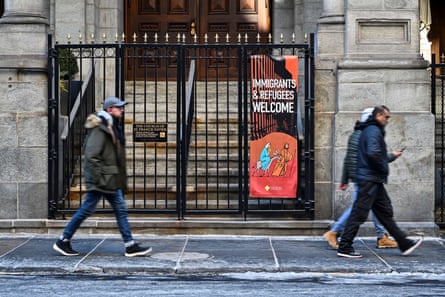
For 2026, the Trump administration set a cap of 7,500 refugees who may be admitted to the US, a significant reduction from the Biden administration cap of 100,000 in 2024. Trump wants the majority to be white South Africans.
An alarming new trend has also been the push to arrest and indefinitely detain refugees who have not yet received their green cards, with advocates estimating that 100,000 are at risk.
Temporary protected status (TPS)
People with temporary protected status (TPS) are those from certain countries given permission to live and work in the US after the US authorities determined their home countries to be unsafe. TPS has been granted to people facing war, political instability or even natural disasters. TPS does not offer a legal pathway to citizenship.
Haiti, for example, was first given TPS after the 2010 earthquake and it has been extended several times. And Venezuela was granted TPS in two instances, first in 2021 and then in 2023.
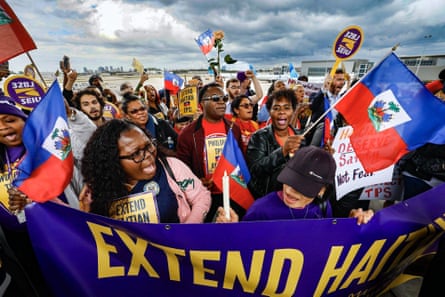
The Trump administration has revoked TPS for about 1 million people from a number of countries, placing many at risk of deportation. Those countries include:
-
Afghanistan
-
Cameroon
-
Ethiopia
-
Haiti
-
Honduras
-
Myanmar
-
Nepal
-
Nicaragua
-
Somalia
-
South Sudan
-
Syria
-
Venezuela
-
Yemen
A number of lawsuits are challenging the administration’s actions to revoke TPS, with varying degrees of success so far.
Blanca Hernández, a supervisory policy and practice associate at the American Immigration Lawyers Association (AILA), said that many people will face danger if they are sent back.
“What are they going back into?” Hernández asked.
Deferred Action for Childhood Arrivals (Daca)
The Deferred Action for Childhood Arrivals program, called Daca, was established by the Obama administration in 2012 and allowed undocumented people, who arrived in the US as children, to live and work in the US with certain protections from deportation. According to US Citizenship and Immigration Services (USCIS), there are approximately 533,000 active Daca recipients in the US, known as Dreamers, who continue to undergo vetting when they reapply.
Ongoing litigation and the Trump administration’s anti-immigrant attacks have placed the already precarious status of Daca recipients under stress, and an increasing number of Dreamers have found themselves arrested and either deported or pressured to leave, although exact numbers are unclear.
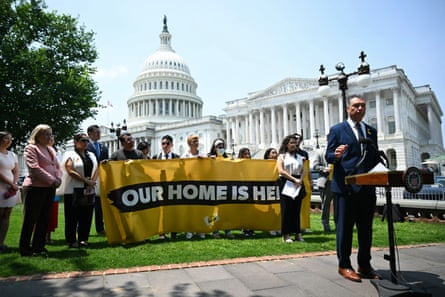
Former homeland security secretary Kristi Noem wrote separate letters to Democratic members of Congress earlier this year, each with different data, showing that at least 260 Daca recipients were arrested last year and from 86 to 174 were deported.
“They are individuals who came here as minors, who didn’t have any other choice,” said Hernández, who was previously a Daca recipient. “It’s been over a decade since Daca came about. So a lot of these individuals married US citizens and were attempting to take the next steps [to obtain legal status]. Now, this current administration decided: ‘No, you shouldn’t have been here to begin with.’”
Asylum seekers
Asylum seekers are people fleeing their countries of origin who arrive in the US and request protection under certain categories.
Joe Biden had already significantly restricted asylum but when Trump returned to the White House he immediately barred all access to the asylum system for new arrivals. This has led to a historic low in encounters with asylum seekers at the border despite asylum being considered a human right, protected by national and international laws.
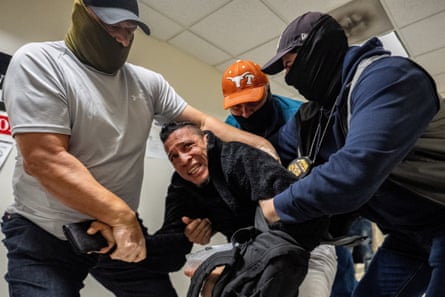
Meanwhile, asylum seekers whose applications are in the system are showing up to routine Immigration and Customs Enforcement (ICE) check-ins or scheduled hearings at immigration court and being arrested, often amid violent and heart-breaking scenes of families wrenched apart. For many, detention and deportation have followed, in a development that has shocked even seasoned advocates and activists, as ICE and government attorneys coordinate to dismiss an asylum seeker’s case.
The administration has also secured “third country” agreements with more than 20 nations to accept deportees who are not originally from that country. Some countries, such as South Sudan, Eswatini, Rwanda, Equatorial Guinea and Ghana, do not guarantee not to send the people back to the countries they fled. Some of these third-country removals are being challenged in court.
Pretermission
DHS has been increasingly relying on a legal action called “pretermission” to quickly remove asylum seekers from the US. If DHS requests “pretermission”, an immigration judge can then quickly order an asylum seeker removed to a third country without a proper hearing. In April of last year, immigration judges, who have historically struggled with a huge backlog of cases, were given wide powers to “pretermit” asylum cases, allowing the judges to quickly clear their dockets. In theory, asylum seekers removed via “pretermission” could seek asylum in the third countries where they are sent.
In one court case reviewed by the Guardian, an asylum-seeker from Nicaragua, who had passed an initial “credible fear” interview with officials, was arrested and detained in Florida’s notorious “Alligator Alcatraz” immigration detention center. An immigration judge, relying on “pretermission”, ordered him removed to Ecuador without a hearing. A federal judge ordered him released.
Victims of crime
Immigrants are able to apply for certain visas if they are victims of crime and helped police throughout an investigation, mainly involving people who have “suffered mental or physical abuse” or are victims of labor or sex trafficking. This system can lead to work authorization and a pathway to a green card.
But ICE now has a policy allowing for the arrest, detention and deportation of those with such U and T visas. The Center for Human Rights and Constitutional Law and other groups have sued the government to try to stop this.
People in humanitarian parole programs
For years, people from certain nationalities with US-based sponsors could request to enter the US under a “humanitarian parole” program and would then be protected from immigration-related arrest and deportation. But the Trump administration paused the humanitarian parole programs for Ukrainians, Afghans, Cubans, Haitians, Nicaraguans and Venezuelans. The Ukrainian parole program resumed last June by court order.
And nearly 1 million people who were given parole after crossing the US-Mexico border using the Biden administration’s CBP One app have had that status terminated.
Early last year, USCIS paused various humanitarian parole programs, including the Cuban, Haitian, Nicaraguan and Venezuelan (CHNV) parole program, the Central American Minors parole program, the International Entrepreneur parole program and the Family Reunification parole program, placing recipients in limbo while their cases were re-vetted. Overall, targeting the humanitarian parole programs has stripped legal protections from more than 1.5 million people.
Student and work visa holders
The Trump administration has targeted immigrants in the US with valid student and work visas. The administration used a rare provision to detain and attempt to deport high-profile pro-Palestinian student activists, for example.
And last year, immigration agents carried out one of the biggest workplace raids in ICE history, storming a Hyundai plant in Georgia and rounding up 475 people, leading to a diplomatic quarrel between South Korea and the US.
Meanwhile, the administration has also made it significantly more challenging for people applying for certain work visas, now charging a $100,000 fee for people seeking high-skilled H-1B work visas.











Comments