
 German (DE)
  English (US)
  Spanish (ES)
  French (FR)
  Hindi (IN)
  Italian (IT)
  Russian (RU)
  3 weeks ago
It took three days for Arianne Betancourt’s joy at the release of her father from months of detention in Florida’s notorious so-called “Alligator Alcatraz” immigration jail to fully evaporate.
At first, she was able to overlook his shockingly gaunt appearance and weight loss, hesitant movements and moments of slurred speech. The tonic of being back in her Miami apartment, she thought, would surely hasten his return to health.
That was on Thursday. By Sunday, however, Justo Betancourt was in the emergency room, with doctors suspecting he had suffered a series of mini strokes, during his detention and since his release. They were unable to perform an MRI scan on his brain to confirm the diagnosis because of the electronic monitoring tag affixed to his ankle.
“If he had a headache, if he didn’t feel good, if his glucose was high, they’d just tell him to drink more water,” Arianne Betancourt said of his guards’ reaction to her diabetic father’s requests for medical help and his twice-daily insulin injections.
“I’m furious at the condition he’s in now. He’s not the same person he was before they took him in there, and I don’t know if he’ll ever be the same.”
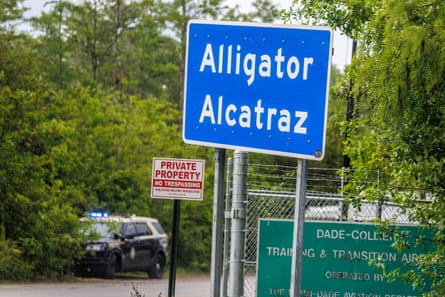
The detention center, hastily constructed last summer on a disused airstrip adjacent to fragile wetlands and Native American ancestral tribal lands in the mosquito-infested Florida Everglades, will close next month. It was condemned as “a failed experiment in human suffering” by critics, and still costs Florida taxpayers more than $1m a day.

Its imminent shuttering follows lawsuits from environmental groups; protests from immigration advocates; unannounced visits by Democratic politicians who called conditions inside the facility “inhumane”; and a 2025 Amnesty International report highlighting commonplace physical abuse of detainees and human and legal rights violations.
Beyond that, there are the individual human stories such as Betancourt’s that will endure after the jail’s closure, and become part of the legacy of Ron DeSantis, Florida’s hard-right governor, who will be termed out of office in January.
DeSantis, a champion of the remote tented camp surrounded by alligators and Burmese pythons, celebrated that 22,000 detainees, all slated for deportation, were kept in metal cages during the nine months of the jail’s existence.
“We did not create the Four Seasons [hotel]. That’s not the intent of this,” he said last year.
The experience of Betancourt, a Cuban national with decades-old drug convictions that were previously not considered a barrier to his continued presence in the US, is largely typical of those who have been held there.
He was taken during a routine immigration appointment in October and shuffled around detention centers in Miami and Texas, before ending up at the Florida facility.
Before a judge issued a writ of habeas corpus last week, concluding there was no reasonable prospect of the government deporting him to his homeland, Betancourt spent four and a half months in the Everglades jail. His daughter said he was traumatized by his own treatment and what he witnessed others experience.
“It’s so much worse than I think most people imagine,” she said. “Guys in there [are] not getting food, all they know is being locked in a cage for months, then they’re dumped in a country where they have no family, nothing.”
The Florida division of emergency management, which runs the jail using a combination of state employees, military personnel and private contractors, has denied any mistreatment or deprivation. The homeland security department has called reports “hoaxes”.
But other former detainees have described conditions inside as “hell”, with cramped and dirty cages, no privacy for showers, overflowing toilets, lights on 24 hours a day, malfunctioning air conditioning, and tiny food portions sometimes infested with worms or maggots.
Advocates say their exposure of the jail’s conditions and its cost has turned the tide of public opinion and hastened its demise.
DeSantis, who is also reportedly mulling another run for the US presidency, already appears to be distancing himself from the jail he once supported.
“Ideally, I wouldn’t want to be involved in this business at all,” DeSantis said at a press conference last week, in comments starkly at odds with his initial enthusiasm and eagerness for opening and operating the jail on behalf of the US Department of Homeland Security.
“We knew it was going to be temporary.”
At a subsequent media event, he said: “If we shut the lights out on it tomorrow, we will be able to say it served its purpose.”
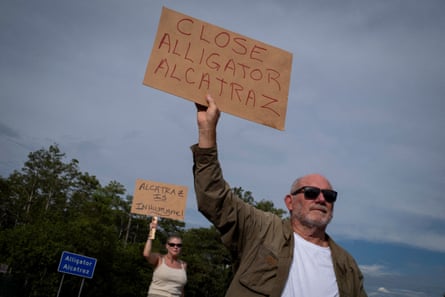
That perceived indifference to human suffering dismays opponents of the detention center, who have staged vigils outside its gates every Sunday since August, a month after it opened.
“If in saying Alligator Alcatraz has ‘served its purpose’, Governor DeSantis means it has stirred the moral conscience of the nation, I would agree,” said Tony Fisher, minister of the Unitarian Universalist congregation of Greater Naples.
“It has also laid bare the moral depravity of our state and federal administrations. The goal is not to close just one detention center, but all of them. The end is to elect people of either party who can show they have compassion for their fellow human beings.”
Some political analysts believe DeSantis miscalculated when he went all in on the detention center, and invited Donald Trump to tour it with him last July, months after the governor’s unsuccessful challenge for the Republican presidential nomination.
“I don’t think it’s going to be quite the political positive that it looked like it would be at one time,” said Aubrey Jewett, a professor of political science at the University of Central Florida.
“When he first pushed it, the average American was still supporting cracking down on illegal immigration. It seemed a clear win for DeSantis, his way of regaining national exposure on this big issue that Republicans cared a lot about, and getting back into Trump’s good graces after challenging Trump and losing and really being an outcast from Trump world.
“In the longer term, maybe not. Overall, public opinion has turned against aggressive immigration enforcement, the average American thinks President Trump has gone too far, and Alligator Alcatraz might be held up as a prime example. DeSantis pushed something really expensive, in an environmentally sensitive area, and with a reputation for not providing even basic civil rights.”
Yet, as Jewett acknowledges, DeSantis is not completely backing away. He told reporters last week that far from soaking about $1bn from Florida’s emergency preparedness fund, the jail had actually saved taxpayers money by not having to fund the “staggering cost” of providing healthcare and education to deported criminals.
His assertion is at odds with an NBC investigation in December that found only one-quarter of the center’s detainees had a criminal conviction, and less than half were facing criminal charges.
“He’s defending this, but that doesn’t necessarily make it factually correct,” Jewett said. “Some of the studies have shown the majority of people held in Alligator Alcatraz were not criminals, and other studies that have looked more broadly at the economic cost of immigration have been mixed on whether immigrants, illegal immigrants in particular, cost money or help the American economy by working hard and paying tax, and paying into social security and Medicare that they’ll never collect.”
While Arianne Betancourt said she was optimistic her father would no longer be deported, he was still in the hospital on Thursday facing a long journey back to health. His ankle tag had been removed, she said, and doctors could finally evaluate neurological problems.
“My dad is only 54, and when he went in there he was sick but he was still sturdy, at least mentally,” she said. “And he came out like this. It’s just the reality of so many [people in the detention center].”














Comments