
 German (DE)
  English (US)
  Spanish (ES)
  French (FR)
  Hindi (IN)
  Italian (IT)
  Russian (RU)
  1 hour ago
Sabrina German, a poll official in Chatham county, details a typical election day, the pressure election workers face, and fallout from 2020 disputes
It’s not that Sabrina German doesn’t have political views. But as the director of voter registration for Chatham county, Georgia, talking politics is like breakdancing in traffic. “I don’t talk politics with anyone,” says German; she knows better.
America’s partisan minefield has trained much of the country – aside from that one uncle you avoid at weddings and funerals – to get pretty good at the art of political diplomacy in polite company.
But after 30 years in her field, German is more than pretty good. With politics seemingly everywhere, she tries to be nowhere in the polarized debates gripping the country.
German is, after all, responsible for registering voters and helping to oversee elections – one of thousands of officials engaged in this effort nationwide. It’s easier to rebut accusations of cheating to advance your own partisan interests if people don’t know you have any.
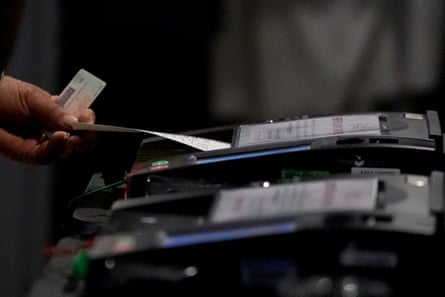
A brigade of election deniers and political activists in Georgia stand ready to pounce on elections officials including German, alleging missteps and mistakes – whether they are real, perceived or entirely made up.
Her life, from volunteer work to personal relationships, is constructed to avoid politics, German said. She has walked out of more than one room when someone started talking politics.
“You can sway people away from the topic which they think they want to talk about, and then you can start talking about something else,” German says in an interview. “The way you start talking about it, you begin to tell them what your office does and what you can do for them versus feeding into their politics. And so, once you explain what you can do for them, and you do it in a decent form, I think most people, they’re respectful of that.”
After growing up in McClellanville, a tiny town of fewer than 1,000 on the South Carolina coast near Charleston, German, 56, has been in the elections field in Savannah, Georgia, since October 1996, working her way up from an absentee ballot clerk to head of the registration office.
Since last year, she has served as president of the Georgia Association of Voter Registration and Election Officials (Gavreo). In states without a critical mass of election skeptics, German’s leadership of such a professional organization might largely focus on mundane career development activities, parsing legislation and crafting best practices for media-shy election officials.
But this is Georgia. If this year’s midterm elections unfold in the same fashion as the 2020 presidential election in the state, German will be in the middle of the fray.
Two poll workers in Fulton county – Ruby Freeman and her daughter Shaye Moss – endured years of death threats after appearing in a viral video from election night that Trump partisans used to falsely accuse them of election fraud as the US president denied the result.
Gavreo is a forum for the primal scream of poll clerks trying their best to stay out of the news. German’s role is to put a face to elections workers who have been on the receiving end of a years-long crusade to impugn their honor.
German thinks about when she may have to defend the next Freeman. “In the position that I am in … you definitely want to stand by a person like Ruby Freeman, because you know the work that they’re doing, and you know their heart for the business,” she says. “It’s not political: it’s just that they have a heart for people, and they want to make sure that the voters are served.
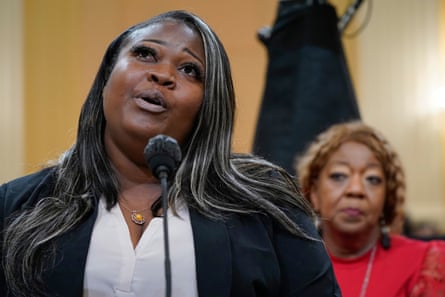
“And I mean, and not sure about other counties, but I know here in Chatham county, we couldn’t do the work that we do if we didn’t have poll workers like her.”
Freeman and Moss won a $148m defamation judgment against Rudy Giuliani, the former New York mayor who promoted the claims against them. The harassment they endured is a lesson for others.
The 2020 election dispute never really ended in Georgia. Undeterred by reality, an army of conservative Trump-supporters have continued to inundate elections offices across the state with voter challenges, diatribes at public hearings and lawsuits.
In the months leading up to the 2024 election, a single voter – Helen Strahl – personally challenged the registration of more than 1,000 Chatham county voters and sent the registration board the names of more than 20,000 other voters for “list maintenance”.
German’s staff needed weeks to manage the deluge, even as it was preparing for the 2024 presidential contest. Strahl claimed to have found people voting in other states and “probably hundreds of dead people, every other month”.
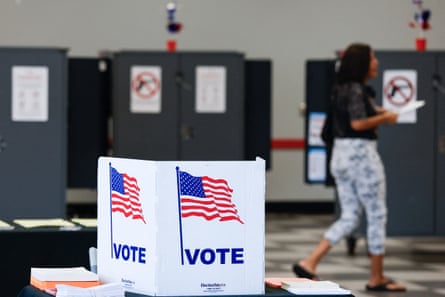
In an interview Strahl, a Glaswegian American, said she had found German’s demeanor to be a bit cool at first. In a half-hour meeting that stretched to 90 minutes, however, she said German’s manner changed.
“At one point, after one of the election board meetings, she actually kind of apologized to me and said that she’d got off on the wrong foot, which took the wind out of my sails,” said Strahl. “She realized that I wasn’t out to stab her in the back. I was actually trying to show her where the problems were.”
Strahl has knocked off the mass challenges since then. “I was making a point,” she said. Strahl saves her ire for Georgia’s outgoing secretary of state, Brad Raffensperger, long a target of conservative election activists.
“I have nothing against her,” Strahl said of German. “I was probably was a pain in the arse asking stupid questions.”
Election day starts at 7 am for German and usually ends after 10 pm, she said: however long it takes to get the job done.
“Election day for us is answering phone calls, ensuring that voters that do come in on foot traffic, they’re going to the correct polling places,” she says. “We’re processing absentee ballots, making sure that we input all of the absentee ballots for election night. We’re also making sure that all of our advance voting paperwork is completed.”
With critics – from the president of the US down – prepared to challenge the validity of any election result they dislike, such paperwork can be critical.
Election offices should “document everything”, she says, noting that many challenges do not arise for many months after votes are cast. “Your documents are going to be able to tell the story for your office,” she says. “When you go back through a year or two later to read that document, you should be able to flow through what happened here, and then figure out what happened at point A, B and C.”
Election day reminds a grind for poll workers.
In Georgia, counties can now start opening and scanning absentee ballots earlier than before, which helps prevent the days-long counting sessions seen in states such as California and Pennsylvania. But election officials must count ballots without stopping until they are done, and they must finish counting absentee ballots by 5pm the day after the election.
Georgia law requires election boards to certify results no later than 5pm on the Monday following the election.
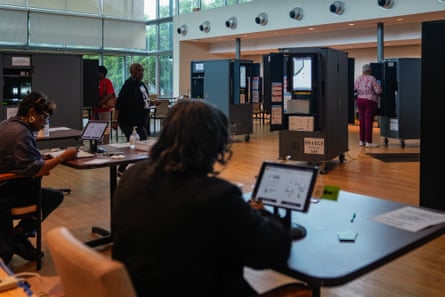
German worries about the toll that a demand for a perfect election has on rank-and-file poll workers across the state of Georgia. “For me, it’s making sure that we have enough poll workers, making sure that we’re following the letter of the law to the T, making sure that we have enough staffing – well, that’s poll workers – and then also security.”
Elections in Georgia require thousands of casual workers: people who come back year after year for a 16-hour shift on election day. In Chatham county, a starting poll clerk is paid the princely sum of $75 for the day. Supervisors may make $320. Poll workers are more likely to be Black, more likely to be women, and more likely to be retirees than the public at large.
The stress of what happened in 2020 still lingers.
German is not worried about Immigration and Customs Enforcement (ICE) agents showing up at polling places, but random “activists” following poll workers home. “That’s the part that bothers me most when I talk about security, because I believe that at the polling places, we’ll have more than enough security.”
Savannah is a bit more than half people of color, with a large Democratic majority. But Georgia’s state-level leadership is resolutely Republican. That leaves German between the tug and pull of two power bases, each looking for a reason to lob accusations.
One of her counterparts learned the hard way what happens when an elections official falls afoul of such politics. Brook Schreiner resigned abruptly from her role as director of Chatham county’s elections office last month, after the county’s elections board reportedly lost confidence in her.
Georgia’s state elections board is dominated by Republicans who have continued investigations into the 2020 election. The seizure of Fulton county election material in January came in support of the state board’s longstanding legal fight with county election officials.
But poll workers – those represented by German and across the country – aren’t political workers. Their job is to count the votes; not cast them.
“Some of our poll workers, they really understand and feel that it’s their civic duty when they come,” she says. “We have long-term early voting workers that [have] been with us for 10 or more years, working the polls.”
Many return election after election, “and not only do they bring their friends on board, but they tell other people in the community to do their civic duty”, she adds. “And then they can come on board to assist with the process.”
















Comments