
 German (DE)
  English (US)
  Spanish (ES)
  French (FR)
  Hindi (IN)
  Italian (IT)
  Russian (RU)
  3 weeks ago
The moment 19-year-old Emely Agustin spotted the group of masked immigration agents tackling a woman facedown on the pavement, her heart dropped.
She saw the woman’s red jacket.
“Oh my fucking God. That’s my mom!” she screamed.
It was the morning of 5 November in Cottage Grove, in central Oregon, and masked officers with Immigration and Customs Enforcement (ICE) had dragged Juanita Avila out of her van. The agents pinned her down as she cried out for her daughter, who started filming. Juanita, a 47-year-old legal permanent resident, had her green card in her pocket, but officers handcuffed and detained her.
“I was really scared. I couldn’t stop shaking,” Emely recalled in a recent interview.
“It was like they were trying to kidnap me,” added Juanita.
The mother and daughter were speaking out for the first time since Juanita’s arrest became part of a court case that secured a major victory for immigrants’ rights in Oregon. The lawsuit challenged ICE’s tactic of detaining people without warrants or probable cause, a practice advocates say has fueled widespread racial profiling and chaotic arrests.
Last month, a federal judge sided with the plaintiffs and issued a preliminary injunction blocking ICE agents in Oregon from continuing their “arrest first, justify later” tactics, as lawyers labeled it. The judge said ICE’s conduct had been “brutal and violent”, saying agents’ arrest strategy “systematically violates federal law and individual constitutional rights”.
From ‘village girl’ to shop owner
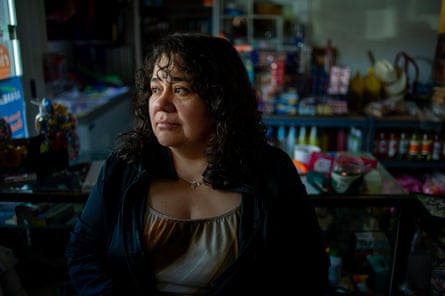
Standing behind the counter at Juanita’s Latina Store one recent morning, Juanita fidgeted with papers and spoke softly about her arrest as customers wandered in for snacks.
Her tiny shop, located in a former bank vault, is on Main Street in Cottage Grove, a town south of Eugene. Juanita packs the shelves with an array of goods, including Latin American spices, corn masa flour, breads, cowboy hats and candles. Under a banner of Guatemalan flags, her window advertises money transfer services for immigrants to send funds to relatives.
Juanita was born in 1978 in Guatemala. Her father was killed in war when she was three years old, and she immigrated to Los Angeles at age 14. In LA, she first lived with a family that exploited her and forced her to work, she said: “I was a village girl who was so innocent. I still have nightmares.” She later worked at a daycare near the University of California, Los Angeles, that served international families. The owner, an Iranian woman, helped take care of Juanita’s newborn son, and she grew to love Iranian festivities and food.
Juanita moved to Cottage Grove with her three children in 2014. She felt safer and more at home in the “quiet and peace” of rural Oregon. She did farmwork, pruning blueberries and foraging for mushrooms. She was grateful for the fresh air, though the hours could be grueling.

In 2016, the former owner of the local shop asked Juanita to take over the store. By then, she was known for helping local families with translations, with neighbors regularly asking her to interpret documents. “I didn’t want people coming into my house,” she says, with a laugh. “So this was perfect. I could have a business where I’d be helping the community.”
Juanita, who got her green card in 2017, also began helping local police with interpretation. In Donald Trump’s first term, she started assisting neighbors facing deportation. One time, she recalled, she was kicked out of a federal building while trying to interpret for immigrants at their ICE check-ins: “They wanted any excuse for them to get deported. It was horrible.” She was haunted by the memory of an inconsolable three-year-old girl whose mother was detained.
But as Trump returned to office, she continued to help immigrant neighbors, a practice that led her into ICE’s crosshairs.
‘I couldn’t breathe’
Around 5.30am on 5 November, Juanita awoke to a call from a friend, saying ICE had arrested a relative whose car was left behind, asking Juanita to retrieve the vehicle so it wouldn’t get towed. Juanita woke up her daughter, and the two drove in separate cars to search for the vehicle.
They couldn’t find the car, and as Juanita was returning home, she spotted flashing lights behind her. She pulled over near a motel, assuming she was getting a traffic ticket from police. The men who approached drove unmarked cars, lacked visible badges, asked where she was born and said she was under arrest, she later wrote in a declaration filed as part of the lawsuit. When she responded asking why she was stopped, an officer did not show a warrant or give a reason, her declaration said.
The officers reached through her window, opened the door, pulled her out and kneeled on her back, the declaration said. They also accused her of being “illegal”, she wrote. One witness video captured Juanita facedown yelling through sobs: “Why are you arresting me? You are not police … Emely! Emely!”
Emely, her US citizen daughter, soon arrived. Footage Emely recorded of the incident shows she immediately explained that her mom had a green card and was carrying it on her. When she yelled to her mom that she was recording, an officer shined a bright light in her face, obscuring her camera’s view.

“You don’t need to tackle her. There’s no reason to fucking do this,” Emely pleaded.
The officers handcuffed Juanita and put her in their car. One officer then told Emely she could also be arrested for “obstruction”, witness video shows. The officers eventually uncuffed Juanita so she could grab her green card. When she again asked why they had arrested her and didn’t believe her, an agent responded: “Because they lie all the time,” according to Emely’s footage.
Juanita was released. The encounter did not lead to charges and lasted roughly 30 minutes.
One of the scariest moments, Juanita recalled, was being thrown into ICE’s vehicle “like a log”, leaving her weeping and coughing through a panic attack: “I couldn’t breathe.” While under arrest, she thought of her 12-year-old son with autism, fearing what would happen to him if she were jailed: “I said: ‘My son is at home. Don’t take me. Don’t do this.’ They didn’t listen. They didn’t care.”
Juanita said she was terrified for her daughter, but added: “If Emely wasn’t there, they would have taken me.”
Emely, who is studying to teach English as a second language, said after the agent shined the light in her face, she fell off a curb and badly injured her knee: “My voice was trembling and I thought if I was arrested, who is going to help my mom? … All I wanted to do was hug her.”
Juanita feared agents had broken her shoulder and went to the hospital. She then visited the police station to report the incident.
Forced into hiding
Juanita’s arrest stunned Cottage Grove residents.
“A lot of people did not believe ICE was doing these things until they saw what happened to Juanita,” said Abelio Carrillo Chales, an organizer with the Rural Organizing Project, a non-profit headquartered in town. “People were shocked and horrified, because she is well-known and has been here for so long. People were really concerned about the safety of their neighbors.”
Locals organized a vigil to support Juanita and others affected by ICE and began doing early morning patrols and joining rapid response networks, Carrillo said.

DHS later confirmed ICE had detained nine people in Cottage Grove that day.
Three of those arrested were Carrillo’s family members, he said. One has since been deported to Guatemala; another was released and a third remains detained. The November operation, Carrillo said, sent many immigrants into hiding, regardless of their status. Children stayed home from school. Parents skipped work. Families struggled to keep up with necessities, like groceries.
Carrillo, who was on the scene for Juanita’s arrest, said he was shaken by the episode and had to take time off work. He felt anguish over his inability to intervene, but knew if he got any closer, he risked detention: “I was really in fear for my life.”
Emely said she had to go on medications for depression and PTSD and found herself shaking anytime a suspicious car drove by.
As Juanita’s bruises faded, she became overwhelmed by the community support. She had spent her whole life helping others and didn’t know how to respond to residents leaving notes and flowers at the store and offering assistance, she said. For more than a month, her older son ran the shop while she largely stayed in bed.
“My therapist said, you better get up. Go back to work. Show them you’re not defeated. The community needs you,” she said. Juanita soon was helping others affected by ICE’s crackdown, bringing food to a young girl who had stopped eating after her father was detained and picking up farmworkers who had been hiding from ICE in the woods.
And she joined the lawsuit. “I was scared, because it’s the government. Who is going to win against the government?” she said. It was painful to keep retelling her account, she added: “But I told Emely, we have to tell our story. Our voices have to be heard.”

ICE quotas and an app
In January, Juanita’s arrest became part of a class-action suit filed by the Innovation Law Lab, an Oregon-based immigrants’ rights non-profit.
Without warrants, the attorneys said, ICE can only arrest people if there is probable cause that the person is in the country without authorization and “likely to escape before a warrant can be obtained”. Instead, ICE was consistently violating people’s due-process rights, often stopping them based on their skin color, with no justification.
The suit exposed details of how ICE had targeted people without warrants, with officers testifying about the Department of Homeland Security’s “Operation Black Rose”, which launched in Portland last fall and, according to DHS, led to more than 1,200 arrests through mid-December.
One ICE officer testified that Black Rose teams of roughly nine to 12 officers were told to target eight arrests per day, with plaintiff’s attorneys estimating this amounted to a daily quota of 50 arrests across Oregon. The officer also revealed agents chose locations with help from a DHS app called “Elite”, which identified target areas where there might be multiple people with some “nexus” to immigration (including documented immigrants without violations).
“It’s a dragnet of arresting whoever, wherever just because they look a certain way or work in a certain industry or don’t speak English,” said Nelly Garcia Orjuela, Innovation Law Lab staff attorney.
Victor Cruz Gamez, the leading named plaintiff, has lived in the US for 25 years and has a work permit and protection against deportation. The father of three was nonetheless arrested by ICE in October when agents mixed him up with a different Victor Cruz, and he spent three weeks in detention before he was released. In an interview, he said he wanted to protect others and show that the government was not targeting “criminals and rapists”, as DHS has claimed.
“They just see us as numbers. They don’t see us as human beings,” he said.
‘There is hope’
On 4 February, the US judge Mustafa Kasubhai sided with Innovation Law Lab, broadly halting ICE’s warrantless arrests in Oregon, saying agents could only detain people without warrants if the agents produced individualized narratives documenting the probable cause they had pre-arrest to carry out the detention.
“There can be no injury more irreparable than being illegally arrested in the manner in which [plaintiffs were] stopped, detained, thrown to the ground and handcuffed,” said the judge, who said Juanita’s arrest was “without any justification”.
Oregon is only the third jurisdiction with these protections, which federal judges ordered in similar cases in Colorado and Washington DC.
Cruz said the ruling meant people could feel comfortable leaving their homes for the first time to get groceries or go to the doctor: “I am so relieved … There is still hope.”
It’s unclear whether officers have complied with the ruling, though attorneys said there were anecdotal reports of reduced ICE activity. In Colorado, ICE has been accused of violating the federal order blocking warrantless arrests.
DHS and the US justice department did not respond to inquiries about the ruling or Juanita’s arrest.
Thomas Ratcliffe, the US attorney, had argued Juanita’s arrest should be excluded from the case since it was an “investigative detention”, not an arrest, but the judge rejected that argument.
Ratcliffe in court also apologized to Cruz for what he had endured and expressed remorse to Emely after her testimony. He acknowledged her mother’s arrest had interfered with her final exams, saying: “I hope that you, your brother and your whole family can put this behind you.”
For her part, Emely said the ruling offered some solace, though she questioned whether officers would follow it, saying: “It’s the only way my family is going to get justice.”
Her family, she said, was slowly moving forward, but she has noticed changes in her mother, who was once outgoing, but is now reserved. Her mom often sits in her store, watching in fear as vehicles pass by.
Emely, who recently turned 20, also said her 12-year-old brother became afraid to go to school, began lashing out and started obsessively watching ICE videos, which caused further distress.
He is now in therapy, she said, and she has made sure that he never saw the footage she took of their mom’s arrest.













Comments