
 German (DE)
  English (US)
  Spanish (ES)
  French (FR)
  Hindi (IN)
  Italian (IT)
  Russian (RU)
  2 weeks ago
For William McDonald, 38, a diesel mechanic from Thunder Bay, Ontario, “Canadian is always the first choice,” even if it means his weekly bills are higher.
“As soon as Trump started putting those tariffs on in February [last year], I started boycotting US goods,” he said. “Avoiding American products has driven my costs up, and I’m still happy to do it.
“I used to drink US beer, but now I drink Canadian beer, and that costs me an extra C$1,000 (£531/US$720) a year. Likewise, groceries cost about C$50 more a week, but you work that extra hour to pay for it.”
McDonald likened Donald Trump’s behaviour towards Canada as “a lot like the schoolyard bully yelling and stomping their feet when they don’t get the cowering reaction they expect”.
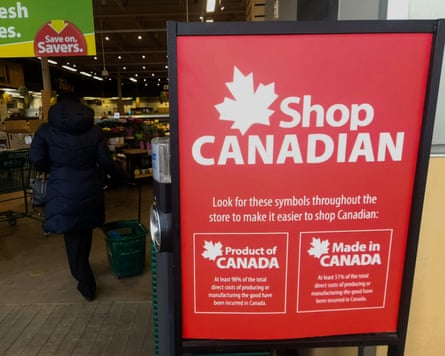
This week the US imposed 50% tariffs on US$20bn (£15bn) of Canadian goods, and Mark Carney, the country’s prime minister, has vowed to match them “dollar for dollar” after the collapse of trade talks between the two countries last weekend. Donald Trump retaliated on Thursday by ordering the federal government to rename Lake Ontario to Lake America.
Such actions have added fuel to a widespread boycott of US products and services by Canadians that began early last year in response to the president’s trade war and threats to annex his northern neighbour.
More than 3,500 people from across Canada shared with the Guardian via an online callout how they have made changes to their lives in response to the US administration’s political and economic stance. Many expressed deep anger and sadness, but remained resolute that this was now a new way of living.
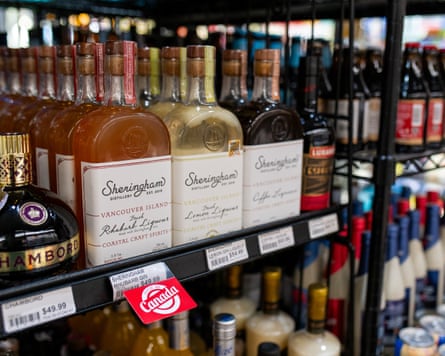
Buying only Canadian groceries, including fresh produce, and boycotting travel south of the border featured heavily among the responses. Respondents have stopped paying for US technology; streaming services provided by Netflix, AmazonPrime, AppleTV and Disney+; petrol; vehicles such as Teslas; and whiskies including Jack Daniel’s. Social media sites including X, Facebook and Instagram were also being avoided.
In July, an Angus Reid survey found 40% of grocery shoppers were actively checking where products came from, and most of those avoiding US products where possible.
The ABUS (Anything but US) or ABUSA (Anywhere but USA) acronyms and “Elbows Up!” slogan – a hockey term for offering a stiff defence – began appearing in Canada last year.
“I think you need to be in Canada to understand how deep the animosity to the US is … even across the political spectrum,” said Denise from Winnipeg, Manitoba.
“‘Elbows up’ is a real thing. We don’t fly US airlines, we stay in locally owned hotels, we won’t even connect in a US airport … we’ve moved investments to Canadian companies, and we actively avoid USA products, produce and groceries. It can be pretty inconvenient to do the research and read signs and labels, and often more costly, but BDS [boycott, divestment, sanction] is the only tool ordinary people have to stand up for our values.”

Elizabeth Lorenz, 68, a retired teacher who lives in Nanaimo, British Columbia, said she would change a recipe to work around a lack of certain ingredients.
“I read labels on packaged food, and if it’s made in the US, I don’t buy it,” she said. “Annie’s Pasta is an example of a product I no longer purchase.
“Grocery stores are increasingly offering more produce from Mexico, Peru, Guatemala, Chile and South Africa. Although this means the transportation of this produce has contributed to more environmental degradation than if I were to buy American produce, my outrage at America’s greed and corruption trumps (apologies for the pun) my environmental concerns.”
She has planted yams and sweet potatoes in her garden “since only American-grown yams and sweet potatoes are available”, she said.
Jane, 54, a teacher, was one of many who believed the relationship between the US and Canada had been badly damaged, perhaps beyond repair.
“I definitely will not support America economically while this administration is in power and, to be honest, I may not ever again,” she said.
“The relationship, in my eyes, has been permanently tarnished.”
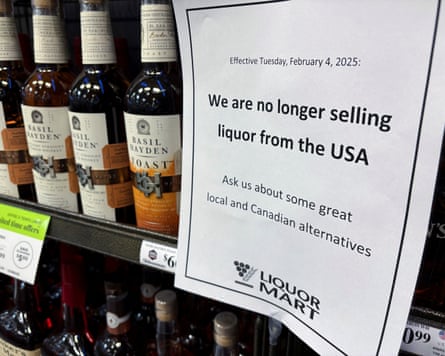
Jane has been buying only Canadian groceries and alcohol for more than a year and has also stopped travelling to the US, opting for a longer journey to see sports in Canada.
“I have been vacationing in Mexico and the Dominican Republic and Europe instead,” said Jane, who lives in Camlachie, Ontario. “I used to go to Detroit for sporting events or concerts and would pick up gas and groceries before returning to Canada. For more than a year, I have been driving four hours to Toronto for those events that I normally would drive only an hour to in the US.”
She said at first making the changes to non-US goods was “quite challenging” but she uses apps and online forums which direct her to Canadian options.
Among the many US products Jane has replaced with Canadian equivalents are Heinz Tomato Ketchup, Kraft Cheese and Charmin toilet paper. She uses the apps CanMade – Canadian Made, Buy Beaver and O SCANada: Buy Canadian. She also uses the website madeinca.ca.
“Grocery shopping is now easier as stickers are used to indicate place of origin,” she said. “Checking origin of product information has become second nature to me now.”
after newsletter promotion

The same is true of James Buchan, 36, who works in IT, lives in Halifax, Nova Scotia and describes himself as “a habitual label reader”.
“All Procter & Gamble and Colgate products have been replaced by Attitude and Lavo products from Quebec,” he said.
“Canadian produce is quite easy to get hold of, and we can get food from Mexico, but ready-made meals are more difficult to find, as the US has it on lock. So making the change could be more difficult for some.”
He also did a clearout of his tech. “I sold all my Apple products: a year-old MacBook, iPhone, AirTags and AirPods, and replaced them with alternatives,” he said. “Tech was the easiest – I do not miss my iPhone or Mac at all.”
He switched his email providers to European-based ones and has done the same for his mapping applications, language-learning apps and calendar. He also left Facebook, Reddit, Instagram and WhatsApp.
Kurt, 61, a retired engineer who lives in Calgary, Alberta, said his whiskey-tasting group “spent a small fortune” annually on American whiskies – in the region of US$10,000.
“Since ‘Liberation Day’ and the first round of tariffs, we decided one way of expressing our distaste is not to buy American whiskies,” he said. “So since then we’ve spent US$0.00. Amazingly, we just stumbled on a whole new batch of Canadian equivalents. We didn’t realise the range and quality of stuff available locally. So we’ve got no intention of ever going back.”
He is also now a “vigorous” label checker, but added this was not always straightforward, citing the US company Kraft, which has a Canadian operation, employs Canadians, and “uses Canadian materials and ingredients when they can”.
“It actually pains me to buy a product that, yes, it’s made here in Canada, but we know their revenues are going back to the company in the States,” he said.
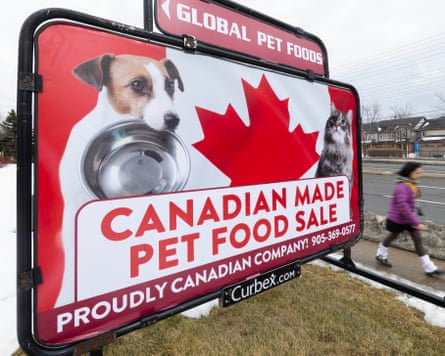
His wife also no longer drinks California wine, and despite being “frequent visitors for 30-plus years” to the US, Kurt said they have not been there since January 2025.
Many who got in touch with the Guardian felt that trust had been broken irrevocably with their US neighbour.
“I won’t go back to buying US products, even if the regime changes, because the US is unreliable and untrustworthy,” said Sarika, 61, an academic who lives in Vancouver.
“It’s a shame, as many of us in the border regions have friends across the border, and we don’t want to see their businesses and towns suffer, but perhaps Americans will now get a little more involved in voting for and enabling a more fair and just government and trade system.”
Vikram, 51, who works at a finance firm and lives in Toronto, said he refused to travel to the US even though he has family there. They visit him instead. He also avoids US products and is now boycotting Amazon.
He reflected the sentiment of many who found the turn of events lamentable.
“I find it quite sad that Canadians are forced to do this as a protest against these ridiculous threats to our sovereignty, but I’m not sure how else to react,” he said. “We cannot go back to looking at our relationship with the US as it was before, because things have changed. We need to shift focus for our own protection and to maintain our sovereignty and control over our economy.”
Kurt, however, sounded a quiet note of optimism.
“We’re going to look back, and we’re going to say, you know what, it was painful, and it was a shock, especially to have your best friend turn on you, but it was the best thing that could ever happen to us,” he said. “Canada will be stronger and healthier after all this is over.”
William also took some solace from how he feels things have changed in Canada.
“After years of internal division in our country, it’s nice to finally see something bind us together again,” he said. “I guess sometimes it just takes a mutual enemy to find one’s resolve.”
















Comments