
 German (DE)
  English (US)
  Spanish (ES)
  French (FR)
  Hindi (IN)
  Italian (IT)
  Russian (RU)
  3 weeks ago
With a president who has called climate change a “hoax”, refused to send a delegation to international climate talks, and packed the federal government with former fossil fuel industry employees, this can feel like a dark moment for climate action in the US. But shifting one’s focus to local and state law makes for a very different outlook.
Analysts have estimated that 75% of the commitments that the US made at the Paris climate agreement – which Donald Trump pulled the nation out of as soon as he took office – can be reached entirely without federal support.
It’s this conviction in the power of local governance that animates Climate Cabinet, an organization focused on supporting pro-climate candidates in under-the-radar races at the state or city level. Climate Cabinet uses data science to comb through the more than 500,000 public offices that US citizens have the opportunity to vote on every cycle, identifies candidates who could make a real impact on the climate, and offers them financial and policy support.
The organization was founded by Caroline Spears, who was inspired while working for one of the country’s largest solar companies. As an analyst, it was her job to look at all the markets in which her company wanted to build, and make sense of why they were able to make progress in some states and not others. She watched as the company built dozens of projects in Massachusetts and zero in the far sunnier state of Arizona.
“This was during Trump’s [first term] – so these two states had the same federal backdrop – but their ability to actually build clean energy was vastly different,” Spears said. “That was solely because of state and local policymaking in those two states.”
This realization convinced Spears that local policy was already playing a larger part in climate action than most people realized, and that it was time to better leverage that impact.

Since Spears founded Climate Cabinet in 2020, the organization has supported more than 500 candidates – running in everything from public school board races in Virginia to state house races in Minnesota – and recorded a roughly 75% win rate. In 2025, that rate was even higher: Climate Cabinet candidates won in 42 of 45 endorsed races, including in a Virginia district where a former climate advisor to the Biden administration won by less than 700 votes. Today, the Climate Cabinet estimates that its candidates have governing power over the emissions of more than 813 million metric tons of carbon dioxide equivalent per year.
“We are supporting people who are running for office in an exceptionally challenging time to be a public face and a public servant,” said Spears. “These are people who often have a track record of voting for climate and clean energy, and it’s an exceptionally brave thing to do at this time. Our job in this moment is to help them get that done.”
City council members fighting coal
For proof that this strategy can pack a punch, just take a look at the top 10 greenhouse gas emitters in the country. On that list you’ll find the Prairie State Energy Campus, a coal power plant in Illinois, which is owned jointly by nine public power authorities across eight midwestern states. One of those authorities is the town of Naperville, a suburb of Chicago, that got locked into a contract with Prairie State that will keep Naperville hooked on coal power until at least 2035.
Coal generation has dropped dramatically around the country over the past decade, in part because it’s increasingly cheaper to build out new renewable energy than to keep old, dirty coal plants running. Against that backdrop, the Illinois Municipal Electric Agency (IMEA), the body with which Naperville signed the Prairie State contract, set deadlines for the city to renew its contract this year, 10 years before the current contract is set to expire. That would keep Naperville dependent on coal through 2055 – which would mean emitting an additional 32m metric tons of greenhouse gasses, according to Naperville’s environment and sustainability taskforce.
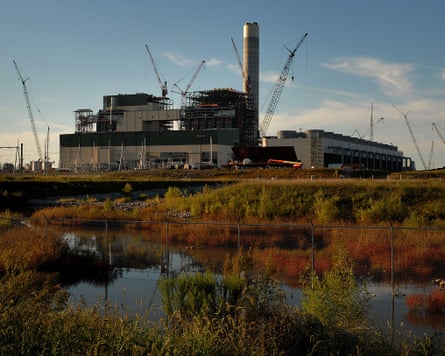
“A lot of people here understand the threat that our environment is under, and it’s shockingly out of line with our values as a community that we are such a major backer of coal,” said Ian Holzhauer, a city council member and longtime resident of Naperville who saw the 2025 deadlines set by IMEA as an attempt to pressure the city into an early renewal. (A representative for IMEA disputed the idea that the contract renewal was pushed early, said that the organization needs long lead times to secure future green energy, and said that it maintains “a diverse portfolio of solar, wind, hydro and coal”.) Realizing that the coal contract would be up for negotiation sometime in the 2020s is part of what convinced Holzhauer to run for city council. He won his first term in 2021, but he wouldn’t have a proper chance to shape the coal agreement unless he won re-election in spring 2025.
That’s when Climate Cabinet began to back him. The opposition was fierce – Holzhauer faced personal attack ads and mailers in the week leading up to the election, created by a group called Safe Suburbs USA that is funded in part by conservative billionaire Richard Uihlein. Uihlein has funneled his extraordinary wealth into far-right causes for more than a decade, spending at least $126,300,891 to support rightwing political causes like election denialism and anti-abortion measures in 2023 and 2024, according to non-partisan campaign finance watchdog group Open Secrets.
“What this does is cut off the back bench for future congressional candidates,” Holzhauer said. “Even in a blue state like Illinois, they’re killing off future potential progressive policymakers early in their careers.”
That rightwing strategy has succeeded in many races, but it didn’t work in this one. Though Climate Cabinet could never outspend the Uihlein dynasty, some combination of its early support of Holzhauer’s campaign and his own years of building a base in his community helped propel him to a second win, alongside three other Climate Cabinet-backed candidates who were willing to rethink Naperville’s power agreement.
Naperville is still locked into its initial contract through 2035. But where the previous city council had been ready to sign the agreement that would extend the coal contract for another 20 years, the current city council has pumped the brakes and is considering either non-renewal or renewal only if it’s paired with significant concessions toward clean energy.
“There has been so much focus on national politics in the last decade that people are missing really monumental decisions that are happening at the local level. The nine members of the Naperville city council have a major impact on one of the 10 largest greenhouse gas generators in the country,” said Holzhauer. “We’ve had two elections the last four years, and both of those elections were decided by under 60 votes.”
A commissioner who oversees 9m acres of state land
Climate Cabinet pays extra attention to smaller or more under-the-radar races for this very reason, and has backed everything from school committee elections to mayoral races. Sometimes, the contribution limit is remarkably small – think a maximum of $450 for a city council race in Colorado – while in other states, like Virginia, there’s technically no limit on the funds Climate Cabinet can donate.
after newsletter promotion
No matter what state Climate Cabinet focuses on though, a little money in these kinds of races goes a lot further than it would in the larger elections: In 2024, more than $5bn was poured into the US presidential race, while Congressional and Senate races together averaged $1.7m, according to Open Secrets. By contrast, the most expensive state or local races Climate Cabinet participates in draw in about $400,000 total, according to the chief operating officer, Emma Fisher.
“Most state and local races aren’t very expensive, which means that most people’s smaller contributions can make a meaningful difference to level the playing field with fossil fuel money,” Fisher said.
One race Spears and Fisher are following closely for 2026 is for the New Mexico land commissioner, a position that oversees 9m acres of state trust land and 13m acres of subsurface mineral rights. The revenue generated by the management of that land directly contributes to New Mexico’s public school funding, but at the moment, nearly 95% of that revenue comes from oil and gas, said Spears.
That’s one reason Climate Cabinet is supporting Juan de Jesus Sanchez for the position. A 13th-generation New Mexican, Sanchez grew up in a ranching family and was elected vice-chair of the Democratic party of New Mexico at just 24 years old. Since then, he’s worked for the US army corps of engineers as a natural resource specialist, spent five years advocating for the state’s traditional irrigation systems at the New Mexico acequia commission, and worked for Martin Heinrich, the US senator.
“What I’m trying to bring to the office is my conservation background,” Sanchez said in a phone call. “With the attacks on public lands that we’re seeing at the federal level, from the Trump administration going after Bureau of Land Management and Forest Service lands, we need a strong person who’s going to stand up and fight for the land. That’s my priority.”
Sanchez has not made any specific commitments in terms of phasing out fossil fuels entirely on state land, especially considering that that revenue is relied upon by New Mexico’s public schools. But he has expressed enthusiasm about the idea of expanding renewable energy, and said he wants to hold fossil fuel operators to the “highest standards” when it comes to cleaning up abandoned wells and the like. He also pledged to maintain the moratorium that the current land commissioner has placed on drilling near Chaco Canyon, in the headwaters of the Pecos River, and near schools.
“The revenue coming from renewables went up by six times since [current commissioner Stephanie Garcia Richard] has been in office, which I think is incredible, and there’s opportunity for that to continue to grow,” he said.
Though Sanchez believes that New Mexicans value protecting their land and want clean air and water, he thinks that many don’t realize the impact that a role like Land Commissioner can have on those priorities. “These are races that many people don’t know about, even here in New Mexico,” he said.
Many of the races that Climate Cabinet has identified are not well-publicized, or not publicized as races with the power to impact climate. In some cases, a candidate may be running on a platform that’s more focused on something else, like childcare costs or reproductive rights, but if elected, they would hold the key to climate action by helping flip a chamber.
“Just a handful of races determine chamber control,” Spears said. “And when chambers in Minnesota, Wisconsin and Virginia flipped, those chambers actually then passed 100% clean energy policies.”
And even though Climate Cabinet candidates lean overwhelmingly Democrat, given the current partisan split around climate issues, the organization decides who to endorse based on “votes, not vibes,” said Spears. That means they have supported a handful of Republican candidates over the years, when they’ve been convinced by the candidates’ voting records that they’ll support climate action once in office.
Though Climate Cabinet’s approach is focused specifically on climate, its focus on using local offices to advance action offers a blueprint for anyone looking for ways to make progress in a challenging political moment. Holzhauer, the city council member from Naperville, said he sees local government as a “lab” where leaders can try out policies that can sometimes go on to influence broader policy, citing two separate bans Naperville passed on assault weapons and puppy mills – both of which Illinois eventually decided to implement statewide.
“There’s a lot of creative people who are trying to make a real difference on things like climate policy at the local level and it really helps if residents are paying attention,” Holzhauer said. “And we actually have a functional government right now. We actually pass bills, we’re not shut down, and it’s not so gridlocked – so at a time where you’re not going to accomplish anything federally, you can still have huge wins on a local policy level.”









Comments