
 German (DE)
 English (US)
 Spanish (ES)
 French (FR)
 Hindi (IN)
 Italian (IT)
 Russian (RU)
 2 hours ago
For Kelsey Gellner, a Seattle-based pediatric nurse, a statewide proposal to bar trans girls from sports participation feels like a violation of her duty as a medical professional. The ballot initiative includes a requirement she calls “invasive and extreme”: all students who wish to compete on girls’ teams would have to undergo genital exams.
“I tell my kids and patients that my No 1 job is to keep them safe,” said Gellner, who is also a board member of the Washington State Nurses Association. “I can say with confidence that girls do not want to have an unnecessary exam that creates an unsafe barrier.”
As attacks on transgender rights have accelerated under the Trump administration, four states have placed measures on the November ballot to further erode those protections, with a focus on banning trans teens from participating in school sports. (Similar restrictions have already been implemented in 27 states.) Though LGBTQ+ groups have long fought against anti-trans policies, the proposal in Washington has drawn broad opposition from adults who work with queer and trans teens, including many healthcare providers, teachers and counselors.
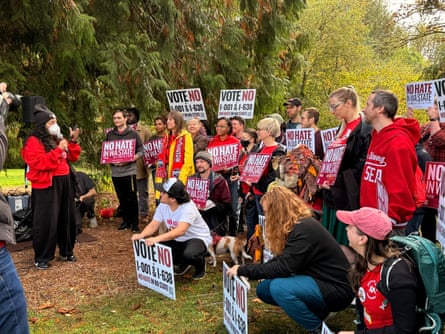
Over the past few weeks, as midterm election organizing has ramped up, Gellner and nurses across the state have campaigned against the initiative by speaking at press conferences, canvassing and door-knocking. They are among more than 140 healthcare providers who have issued a statement opposing Initiative 638, while unions like the Washington Education Association and the American Federation of Teachers are actively mobilizing members across the state, organizers said.
Washington’s ballot measure was introduced last year by Let’s Go Washington, a political action committee founded by the hedge fund manager Brian Heywood, a multimillionaire who has bankrolled many conservative initiatives. It’s widely considered to be the most restrictive of the four statewide measures, mandating that girls show proof of female anatomy through expensive genetic or hormone tests, or a genital exam. Boys are not required to undergo the same sex-verification process.
“The way the measure is written says that I, as a physician, cannot rely on a birth certificate,” said Libby Loft, a family doctor in Spokane. “I have to examine someone’s reproductive anatomy – that seems inappropriate to me for a sports physical.”
‘Making a villain out of trans girls’
The wave of measures targeting transgender youths’ participation in sports followed a supreme court decision in June that ruled such bans are constitutional. At the same time, dozens of hospitals have discontinued care for trans youth after Trump threatened to withhold federal funding. Yet the groups that such policies are supposedly targeting are often exceptionally small: the Washington Interscholastic Activities Association has said that it is aware of only about 10 student athletes who identify as transgender out of more than 200,000 in the state.
A sex-verification requirement adds another barrier for girls to participate in team sports, Loft said, when they are already twice as likely as boys to drop out by age 14.
“I don’t see this as a way to level the playing field for girls, and we’re making a villain out of trans girls who are children,” Loft said.
Let’s Go Washington and I638’s proponents have argued in the voter guide that the sex verification requirement is a standard procedure endorsed by the American Academy of Pediatrics – a claim the medical group has publicly rejected.
Gellner said a genital exam was wholly different from a sports physical, which is used to determine metrics like vision and heart health and, crucially, doesn’t require a student to remove her clothing. She added that any policy that puts girls through intrusive medical procedures “opens up a can of worms” given the horrific crimes of Larry Nassar, an ex-USA Gymnastics doctor who was convicted in 2023 of sexually abusing girls for decades.
“While I believe that a vast majority of people who enter the medical profession do it for the right reason, writing legislation that opens the door to predators is just not responsible,” Gellner said.
A ‘culture war issue to divide us’
Libby Watson, campaign manager for No Hate in Washington State, said organizers have spent the past year and a half building a broad coalition against two ballot measures they consider detrimental to LGBTQ+ rights: the one that targets trans sports athletes, and another that would expand parents’ rights to access public school records.
The No Hate campaign has amassed nearly 600 endorsers, including prominent Democratic politicians like the US senator Patty Murray and groups such as Planned Parenthood and the Washington State Nurses Association. The group is now ramping up its door-knocking, phone-banking and canvassing efforts, powered by more than 6,300 volunteers, Watson said.
Public awareness about the anti-trans sports measure had increased dramatically over the past couple of months, Watson said, as the No Hate campaign held up to four phone-banking sessions a week. Organizers also found that messaging around the unjustness of the policy – the fact that only girls would be affected – and the invasiveness of the genital exams resonated most with voters, she said.
“We have people power,” Watson said. “We have many people who haven’t been involved before but care enough about beating these initiatives so that Washington remains a safe state for queer young people.”
John Gallagher, a Seattle-based high school teacher and former cross-country coach, said the measure put coaches in an especially tough position because their priority is to support all athletes, no matter their gender identity.
“To me, this particular policy is incredibly exclusionary,” Gallagher said. “It’s a lot of effort to exclude a very small population of kids who are just trying to be themselves.”
Despite being heavily out-funded by Let’s Go Washington, Watson said she was optimistic that the No Hate coalition is building up more than enough momentum to mobilize voters and defeat the two measures at the polls.
“These are culture-war wedge issues to divide and conquer us,” she said. “The cost of housing, gas prices – these are the real issues people are facing and want to see addressed.”
Advocates say the state’s school-records proposal also could disproportionately hurt LGBTQ+ youth. The measure would prevent school counselors from providing a safe space for students to disclose bullying, substance use or struggles with their physical or mental health. As LGBTQ+ youth are more likely to experience homelessness, domestic violence and suicidal ideation, Jaime Fineman-McKinney, a school counselor in Tacoma, said many may not feel safe at home and need protection from their parents.
“If they’re coming to me as a trusted person and I have to then out them, I just put them in a very unsafe situation,” she said.
Loft, the Spokane-based family doctor, said it did not surprise her that medical professionals have come out in droves to fight the two ballot proposals.
“We all have the goal of helping our kids live healthy lives,” she said.


















Comments