
 German (DE)
  English (US)
  Spanish (ES)
  French (FR)
  Hindi (IN)
  Italian (IT)
  Russian (RU)
  3 weeks ago
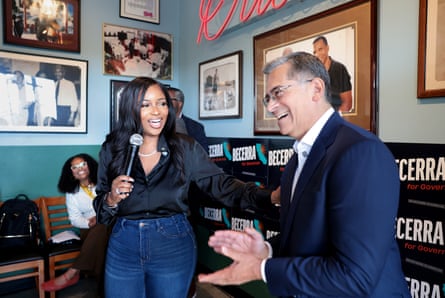
Xavier Becerra arrived at Dulan’s on Crenshaw grinning like a man who couldn’t believe his luck. Joining him at the south Los Angeles soul food restaurant on a Tuesday morning in the final stretch of California’s volatile race for governor was Jasmine Crockett, the firebrand Texas Democrat, who had flown in to endorse his campaign.
“We had to go search for one of the best fighters in the world,” Becerra said of Crockett, as he addressed a crowd of Black community leaders and union workers gathered for a buffet breakfast, “and make sure she could come in and inspire us.”
Supporters pressed closer, leaning over plates of eggs and grits with their phones raise, to record the congresswoman, as she urged Californians to choose “credentials” over “gimmicks” in the contest to replace the term-limited Gavin Newsom.
There were murmurs of agreement, followed by loud cheering when Rex Richardson, the mayor of Long Beach, predicted that California was on the verge of the “Becerra era”.
“I think the voters are waking up,” he said.
For Democrats tuning in around the US, the race to lead the most populous state in the country, the home of Hollywood and Silicon Valley, and the world’s fourth-largest economy, has been, simply put, uninspiring. California is, after all, a state that has elected actual movie stars to the governor’s mansion – most recently Arnold Schwarzenegger – but this year’s campaign has lacked main-character energy. It’s felt like watching a “minor league baseball game when you thought you had a ticket to the World Series”, one national strategist quipped.
How did Democrats get here? A Kamala Harris-sized hole in the field, top party figures passing on a run, and allegations of sexual abuse all converged in what has been a somewhat head-scratching, unusually helter-skelter but undoubtedly high-stakes battle for the governorship.
Beneath the drama are the more fundamental questions Democrats have yet to answer, said Mike Madrid, a former political director of the California Republican party who is now a prominent anti-Trump commentator.
“The Democratic party is really struggling to figure out who it is and what it is,” Madrid said. “In the Trump era, especially in a state as blue as California, the tip of the resistance, the party has defined itself almost entirely on what it is against and not what it’s for. And now that it’s got this choice to make, it doesn’t know what to do.”
Until recently, few would have predicted that, with days left before the 2 June primary, Becerra stands a chance to advance to the November general election.
Just weeks ago, he was stuck at 3% in the polls, one of the more than half-dozen Democrats being urged to drop out and make room for a more viable contender. Becerra, like most of his Democratic rivals, ignored those calls.
Now, as ballots trickle in, he is locked in a fierce three-way contest with billionaire investor turned liberal mega-donor Tom Steyer, the top choice of progressives, and British-born Fox News personality Steve Hilton, a Republican endorsed by Donald Trump. Under California’s quirky primary system, the top two vote-getters advance, regardless of party.
“There’s simply no precedent in modern California political history for a field this big or this amorphous,” said Dan Schnur, who teaches political communications at the University of Southern California, the University of California, Berkeley and Pepperdine.
Political fortunes could still change, again. Many Democrats are holding onto their ballots in hopes that the field will settle, as the attack ads fly. Steyer, Becerra argues, is trying to “buy his way” into the governor’s mansion while making progressive policy promises he simply cannot keep. Steyer, meanwhile, accuses Becerra of being a “career politician” whose experience is riddled with management failures and policy inconsistencies.
“This race isn’t over,” said Rusty Hicks, chair of the state Democratic party, acknowledging the “twists and turns” of a primary election he described as “in many ways, crazy”.
When the contest first kicked off, Joe Biden was president and Dianne Feinstein, the late California senator, was still serving in Washington.
Then Donald Trump defeated Kamala Harris, and her return to California raised hopes that she might run to lead her home state. She formally ruled out the possibility last July.
Democrats scrambled for an alternative, seeking to recruit the US senator Alex Padilla, who declined. Attorney general Rob Bonta also passed. The field grew, but no one with Harris’s profile ever jumped in.
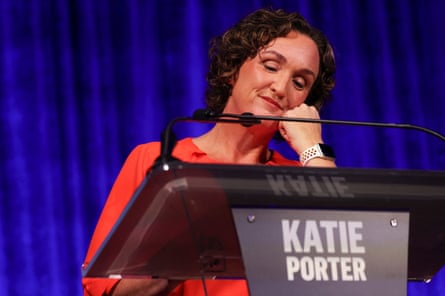
Left was a roster of Democrats with résumés but little star power. In addition to Becerra and Steyer, it included: the congressman Eric Swalwell; the former congresswoman Katie Porter; the San Jose mayor, Matt Mahan, the former Los Angeles mayor Antonio Villaraigosa; the former state controller Betty Yee; the state superintendent of public instruction Tony Thurmond – and more still, none with more than 20% of the electorate’s support. Earlier this year, panic began to set in.
Surveys consistently showed two Republicans, Hilton and Riverside county sheriff Chad Bianco, leading the race, raising the possibility, remote as it always was, that Democrats might be locked out entirely of the general election in November.
“We do have to just make sure that we don’t shoot ourselves in the foot, so to speak,” Ken Martin, chair of the Democratic National Committee, said in February, on the sidelines of the state party convention in San Francisco, where delegates deadlocked over an endorsement.
As pressure to consolidate the field intensified, Swalwell began to rack up endorsements and edge ahead – until several women came forward with shocking accusations, alleging sexual misconduct and assault. Swallwell denied the allegations, but ended his campaign and resigned from Congress.
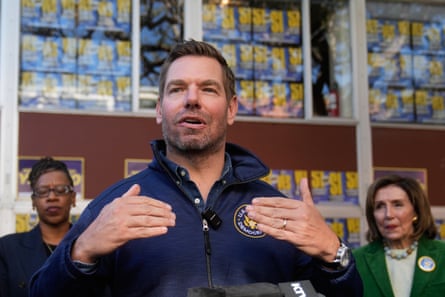
As Swalwell imploded, the race fractured, again. Steyer began to scoop up progressive support: the Bernie Sanders-aligned Our Revolution and even a tepid recommendation from the Democratic Socialists of America. Hilton, with Trump’s backing, has rallied Republicans behind his appeal for “some fresh thinking after 16 years of one-party rule”.
“I had a fever dream that in California, socialists were supporting a billionaire and Maga was supporting an immigrant,” Jodi Hicks, CEO of Planned Parenthood Affiliates of California, which has endorsed Becerra, wrote in a widely shared X post.
The Golden state has long functioned as a kind of vanguard for liberal governance: a place that embraces progressive taxation, climate action, immigrant protections and LGBTQ+ rights alongside a culture of celebrity and innovation. But an affordability crisis, the sky-high cost of housing, a hostile federal government and worsening natural disasters have infused the race with a more existential question: is the California dream broken?
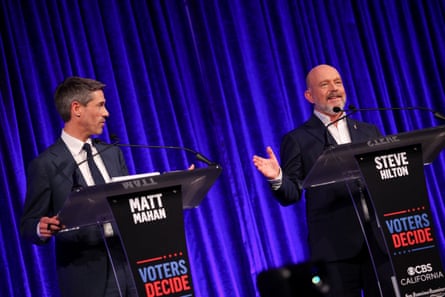
In the tumult, amid the Democratic candidates’ competing answers to that question, Republicans have sensed an opening. California can be “golden again”, Hilton says in one of his ads, urging voters to turn the page on “years of Democrat failure”. Images of Newsom, Harris and the mayor of Los Angeles, Democrat Karen Bass, flash across the screen.
In Los Angeles, former reality TV villain Spencer Pratt, a Republican who lost his home in the Palisades fire last year, is attempting to unseat Bass by tapping into the furious anti-establishment current that propelled Trump to the White House and Zohran Mamdani to the New York City mayor’s office. Most observers believe Pratt remains a longshot, but his sudden contention, they say, reflects deep discontent with the current state of affairs.
“California suffers from the same problems as the rest of the country, only more so, because of its size and its dynamism,” said Miriam Pawel, a journalist and author who has written extensively about the state’s politics, history and culture.
If 2025 was any indication, Californians are unlikely to see electing Republican leaders – particularly ones Trump finds agreeable – as the solution. In November, voters overwhelmingly passed Prop 50, which asked residents to redraw the state’s congressional map to advantage Democrats in response to a Trump-sought gerrymander in Texas. Democrats enter this year’s midterm elections with considerable strength, according to recent polling, even as they remain deeply frustrated with their party and divided over its path forward.
Voters don’t want business as usual, argued Lorena Gonzalez, president of the powerful California Federation of Labor Unions, which issued a multi-candidate endorsement of Steyer, Porter and Villaraigosa.
“If we don’t take on the current economic system, we are going to continue to see wealth inequality [grow] in ways that are just astounding,” Gonzalez said.
“We have to do it in California,” she added, “so the rest of the nation can see that it’s possible.”
At a Steyer event in east Los Angeles, Ruby Ortega, a 50-year-old veteran who now works as a healthcare aide, said she was struggling to pay rent and put gas in her car.
“Things need to change,” she said. “I’m tired of it. How are we supposed to live like this?”
Ortega, who wore a cross around her neck, said she remained undecided. She liked Steyer’s plan to make the wealthy pay more, but was also drawn to Becerra’s record of taking on the Trump administration as attorney general – yes, she’d heard about the 122 lawsuits he filed against the federal government in Trump’s first term.
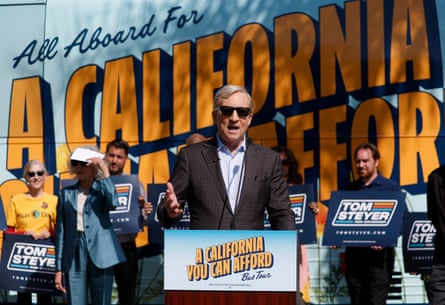
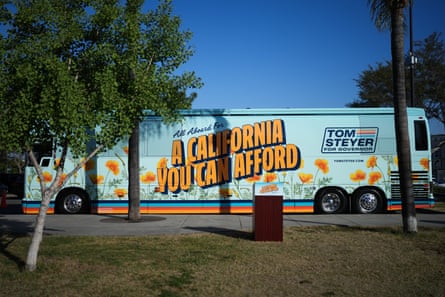
Steyer’s supporters say this moment calls for the kind of progressive platform he has embraced, zipping across the state on his “A California you can afford” bus tour. Casting his wealth as an assurance that he “can’t be bought”, Steyer has spent more than $190m of his personal fortune on his campaign so far, much of it to blanket the airwaves with commercials.
“We don’t have the luxury of returning to the status quo,” said Betty Yee, the former state controller, who suspended her campaign for governor and endorsed Steyer.
Over the course of more than a dozen, often unwieldy, debates and forums, the Democrats all mostly agreed that big changes were needed in Sacramento – and Washington. And with Newsom already looking ahead to the 2028 presidential race, many believe it will be up to his successor to deliver them.
“If the next governor doesn’t challenge the status quo in Sacramento to deliver dramatically better outcomes, we are going to lose the trust of the electorate and end up with a Republican governor in eight years,” Mahan, the San Jose mayor, said during an interview at a coffee shop in West Hollywood. “Maybe four.”
Mahan is offering a centrist approach he says has worked to reduce homelessness and increase affordable housing in San Jose, which, he proudly remind voters, is the largest city in Silicon Valley and the third-largest in the state. Despite a burst of early support from tech leaders and businessmen, like Google co-founder Sergey Brin and billionaire real estate developer Rick Caruso, Mahan has struggled to break out. But he continues to make his case, arguing that he is the best Democratic alternative for voters still still in search of “someone who will be a fixer of our problems here in California”.
In an unusual move, plenty of California Democrats are waiting to return their ballots, holding out for more clarity – and more polling – before they vote. It’s a strategy born of caution, said Greg Bergantz, a leader with the group Indivisible El Dorado.
“I want everyone to vote,” he said, but he hoped Democrats would be strategic about it. Though the chances of both Republican candidates advancing had all-but evaporated, Bergantz said he preferred to wait for the final batch of “gold-standard” polls to be released before he makes a final decision.
“Things are in topsy-turvy right now,” he said. “And we don’t want to do anything that’s going to make Trump happy.”
While many feel the race has failed to inspire, some observers have argued the campaign is more a return to the norm for a state that has also embraced technocrats and workhorses.
“I think Californians want a governor whose name they don’t remember,” Madrid said.
It’s one explanation for Becerra’s unlikely ascent. An experienced Democrat with a compelling biography, he is, by his own admission, “not the slickest” candidate to ever run for public office.
Garry South, who helped elect Gray Davis in the state’s last truly competitive Democratic primary for governor in 1998, said California voters often reach for the steady choice.
“When people are considering who they want to be governor of the biggest state, there is a certain amount of pragmatism that sets in,” he said.
South saw echoes of the 1998 campaign, recalling that Davis was a politician whose first name, some joked, matched his personality. Yet he surprised the pundits and won. “Boring and dull are in,” Davis spokesperson Michael Bustamante told the Washington Post in 1999. “Just look at Gray Davis.”
Bustamante is now working for Becerra’s campaign, and was on hand Tuesday for the breakfast at Dulan’s, where Crockett, the Texas congresswoman, argued passionately that the governor’s race was bigger than California.
“I remember a presidential election where people wanted to talk about everything but qualifications,” she said. “And now our democracy hangs by a thread.”















Comments