
 German (DE)
  English (US)
  Spanish (ES)
  French (FR)
  Hindi (IN)
  Italian (IT)
  Russian (RU)
  2 weeks ago
The family of Kristen Galvan, a 15-year-old Houston girl who was sex trafficked and murdered, says law enforcement failed her twice by not protecting her after she gave forensic interviews about her traffickers, and later by taking more than six years to identify her remains.
The Texas attorney general’s office announced on 28 July that Kristen’s remains had been positively identified using advanced DNA testing conducted over the past year. Parts of her skull, clothing and an earring were found beneath a bridge beside a jogging trail in Missouri City, about 10 miles outside Houston.
The remains were recovered by law enforcement on 29 January 2020 about three weeks after she disappeared.
Kristen was bound with duct tape, beaten and stabbed to death, said Robyn Cory, her mother. The rest of her body has never been recovered. An investigation into her homicide is ongoing, the Texas attorney general’s office has said.
The Guardian reported in January that Kristen’s death was first confirmed to her family through mitochondrial DNA extracted from one of her molars, with testing verifying a mother-child relationship with Cory.
Kristen’s case generated significant media attention and has been featured in several television documentaries about missing people.
Kristen, who was also known by her nickname “Kiki”, was an honor-roll student who dreamed of joining the military. Her life changed in 2019 when she was groomed by a sex-trafficking gang through a boy acting as a scout at her school. Before long, gang members began contacting her on Instagram, showering her with compliments and invitations to parties as they worked to groom her.
On 1 November 2019, she was lured away from home by the gang, who sex trafficked her to buyers over social media and forced her to walk Houston’s red-light district. Nine days later, police found her there and brought her back to her family. She arrived home deeply traumatized and fearful her traffickers would harm her or her family unless she went back to them.
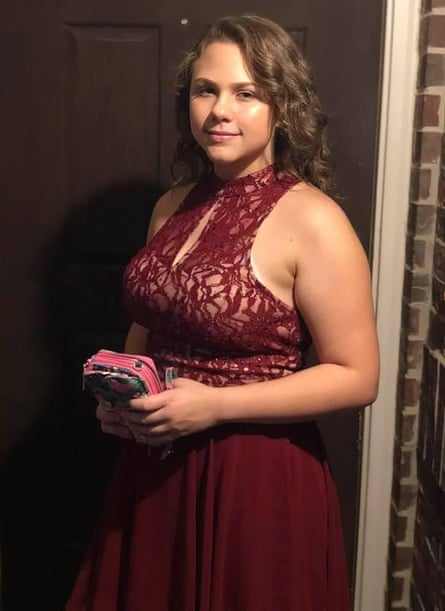
“Kristen screamed at me, ‘They’re going to kill you. They have pictures of you all. They’re going to kill my brothers.’ I didn’t realise the hold they had over my child,” Cory said.
At that time, Kristen also gave written statements that provided evidence that helped convict three men who trafficked her, and her phone was taken into custody.
But Houston police did not offer the family witness protection, Cory said. She believes this could have saved her daughter’s life. The Guardian has viewed an email sent by her family to Houston police on 27 November 2019, seeking an update on the arrest of her trafficker, which said that Kristen was very concerned for her safety, as well as the safety of her family.
“Two months before my baby was murdered, we were pleading with them for help,” Cory said. “We knew we were in danger. This could have all been prevented if she had been given protection after she gave evidence against her traffickers.”
Two law enforcement officials not involved in the case, who spoke to the Guardian, said providing witness protection to trafficking victims – particularly those whose traffickers have gang affiliations – is widely considered best practice.
“If Kristen’s case had been taken seriously as an endangered trafficking victim rather than just a runaway, her life could have been spared,” said Betty Simons, a private investigator who worked on Kristen’s missing persons case for six years. “It didn’t need to end this way.”
The Houston police department and the US attorney’s office for the southern district of Texas, which prosecuted Kristen’s trafficker Aryion Jackson, did not respond to requests for comment from the Guardian.
As a precaution, her family relocated Kristen to her grandparents’ home in Spring, in Montgomery county, Texas. Kristen went missing again in early January 2020 and was never seen again.
Cory and Simons say Kristen’s disappearance was not treated with sufficient urgency by the Montgomery county sheriff’s office. The family requested an Amber alert – an emergency notification issued to the public when authorities believe a child is believed to be missing and in danger – but the request was denied.
“I begged for an Amber alert, but law enforcement mislabelled her as a runaway. They don’t look for runaways,” Cory said.
Cory also requested that investigators ping Kristen’s phone to try to determine its location in the days following her disappearance. She said that request was also denied.
Montgomery county sheriff’s office, which led the missing-person investigation, did not respond to requests for comment about its efforts to locate Kristen after she went missing. The sheriff’s office said in a press release that it assigned Kristen’s case to a human trafficking unit on 16 July 2020, which is two weeks after she went missing and seven days after she is believed to have been murdered.
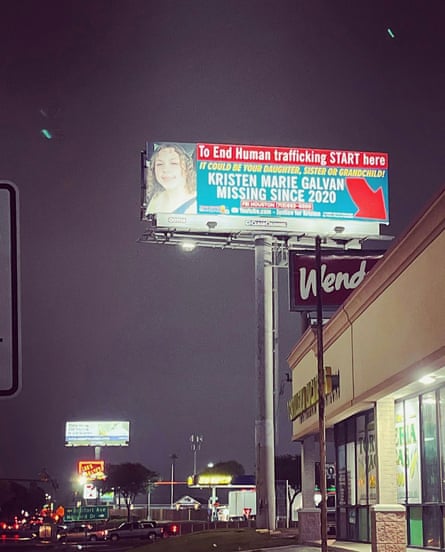
Despite Kristen’s remains being found three weeks after her disappearance in Missouri City, investigators said they were unable to identify them using conventional DNA testing.
“Missouri City police department attempted to identify the remains, but their condition prevented the development of an STR [short tandem repeat] profile, making advanced DNA testing necessary,” said the Texas attorney general’s office in a statement.
Last week, Cory and Simons met with the medical examiner on Kristen’s case, who said that DNA testing could have been conducted when her remains were first found, which contradicts the statement from the attorney general’s office, they said. The Texas attorney general’s office and Missouri City police department did not respond to a request for comment.
Additionally, Cory said investigators told her in 2025 that no soft tissue sample had been collected before her daughter’s remains were chemically processed, with the “flesh scrubbed off them”, for a forensic facial reconstruction sketch artist. She says investigators told her that extracting DNA after that process became significantly more difficult.
“How do you find a deceased missing child in your city and not properly sample DNA? She should have been identified years ago, in my opinion,” said Cory.
The Missouri City police department did not respond to questions.
In 2021, a profile of an unidentified Jane Doe was listed on the Department of Justice’s National Missing and Unidentified Persons System (NamUs), a database of missing, unidentified and unclaimed individuals. It estimated the victim to be between 12 and 18, of Hispanic and American Indian heritage, which Kristen has from both lineages.
Cory said the case file included a forensic facial sketch that bore a striking resemblance to Kristen. She says her requests to detectives with the Montgomery county sheriff’s office and the FBI to investigate whether the Jane Doe was her daughter weren’t acted upon.
In a 29 July press release, the Montgomery county sheriff’s office said it only received a tip that the Jane Doe might be Kristen on 8 July 2025.
Yet, the Guardian has viewed text messages between Cory and law enforcement from 2022 in which she asked investigators to examine the Jane Doe profile. Cory also first mentioned the profile to the Guardian in an interview in 2024.
“I had saved the Jane Doe profile because I always found myself awake at 4am, going back and just staring at the sketch,” Cory said. “I kept asking but they would never test her.”
The Montgomery county sheriff’s office did not respond to questions about the discrepancy in the timeline.
Cory said the breakthrough came in early 2025 after the Montgomery county sheriff’s office cold case division took over the investigation and acted on her request to investigate the Jane Doe profile. The detective then located the Jane Doe’s remains at the attorney general’s Office, which had held them since 2022.
Cory said she was very grateful for the investigative work detectives at the cold case unit Montgomery county sheriff’s office, Missouri City police department and the attorney general’s office have done over the past two years. But she says she still has unanswered questions about what efforts were made during the first four years after her daughter disappeared by law enforcement officers previously working her daughter’s case.
“Nobody listened until the cold case detective did in March 2025,” said Cory. “The new detectives on the case have moved mountains.”
During her five-year search for Kristen, Cory helped recover and rescue other trafficked girls. She also advocated for safety improvements along Houston’s Bissonnet Street, an area long associated with trafficked sex workers. Her work contributed to the installation of barriers designed to disrupt trafficking activity.
“The Galvan family’s unwavering commitment to seeking answers not only ensured Kristen was never forgotten but also inspired advocacy that continues to benefit vulnerable children, victims and families throughout the Houston community,” the National Center for Missing & Exploited Children said in a statement.
Last week, Cory was permitted to spend time with her daughter’s remains at a medical examiner’s office. They were placed in a small square cardboard box with a lid and set on a desk in front of her. The box was labeled only with Kristen’s case number. Cory used a pen to write her full name, Kristen Marie Galvan, on the box and draw hearts, to give Kristen her name back, she said. She placed a bouquet of flowers on top.
“After all these years, I felt like I needed to be near her,” she said. “I carried the box. It was so light, but I could feel her with me.”
Cory is now planning a memorial at the site where her daughter’s partial remains were discovered in Missouri City. It will feature a cross illuminated with lights, she said, because “Kristen was scared of the dark”.


















Comments