
 German (DE)
  English (US)
  Spanish (ES)
  French (FR)
  Hindi (IN)
  Italian (IT)
  Russian (RU)
  3 weeks ago
It was the kind of cold, damp morning that makes it hard to get out of bed, much less get a child out the door. The sun had not even risen when five-year-old Thomas Cooper and his mother, Annie Cooper, arrived for an appointment on 31 January at the Oxford Center in Troy, a northern suburb of Detroit, Michigan.
Thomas was an exuberant child with a button nose and pinchable cheeks – a little kid who loved running fast, playing Minecraft and watching Charlie and the Chocolate Factory, according to a GoFundMe set up by his family. He had just received money in a special red envelope for lunar new year, and he planned to spend it later that day with his little brother. But first, he was going to receive hyperbaric oxygen therapy for his attention deficit hyperactivity disorder and sleep apnea.
That morning, Thomas got into a tubular metal and clear plastic chamber, which was sealed, pressurized and filled with 100% oxygen. Then, according to an expert who viewed video of the incident, Thomas squirmed enough to pull the sheet off the mattress, causing a spark of static electricity. In the oxygen-rich environment, that spark became a flash fire that incinerated Thomas within seconds. Annie, desperately trying to open the tank, got badly burned on her arms and chest. When firefighters arrived just before 8am, all they could do was put out the flames.
Hyperbaric oxygen therapy (HBOT) – breathing concentrated oxygen in a highly pressurized enclosure – is prescribed by doctors for a handful of conditions such as severe burns, non-healing wounds or radiation injury. When it is provided by trained and licensed physicians and nurses in medical facilities using equipment that meets FDA regulations and is properly maintained, it is safe and effective.
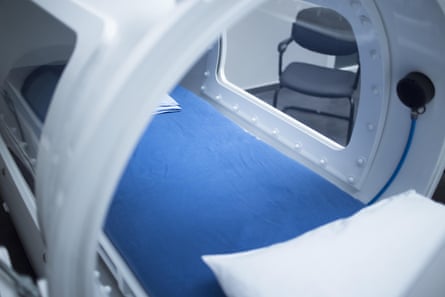
But hyperbaric physicians and experts told the Guardian that HBOT is increasingly being made available in wellness businesses, provided by people without medical degrees or sufficient training, including chiropractors, physical therapists and alternative medicine practitioners. Without evidence, these businesses often promote HBOT as a cure-all for everything from Alzheimer’s to ADHD to wrinkles. The website for the Oxford Center, where Thomas received HBOT, marketed it for 108 conditions including sleep apnea and ADHD – many more than the 13 approved by the FDA.
“It’s absolute anarchy and chaos,” said John S Peters, a healthcare executive and the executive director of the professional organization Undersea and Hyperbaric Medical Society (UHMS), which runs the US hyperbaric oxygen facility accreditation program. (The American Medical Association recommends that all states require HBOT facilities be UHMS accredited, though none currently do.)
Experts including Peters say that fires like the one that killed Thomas are rare. UHMS estimates that seven people have died since 2009 due to fire, suffocation or other adverse events in HBOT chambers. But they expect to see a further rise in deaths, as well as injuries, as HBOT spreads across med spas, wellness centers, private homes and other non-medical settings; you could think of it almost as if massage parlors were giving out antidepressants that also might explode. Peters believes unsafe HBOT chambers may now number in the tens of thousands in the US. Meanwhile, Maha influencers are glomming on to HBOT. And so are celebrities: Justin Bieber put chambers around his home and recording studio for his anxiety. Mayim Bialik and LeBron James swear by it.
The Michigan attorney general alleges that on the day Thomas died, the Oxford Center did not have a physician or safety coordinator on the premises, and the HBOT technician was not properly trained. The chamber had not received maintenance checks and was likely too old to be safely used, the attorney general claims, and Thomas himself allegedly did not receive a safety check before getting into the chamber. Nor was he fitted with a grounding strap, a device that would have likely prevented the fire.
“In the Michigan incident there was no physician oversight when they oriented the parents. There was no mention of risks and benefits and consent … the risk is death,” Peters said. “It’s a total failure.”
The Oxford Center owner and CEO, Dr Tamela Peterson (her doctorate is in education), as well as the center’s safety manager and management assistant have been charged with second-degree murder, while the operator of the chamber was charged with involuntary manslaughter. All four have pleaded not guilty. The Oxford branch where Thomas died is permanently closed, and the trial judge is allowing Peterson to sell the company’s second location.
The Cooper family has filed a civil suit for $100m in damages against Peterson and the other employees who were charged, as well as the Oxford Center and the manufacturer of the chamber, Sechrist Industries. The Oxford Center and Peterson denied the family’s allegations of gross negligence, breach of warranty and failure to warn of risk of injury in an answer to the suit. In a hearing on 1 December, the safety director for Sechrist Industries testified that using a grounding strap, which the Oxford Center allegedly neglected to do, is required by the chamber’s operating manual.
Sechrist Industries and the Oxford Center could not be reached for comment. Peterson’s lawyer declined to comment, citing the ongoing criminal case.
“That shouldn’t ever happen,” said Dr Thomas Masters, undersea and hyperbaric medicine medical director at Hennepin county medical center in Minneapolis, of the fire. “And as these things [non-medical providers of HBOT] proliferate around the country, I worry that it’ll be something that happens more and more often.”
Then, in July, it happened again: Walter Foxcroft, a physical therapist, was killed in a fire in his own chamber.
Enter the chamber
Say you have just had a mastectomy and it isn’t healing because of poor blood flow. Or perhaps you have diabetes and you have developed an ulcer on your foot that has not responded to other treatments. You might end up with a prescription from your doctor for hyperbaric oxygen therapy.
When your first appointment with an HBOT physician rolls around, you are instructed to arrive without any skincare products on, because those can be flammable. In the office the physician goes over the benefits and risks of HBOT, answers your questions and gets your informed consent for the treatment. A registered nurse – also with extensive training or board certification – takes your vital signs and monitors you closely throughout your appointment.
You remove your clothes and put on a special gown or scrubs designed to minimize static electricity. The outfit probably does not have pockets because you can’t bring electronics inside the chamber; that would be a fire risk. The nurse or chamber technician – who is also certified – does a safety check for hearing aids, a watch or anything else that could pose a fire risk.
The chamber looks like an adult-sized incubator, or a submarine, or Sleeping Beauty’s glass-domed bed. A TV might be set up just outside so that you can watch a show with all the phone-free time you’re about to have.
After you are helped into the chamber and fitted with a grounding device to prevent static electricity, the tech – who has completed a safety checklist on the chamber that day – seals you in and begins pumping in pure oxygen. As the pressure increases to an equivalent of being 45ft, or about 3.5 storeys, underwater, your ears might pop and you may feel a bit woozy or claustrophobic. But the real action is happening in your lungs and bloodstream: 100% oxygen, more concentrated than the 21% oxygen in the air we breathe, diffuses from your lungs into your blood, where it is carried not only by your red blood cells but also, due to the intense pressure, your plasma.
Packed with oxygen, this blood travels all through your body, encouraging the growth of fresh new capillaries and improving circulation and oxygenation of tissues, which is key for wound healing, infection control and the growth of healthy tissue. One or two hours pass before the chamber is depressurized and you can head home until your next appointment.
Now imagine instead that you have been struggling with anxiety and have had difficulty getting an appointment with a therapist, or you have lower back pain that will not go away. You drive by a shiny new medical spa that offers HBOT and promises it can treat your problem for $200 an hour. Bonus: it will also apparently make your skin look great. Plus, you’ve heard about it on a wellness podcast, and you know US health secretary Robert F Kennedy Jr recommends it. Joe Rogan loves it too, claiming it’s “phenomenal for everything”.

Dr Caesar A Anderson is the medical director at University of California San Diego’s hyperbaric medicine and wound healing center. In his work, he sees the therapy doing tremendous good, especially in helping people with diabetes avoid amputations. But he often has to educate people who show up in his office convinced that HBOT is a miracle cure for anything – including, say, cancer.
Anderson said this is often because people have come across online misinformation from influencers who promise that HBOT is practically the elixir of life. “When these patients show up to us, I think half the battle is understanding that your role as a physician is to do no harm and to always be a true patient advocate,” Anderson said. That means explaining what HBOT can, and cannot, do – therefore protecting people from unnecessary treatment while helping them find the care they do need.
Sold as a panacea
Sage Workinger-Brecka was ready to go to dinner. But her husband, Gary Brecka – a self-described biohacker, host of the Ultimate Human podcast and co-chair of the Maha Action Committee – was taking too long with his HBOT. According to a video posted by the couple in May, she walked into a large room in their home and pan the camera to a black hyperbaric chamber with Gary inside, peering out at her while on a video call. Annoyed, she told him: “You’re gonna have to do emergency,” referring to a rapid decompression button for emergencies. “Out you go.”
Dr Owen J O’Neill, the medical director at Westchester Hyperbaric Medicine and Wound Care and president of UHMS, emailed a to-the-point assessment of the video: “Chamber questionable, training questionable, cell phone in chamber against fire safety, definitely not accredited.”
This was a month after Brecka met up with Kennedy at a UFC fight and invited him over to do nutritional IVs and bro out over his HBOT setup – “a complete gamechanger for human performance, longevity, and recovery”, he called it.
The previous fall, Kennedy had claimed HBOT was being “suppressed” by the FDA. Dr Mehmet Oz, the former TV host and current head of the Centers for Medicaid and Medicare Services, promoted hyperbaric oxygen as long ago as 2009 as a “simple way to extend your lifespan”. (Oprah.com reported: “Dr Oz comes out of the chamber feeling more alert and jazzed up.”) The alternative medicine entrepreneur and Kennedy’s close friend Dr Mark Hyman said HBOT “support[s] a longer, more vibrant life”, and he promoted it on the podcast of Donald Trump’s nominee for surgeon general, Dr Casey Means.
It is easy to see why people imagine oxygen as a panacea. We need it to live, so intuitively, more must be better. But hyperbaric chambers are complex medical devices, and there are many ways that HBOT can go wrong in untrained hands. Notably absent from Maha-world testimonials is information about safety risks, FDA regulations or how to find a medical provider.
Anderson said that Thomas Cooper’s death is one tragic indication of the danger involved in wellness businesses and non-physicians pushing HBOT for just about anything. He pointed to a comment that the Oxford Center CEO, Peterson, reportedly made in private messages about promoting HBOT for erectile dysfunction: “Whatever gets bodies in those chambers, lol.”
“Just disgusting,” Anderson said. “It’s a spa mentality that is not necessarily geared towards the Hippocratic oath, right? It’s a money maker.”
“We are administering a drug just like any other,” Masters said. “It’s not a holistic wellness thing.”
Some experimental uses for HBOT, such as treating veterans with traumatic brain injury or people with long Covid, are being studied with the oversight of physicians. But many unregulated centers promise results that are unproven at best and invented at worst.
Hyperbaric physicians say that families trying to get help for their children are especially vulnerable to medical misinformation, sometimes putting kids in harm’s way.
On an evening in June 2011, in a family home in North Carolina, 19-year-old Jarred Sparks got into a soft-sided chamber, helped by his brother who turned on the oxygen and left the room. According to the family’s subsequent lawsuit against the chamber manufacturer, Sparks had autism, and his family had gone to Dr Jerry Kartzinel, a pediatrician who wrote a book with actor Jenny McCarthy spreading the myth that autism is caused by vaccination. Kartzinel allegedly told the family that doing HBOT would alleviate Sparks’s autism symptoms, so the family bought the chamber from OxyHealth.
Soft-sided chambers are like body bags that can be inflated with pressurized, concentrated oxygen; the FDA warns they pose a risk of fire and suffocation when used this way.
Later that night, Sparks’s mother found the bag partially collapsed around her son. According to an investigation, a valve had disconnected, cutting off air flow, and Sparks had suffocated. In September 2015, a judge dismissed the lawsuit against OxyHealth partly because the family did not use the bag according to the manufacturer’s instructions.
“There’s basically no evidence to support hyperbaric oxygen therapy as autism therapy,” said Dr Andy Shih, the chief science officer at Autism Speaks. And yet, misinformation about the therapy has been a problem for 20 years. For instance, businesses advertising HBOT for autism often show children happily relaxing in chambers with iPads – “a total fire hazard”, as one expert described it. “People keep marketing it. It really preys on the fears and the hopes of parents and caregivers,” Shih said.
Walter Foxcroft, a physical therapist who ran Havasu Health and Hyperbarics, was a beloved fixture of Lake Havasu in Arizona, where he dressed up as the wildcat mascot for games at University of Arizona, his alma mater. His center, which was not UHMS accredited, billed HBOT as a treatment for autism, as well as dementia and ageing.
According to a police report, just before 11pm on 9 July, Foxcroft’s wife went to find him at his work after he did not come home for dinner. She discovered him burnt to death in his chamber and called 911. Foxcroft had apparently been alone, and several electronics were found with him inside the chamber. The death was ruled accidental.
A spark away from catastrophe
HBOT is not a new technology. In 1861, the first hyperbaric chamber in the US was built in New York and eventually deployed to treat decompression sickness in workers excavating the Hudson River tunnels – a disorder it is still used to treat today.
In 1963, first lady Jackie Kennedy gave birth prematurely to a baby boy, Patrick. Because his lungs were not fully developed, he went into respiratory distress. Physicians, desperate to save the president’s baby, put Patrick into a hyperbaric chamber despite no evidence it would work, where he died 39 hours after his birth.
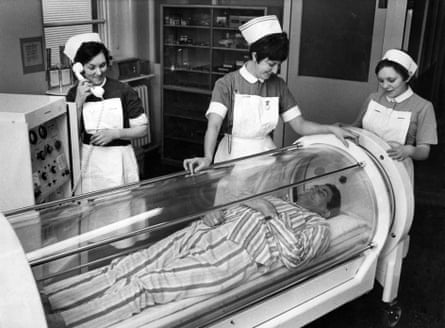
These days, HBOT is becoming a wellness status symbol. Kendall Jenner answers emails and watches Netflix from inside her own pricey chamber. Longevity and biohacking entrepreneur Bryan Johnson sings its praises – “This machine made me younger. (Insane results)” – to his nearly 2 million YouTube subscribers.
Endorsements like these have given HBOT an aspirational veneer as savvy self-care, like a facial or a cold plunge but more exclusive. That gloss can obscure some important facts, namely that HBOT is supposed to be available only by prescription and that not all HBOT is the same: many wellness businesses provide “mild hyperbaric oxygen therapy”, meaning the pressure is lower than effective, evidence-based treatment.
At Remedy Place, a “social wellness club” with locations in New York City, West Hollywood and Boston, you can indulge in one-hour HBOT for $190, which comes with the non-specific promise of “enhancing the performance of every internal system and accelerating your success”. Akshie Shah visited a Remedy Place in Manhattan for HBOT in November 2023. According to an ongoing lawsuit, she alleges that she woke up alone in the pitch black of a sealed chamber: her session time had elapsed and the machine had shut off, but no one had come to get her out. She said she struggled to breathe – if the air supply was indeed off, carbon dioxide would have been slowly filling the chamber – and that no one answered the call button. She started to panic, banging on the sides before someone let her out. Her lawsuit alleges Remedy Place offered two free HBOT sessions by way of apology.
Shah’s lawyer, Richard W Grohmann, told the Guardian that the industry is “crying out to be regulated”. Lawyers for Remedy Place denied the allegations, arguing in an answer to the complaint that Shah knew the risks and that any damages were the fault of parties Remedy Place was not responsible for. Remedy Place declined to comment to the Guardian.
Unscrupulous marketing from med spas and wellness businesses alarms Dr Sandra Wainwright, medical director of hyperbaric medicine at Yale New Haven Health’s Greenwich hospital. “‘Come to the spa. We’ll do cold plunge and infrared therapy and sauna, and then we’ll do some hyperbaric treatment. You’re going to feel amazing’. And I’m sure that they do feel amazing after all of that, and maybe there’s some benefit,” Wainwright said.
“But it just takes a little stress fracture in the side of the chamber that can explode it, or mishandling of oxygen or using the equipment not as recommended by the manufacturer, and that can be a catastrophic accident.”
Koby Grover, an EMT and former firefighter, has first-hand insight into how HBOT is provided in non-medical settings. He said he saw enough problems when he worked as an HBOT technician at Portland Chiropractic Neurology in Portland, Maine, that he feared for clients’ safety.
He was particularly worried about the soft-sided chambers used at the clinic: they often vacillated between very high and very low pressures, and patients reported feeling dizzy and nauseous. He said they were not properly maintained, causing dust buildup in the relief valves, and that because several of the compressors were not designed for use with those chambers, the oxygen tubing would fall out. Once, when a soft-sided chamber’s zipper broke, he claims the owner of the clinic had it repaired by a local seamstress, putting that chamber at high risk of rupture.
Grover, who is not a certified HBOT technician, said his training consisted of an orientation on the machines and an introductory course on HBOT over Zoom. In a text message, he described other concerns: he was responsible for monitoring not only the oxygen generation room and the purity of the oxygen, but also up to 10 chambers with people inside at once. “If the oxygen depleted in tank one without me swapping it, the patient would no longer have breathing air [through their mask]. Which was a concern to me given I had to be everywhere at once,” he said. (Sometimes chambers are pressurized with regular air and the concentrated oxygen is delivered via mask.)
He said the tiny oxygen generation room was also a potential hazard: “The combination of oxygen, heat and electrical components in such a tight space created a significant fire and explosion risk.”
Grover quit in April, after about three months on the job. He said he brought these concerns to management, to no avail.
Portland Chiropractic Neurology said in a statement: “The safety and comfort of our patients is our top priority. That’s why we have always followed all recommended safety protocols in connection with our hyperbaric program.” It added that it is expanding to be Maine’s first hyperbaric center “built and operated to hospital standard”.
Fighting for regulation
Tom Workman, a 75-year-old retired air force colonel, aerospace physiologist and certified hyperbaric technician, has amassed a mountain of evidence about unsafe HBOT, including a video of a soft-sided chamber explosion in India. The footage is disturbing in its sudden violence as the bag bursts and the occupant slowly emerges from the wreckage, dazed and unsteady. Workman said the man suffered gastrointestinal trauma. He calls soft-sided chambers “ziplocks”.
Workman was UHMS’s director of quality assurance and regulatory affairs, and he developed the organization’s accreditation program back in 2001. He is spending his retirement documenting facilities providing unsafe HBOT – he has a list of nearly 300 locations that concern him, in every state except Rhode Island – and sending his concerns to the FDA.
“It’s a cancer,” he said. “I can’t put it any stronger.”
Laws regulating med spas, health clubs and wellness businesses vary by state, but generally they are not overseen with the same thoroughness as healthcare – even when they purport to provide it, as with HBOT. Workman said the FDA should take an active oversight role with HBOT because it regulates medical devices (the chambers) and drugs (the concentrated, medical-grade oxygen). But it has not done much besides sending a strongly worded letter reminding HBOT providers of safety codes and issuing public safety warnings.
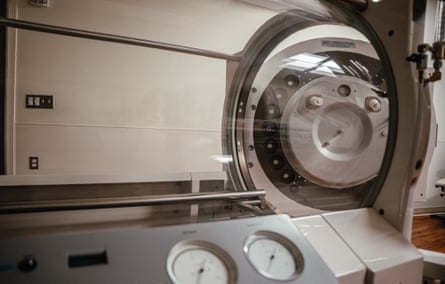
Workman said that FDA resources seem to be allocated to more high-profile problems, like kids vaping. Now that Kennedy, who has contended that HBOT is too regulated, is in charge, a crackdown seems even less likely, just as HBOT’s popularity explodes. While individual lawsuits can hold certain facilities accountable when incidents happen, they do not provide broad protection for consumers. According to Stateline, lawmakers in Thomas Cooper’s home state of Michigan want to mandate that facilities providing HBOT be UHMS accredited.
The FDA responded to a request for comment by pointing the Guardian to its August letter to HBOT providers and added that it decides when to conduct safety inspections based on multiple factors, including reporting from facilities and device manufacturers of adverse events.
Experts say anyone prescribed HBOT should choose a center accredited by UHMS to be assured of their safety. When in doubt, O’Neill, the hyperbaric physician from Westchester and UHMS president, has this advice:
“When you go to a hyperbaric facility to be treated, the first question you want to ask is: ‘Are you being evaluated by a medical doctor? Is the medical doctor going to be onsite while you’re treated? Is there an appointed safety coordinator that’s going to be onsite while you’re treated? Have the technologists who are running your treatment been appropriately trained and certified? Is the chamber hard shell?’”
“If none of those things are there,” he said, “run.”










Comments