
 German (DE)
  English (US)
  Spanish (ES)
  French (FR)
  Hindi (IN)
  Italian (IT)
  Russian (RU)
  3 weeks ago
When Rosaly Estévez “self-deported” from Miami to Havana last November, US immigration officers bid farewell by removing her ankle monitor. The 32-year-old had been told she was about to be detained, so she left with her three-year-old son, Dylan, a US citizen.
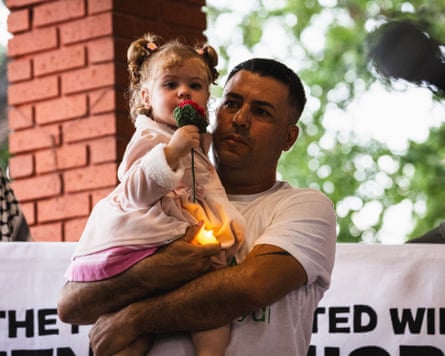
Heidy Sánchez, 43, wasn’t given a choice. She was forcibly removed from Florida last April but, worrying about Cuba’s failing healthcare system, she left her two-year-old daughter, Kaylin, behind with her American husband, Carlos.
“My little girl was still breastfeeding,” she said. “Waiting to get on the plane, my breasts were swollen, and I kept saying, ‘Kaylin must be hungry.’” Sánchez had struggled for years to conceive and Kaylin is her only child.
Neither woman has a criminal record, but both have been caught up in the US government’s push to deport Cuban immigrants. Now they each live in small towns south of the Cuban capital of Havana, passing their days talking to lawyers and family in the US.
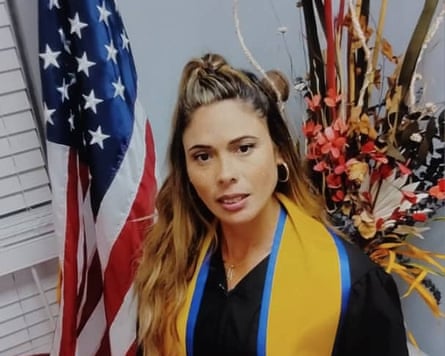
“It’s been brutal,” said Estévez. “Imagine Dylan hugging his phone every night when he sees his dad. I wouldn’t wish this on any mother.”
As the US government heaps pressure on Cuba, cutting off access to its oil shipments, Donald Trump has framed the campaign as an effort to make the island safe for Cuban Americans.
“A lot of people that live in our country are treated very badly by Cuba,” Trump said recently. “They all voted for me, and we want them to be treated well. We’d like to be able to have them go back to a home in their country, where they haven’t seen their family, their country for many, many decades.”
It wasn’t the likes of Estévez and Sánchez he was talking about.
“Like many of the president’s statements on Cuba, it’s difficult to know exactly what he’s referring to,” said Michael Bustamante, chair of Cuban and Cuban-American studies at the University of Miami. “Cuban-Americans who left decades ago are perhaps among the least likely to want to return full-time to a future Cuba, though they could certainly play a role as investors in the future economy.”
The nativist sentiment in Trump’s statement landed among an already spooked exile community. About 2.9 million Cubans have moved to the US since the 1959 revolution, in a series of waves – the largest the most recent, due to the collapse of the Cuban economy.
Cubans have traditionally enjoyed a privileged position in the US compared with other Latin American immigrants, thanks to fast-track routes to residency and citizenship. Nearly all those have now closed and some, such as a parole introduced by the Biden administration, have been reversed, meaning those who had arrived legally now face deportation.
Although ICE isn’t seen on the streets in Florida – the state being Republican-run – its agents still exert huge pressure. Currently, about 45,000 Cubans across the US are believed to have been issued with deportation orders, with another 550,000 vulnerable.
Ernesto Pérez – not his real name – crossed the Texas border in 2019 and was held in detention for 15 days, then made his way to Florida.
He is one of the vulnerable people: waiting for his asylum claim to be heard, living with his girlfriend who is similarly anxious about her immigration status. “We have tried to switch to working at home, and we try not to go out at weekends or have any regular life activities,” he said. “Most of my friends here are in the same situation.”
He is one of 850,000 Cubans who have arrived in the US in the last four years, putting pressure on the Cuban American community while draining Cuba itself of its best and brightest. The sheer numbers of new arrivals mean the latest generation of immigrants is now facing prejudice from those who came before.
“The people who have been here for many years look at the new generation and say, ‘Who are these people?’” said Pedro Freyre, a leading Miami attorney, whose family fled Castro’s revolution in 1959. “They say, ‘They don’t even sound like us. They have different values.’ So if they get picked up [by ICE], the stock response is ‘We came here legally.’ You hear that a lot.”
While Trump’s latest words can be read to suggest he ultimately wants to rid the US of Cuban Americans, his increasingly deep connections in Florida mean he has many Cuban American supporters. He has handed US ambassadorships to Spain, Argentina and Peru to wealthy Cuban American donors with no political experience. And the parents of his secretary of state, Marco Rubio, came from Cuba.
Nonetheless, earlier in January, Trump reposted a tweet from someone saying Rubio should be president of Cuba, writing: “Sounds good to me!” Rubio, who was born in the US, has ambitions to be US president.
“In [Trump’s] mind, he seems to be conflating several things,” said Ada Ferrer, an award-winning historian whose new book, Keeper of My Kin, about the Cuban exile experience, comes out in the US in May. “He thinks of Cuban Americans as Marco Rubio, and he’s inclusive of those sort of people. Then he thinks of recent arrivals and sees them as immigrants to be deported.”
Dariel Fernández, who was born south of Havana and arrived in the US in 2002 at the age of 22, was sworn in as Miami-Dade county’s first-ever elected tax collector last year.
A proud follower of Trump and a sworn enemy of Cuba’s communist regime, he caused a sensation when he began to use his powers to target local companies doing business with Cuba: those sending food parcels, organising travel, recharging phones or arranging elderly care on the island.
“I always say that this is a national security issue for the United States of America,” he said. “We cannot allow the [Cuban] dictatorship to receive help from companies that are based here in the United States of America.”
However, bring up immigration and he backs away fast. “In my role, I don’t have anything to do with that,” he said.
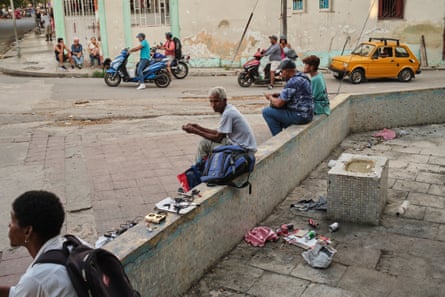
In Cuba, it is hard to find any of the 1,600 Cubans who have so far been deported. Nearly everyone who was on Sánchez’s deportation flight has already moved on to other places, she said. With help from those they left in the US, they have gone on to Brazil, Mexico or other countries without visa requirements for Cubans, such as Serbia.
She won’t make that choice, though. “It’s pointless for me go to Mexico given Kaylin is still far away.” So instead she waits, hoping that her lawyer might get her a pardon, or that the US embassy in Havana might help.
The stakes are high: waiting for her in Tampa is not only Kaylin and her husband, but two IVF eggs, on a different type of ice.
Eileen Sosin contributed additional reporting













Comments