
 German (DE)
  English (US)
  Spanish (ES)
  French (FR)
  Hindi (IN)
  Italian (IT)
  Russian (RU)
  3 weeks ago
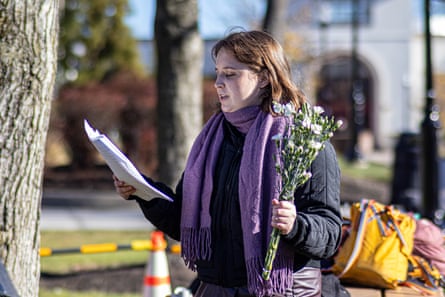
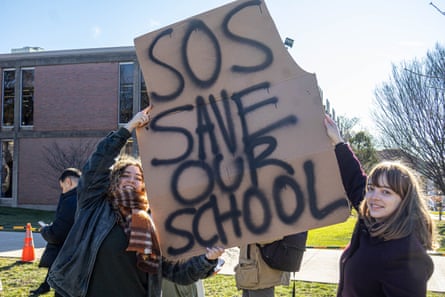
Last month, students at Montclair State University in New Jersey held a mock funeral outside the university’s college of humanities and social sciences building. Carrying bouquets of flowers, they stood by a tombstone inscribed with the names of the school’s 15 departments, including English, history and sociology.
“We are gathered here today, in front of the humble home of CHSS, Dickson Hall, to mourn the death of the social sciences and humanities at the hands of the MSU administration,” Miranda Kawiecki, a junior at the college and one of the protest’s organizers, read from a written eulogy. “I coordinated this demonstration because I have dreams that cannot be monetized. I have a problem with our society that cannot be solved with an algorithm. I have words to write and say that cannot be generated artificially.”
The mock funeral was a protest against the university administration’s plan to overhaul the college by consolidating its departments into four thematic schools – including one devoted to “human narratives and creative expressions”, encompassing what was previously taught in the English, classics, languages and Latino Studies departments, among others.
Fears over the future of the humanities aren’t limited to New Jersey’s second-largest public university. At many schools, those fears are existential.
In Indiana, lawmakers passed legislation last year forcing the state’s public universities to cut or consolidate some 400 academic programs, or nearly 20% of the system’s degree programs – most in the humanities and social sciences. At the University of Texas at Austin, staff are bracing for cuts they expect will take aim at ethnic and regional disciplines such as African studies, Latina/o studies, and gender studies. The University of North Carolina is planning to close six centers dedicated to geographical area studies, including the Institute for the Study of the Americas and the Center for Middle East and Islamic Studies. The University of Chicago has paused graduate admissions for nearly all its humanities programs.
Restructurings, consolidations and layoffs – increasingly orchestrated with the help of corporate-style consulting firms – are underway at scores of other public and private universities across the country – with more than 9,000 higher education jobs cut last year alone (including in the sciences), according to an analysis by Inside Higher Ed.
Behind the crisis are both budgetary concerns that critics say are the result of years-long disinvestment in public education in particular, and political pressure from the right, including the Trump administration’s cuts of billions in federal research funding to universities that do not fall in line with the president’s ideological agenda.
More fundamentally, however, the state of the humanities and liberal arts reveals a widening conflict over the “value” of higher education – with increasingly corporatized universities favoring market-driven metrics for evaluation, and proponents of humanistic education stressing that its worth to both individuals and society at large cannot be measured that way.
At Montclair State, for instance, the administration argued in an email to the university community that the restructuring was a “strategic effort” aimed at “maximizing faculty impact, enhancing student success, and ensuring the vitality of every academic program”.
Critics denounced the restructuring plan as corporate-speak masking an attempt to curtail faculty’s control of their departments.
“It’s a huge crisis,” said Adam Rzepka, a professor of English at Montclair State, referring to the national state of humanistic education. He says the crisis is both decades in the making and “manufactured” by university administrations that increasingly emulate corporate governance structures. “It’s not new, but it’s been accelerating in crazy ways under Trump because Trump has basically issued a blanket permission structure to use executive and corporate power this way.
“The humanities simply don’t fit a corporate model because they are just not monetizable in the same way the sciences or even the social sciences are,” he added. “And the deeper reason they’re coming under attack is that free thought and rigorous, free inquiry is dangerous to executive power.”
Andrew Mees, a spokesperson for Montclair State, disputed students’ and faculty’s criticism of the university’s restructuring plans, writing in an email to the Guardian that the plan to reorganize the college into four schools will not involve layoffs and that faculty will remain “the stewards of the curriculum”.
“Restructuring would change bureaucracy, not dictate course content,” he added, noting that enrollment in some of the college’s majors was down by more than 20% over a five-year period.
“The humanities and social sciences remain the heart of the university’s core curriculum, but the number of students choosing specific humanities majors has declined.”
‘Less oriented towards the market’
For centuries, humanistic education has aspired to the holistic development of the individual by nurturing skills like critical thinking and ethical reasoning. While a liberal arts education predicated on humanistic learning principles was once a prerogative of the elites, the model expanded substantially throughout the 20th century, largely thanks to public investment in education and transformative initiatives like the New Deal and GI bill.
But as large swaths of the US public gained access to once-elite educational opportunity, backlash followed from those who viewed the investment as a waste of public resources and an educated citizenry as a political threat. In the 1970s, politicians like then California governor Ronald Reagan responded to social movements of the time by seeking to impose tuition costs, while elsewhere, austerity measures also led to the introduction of tuition at previously free colleges.
“There’s been a long-running attack on the basic idea of public higher education, specifically higher education that is focused on the development of the whole person, as opposed to higher education that’s focused on job training,” said Eric Hayot, a comparative literature professor at Penn State University who often writes about the state of the humanities. “And there’s a generalized attack on the liberal arts, and specifically the humanities, because the humanities are the place where education is less clearly oriented towards the market.”
As disciplines like race and gender studies became sites of politicised “culture wars” over the last decades, those attacks intensified. Eventually, they led to accusations of “wokeism”, the right’s characterization of universities as “the enemy”, and the Trump administration’s ongoing war against higher education. Meanwhile, factors like the 2008 financial crisis led to collapsing enrollment across the humanities and deep seated anxiety about graduates’ career prospects.
Against this backdrop, confidence in higher education has collapsed over the last decade – from 57% in 2015 to 36% in 2023.
“Our students today come into college with very little sense of the value of those things, even unconsciously,” said Hayot, referring to the critical thought intrinsic to the study of the humanities.
The end game, he believes, is a political and educational “oligarchy”, in which the children of elites can access a humanistic education – “and the rest of the country, they go to trade schools”, he said.
Some version of that outcome is already underway at several universities across the country.
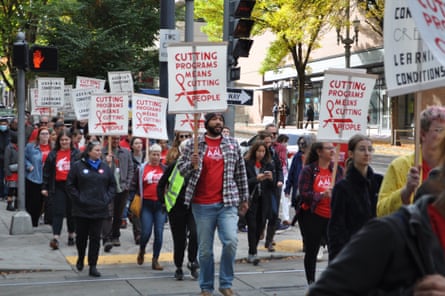
At Portland State University, a public university in Oregon, the administration last year cited an $18m budget deficit when it laid off 17 non-tenure faculty members – 15 of them from the school’s college of liberal arts.
While the university also laid off dozens of non-teaching staff, and is threatening the jobs of dozens more, it has contracted with Gray Decision Intelligence, a higher education analytics firm, to launch an overhaul of the university’s academic programs. The plan – dubbed “Pivot” – includes selecting academic programs to be “sunset” on the basis of “persistent low demand, weak financial contribution, and limited mission alignment”, according to a 45-page prospectus shared with the Guardian. The review includes “program vitality reports” based in part on an analysis by the consulting group, which offers AI-generated reviews of “student demand, job market trends, and competitor activity” to clients that include more than two dozen private and public universities – including Montclair State – and technical schools.
The union representing Portland State’s faculty is fighting the cuts, and an independent arbitrator last month ordered the university to reinstate most of those laid off. The university initially refused to implement the binding decision but last week, after the Guardian reached out for comment, it reinstated 10 faculty members.
Katy Swordfisk, a spokesperson for the university, wrote in a statement to the Guardian that “like universities across the country, PSU is facing a changed landscape for higher education. It is imperative that we review our programs and operations and optimize for the future so that we can continue to serve students and our region”. She added that the process is also responsive to “demand” from students.
Bob Atkins, Gray Decision Intelligence’s founder, said in an email that it does not make recommendations about cuts but rather gives clients “tools and training they use to make better-informed decisions”.
“We emphasize that decisions should be data-informed, not data-driven: judgment is required,” he wrote, noting he had himself been a history major. “There are critical qualitative factors – such as institutional mission and the holistic value of the liberal arts – that data alone cannot represent.”
Faculty at Portland State say that university leaders have been less than transparent, and that their embrace of consultant-informed restructuring is fundamentally at odds with the hard to quantify value of a liberal arts education.
Bill Knight, a professor of English and president of Portland State’s American Association of University Professors chapter, believes universities will eventually reinvest in the liberal arts model, but cautioned about the dismantling currently underway.
“Nationwide, people are making really hasty decisions,” he said. “And it’s tragic because it’s hard to get these things back when they’re cut.”









Comments