
 German (DE)
  English (US)
  Spanish (ES)
  French (FR)
  Hindi (IN)
  Italian (IT)
  Russian (RU)
 WASHINGTON (AP) — In the year since President Donald Trump’s second inauguration, he’s made sweeping policy changes, eliminated hundreds of government jobs, battled dozens of cases in courts and most recently, deployed Immigration and Customs Enforcement officers to major American cities in an effort to tackle immigration concerns he campaigned on. In this episode of The Story Behind the AP Story, White House reporter Darlene Superville and Washington radio correspondent Sagar Meghani break down some of the biggest news events in Trump’s first year in his second presidency.
Haya Panjwani, host: Around this time last year, you may remember hearing from the AP’s Darlene Superville and Sagar Meghani about President Donald Trump’s inauguration. Hi, I’m Haya Panjwani. On this episode of The Story Behind the AP Story, we speak with Darlene and Sagar once again. We’ll take a look at the last year since Trump took the oath of office for a second time. He’s made sweeping actions on policy, government operations and even remodeled the White House itself.
Darlene Superville, White House reporter: My name is Darlene Superville and I’m a White House reporter for The Associated Press.
Sagar Meghani, AP Washington Digital Audio correspondent: And I’m Sagar Meghani, I am AP audio’s Washington correspondent.
MEGHANI: From the economy to immigration to foreign policy to essentially policing America’s cities, these things that he had talked about on the campaign trail but that have really come to fruition over the last 11 and a half months.
SUPERVILLE: I would say one of the major themes of Trump’s second first term is just this sort of determination that you see in the president this time around compared with his first term. When he was president the first time, Donald Trump was coming to Washington from being a businessman. He’d never really been in politics before. He ran, he was elected, seemed to be surprised that he was elected, but then he had to step up, become president, build a government, build a cabinet. He didn’t know a lot of people in the political world and ended up having a lot of people who became members of his cabinet kind of foisted upon him. But I think one of the things that we have seen or saw this time around in the past year is that he’s now surrounded himself with people that he knows, people that trust, people who can implement his agenda, and we’re seeing that happening.
PANJWANI: During President Trump’s campaign for office, he pushed for reform in government operations.
SUPERVILLE: Trump’s second term introduced a new acronym to the plethora of acronyms that exist all throughout the federal government. This one is DOGE, D-O-G-E for Department of Government Efficiency.
PANJWANI: He brought in Elon Musk, owner of Tesla, SpaceX, and X. Musk became one of the president’s biggest supporters and gave Trump the idea to slash government spending and the federal workforce.
SUPERVILLE: He came into the administration at the beginning, was here for a few months. He had an army of young workers who kind of went through all the federal government, all of the departments and cabinet departments and agencies, and basically highlighted places where they thought they could cut spending, jobs that could be eliminated. The end result of that was that easily, thousands of federal workers no longer work for the federal government. Some spending has been slashed, although not the $2 billion that Elon Musk had said he could do.
PANJWANI: Trump also campaigned on reducing crime in U.S. cities.
SUPERVILLE: The president sent the National Guard into a number of U. S. cities because he had this idea that a lot of these places were just overrun by crime. You name it, he thought it was happening there: Murders, killings, kidnappings. The first place he did this to was Washington, D.C. He tried to do it in Chicago. He’s tried to do it in Portland, doing it in New Orleans. And as part of his agenda too, he talks a lot about wanting to make America safe. He sees sending the guard into these cities as part of that bullet item on his agenda.
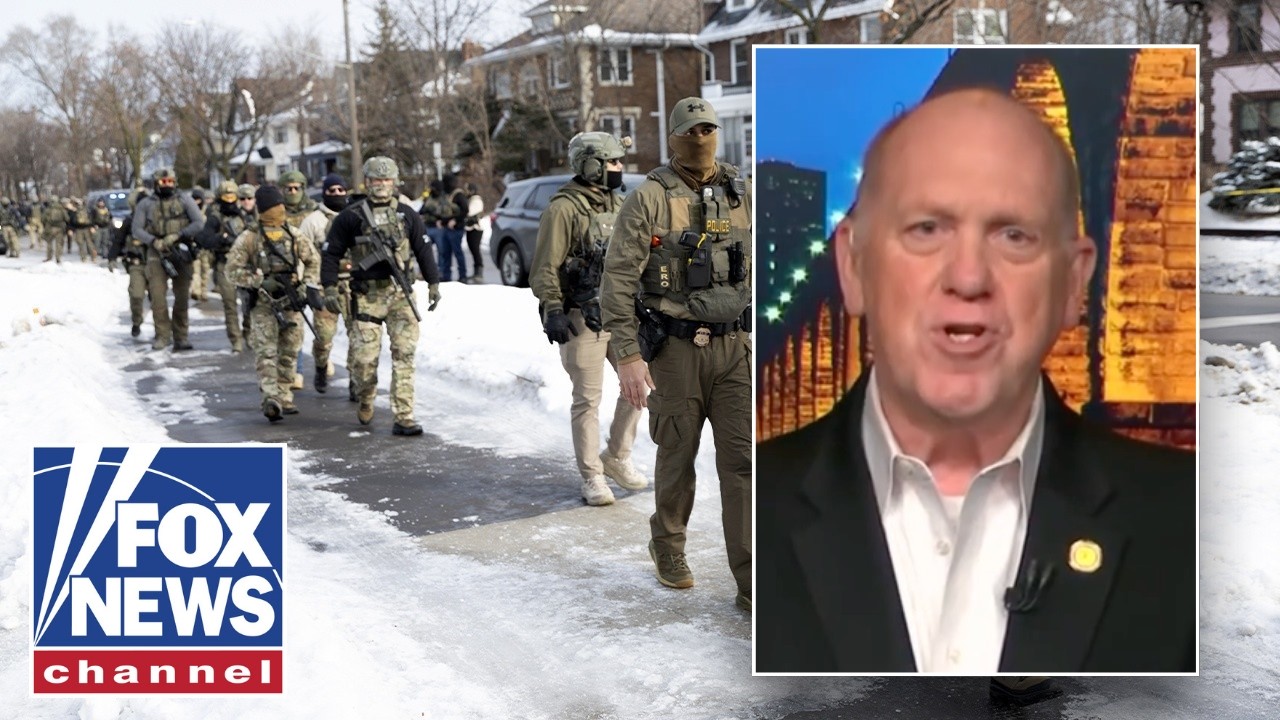
MEGHANI: And months later, we still see uniformed National Guard here on the streets in Washington inside train stations. He has wrongly stated many times that Washington is completely safe now. There have been no murders for months. None of that is true, but yet you still see that armed presence on the streets. The flashpoint of the Trump immigration raids involving ICE officers has become Minnesota. That is not just about immigration writ large, it’s about his longstanding complaints about the Somali community in Minnesota and his claims, and the Justice Department is investigating, that members of this community have essentially ripped off the state with childcare programs and all kinds of other things. He has repeatedly railed about Somalis being trash, that they should go back to their own country. He’s railed against Congresswoman Ilhan Omar. We’ve seen the protests on the streets of Washington and are on the streets of Minnesota, and again, a fatal killing by an ICE agent of Renee Good, a lot of controversy about exactly what happened on that street. The point remains that a federal immigration officer shot and killed an American woman on the streets of an American city. So that story is not going away, whether the ICE agents do soon or not.
SUPERVILLE: Another point on the immigration and the use of ICE, it’s part of the president’s agenda, which he ran on, and the American people seemed to have support because they elected him. He wanted to carry out the largest mass deportation ever in U.S. history. He came into office and set this all in motion. But one of the things that people around the country are seeing and also objecting is just the sheer force of this effort.
MEGHANI: Immigration remains a strength for the president among his base, but several Republicans have said the administration’s aggressive tactics in Minneapolis go too far. The focus should instead be on immigrants with criminal backgrounds. A recent AP-NORC Center for Public Affairs Research poll found just 38 percent of adults approve of the president’s leadership on immigration. His approval on that has fallen a dozen percent among Republicans over roughly a year.
PANJWANI: The president has touted himself as somewhat of a peacemaker when it comes to global conflict.
MEGHANI: Russia’s war in Ukraine was the one that then President-elect Trump had claimed that he could solve within 24 hours of stepping into the Oval Office. Here we are a year later, that war is not over. He has consistently said for months now that he thought it would perhaps be the easiest of the conflicts he has addressed, yet it has not been. He’s clearly angry that they have not been able to reach some type of deal.
SUPERVILLE: With respect to the Middle East, the President did get a lot of praise and plaudits for coming up with a plan to solve tensions between Israel and the Gaza Strip. That plan is still not yet fully adopted by the parties, and that’s been a source of, shall we say, disappointment for the president.
MEGHANI: There have been smaller conflicts that, yes, have been eased, but for a man who has billed himself as a peacemaker, clearly Russia-Ukraine is the one outstanding agenda item that he has yet been able to end. In all, it’s led to essentially expanding America’s role in foreign entanglements, which would seem to be at odds with the president’s claim that he no longer wants forever wars that everything has to be “America First” even down to foreign policy. Yet we’ve seen him inject himself in Russia, Ukraine, in Gaza and most notably perhaps in Venezuela. First, you’ve had these military strikes on suspected drug-running boats that have killed people at sea, and then you had the stunning overnight raid into Caracas. President Trump all but saying he’s going to run Venezuela that the U.S. is going to play a big role in controlling Venezuelan oil sales. He tried to turn that into claiming economic opportunity for the United States. You had even Republican lawmakers saying, well, you can’t just mount military action in a foreign country and take a foreign leader without letting Congress get involved.
SUPERVILLE: And there’s been a whole flurry of activity and talking points and counterpoints between the U.S. and Greenland and Denmark about Trump and his very strong desire for the United States to own Greenland for what he says are national security interests. Greenland and Denmark say that’s never going to happen. Both sides are talking and there's no resolution.
PANJWANI: Trump repeatedly bent Congress to his will, and resisted the full release of the Jeffrey Epstein case files.
MEGHANI: Finally, Congress was forced by some members to order the Justice Department to release these files. It has released several thousand of them. There are more than two million of them, and DOJ claims it’s working to redact sensitive information to protect victims in this case, but that has not been good enough for Democrats whose rallying cry when other things have happened or the president has announced new initiatives simply becomes “Great, release the files.”
SUPERVILLE: One of the reasons the Epstein files continues to have legs, so to speak, is that the fact that President Trump had a relationship, a friendship with Jeffrey Epstein. They both lived in Palm Beach, they were friends. There have been numerous photos that have been in the media and elsewhere of both of those gentlemen at parties, laughing, dancing with women, so on and so forth. And the president initially was very reluctant to release these files, even though it was something that was very important to his base. It was only after momentum built in Congress for the legislation to force the Justice Department to release the files that the president changed course and agreed to sign the bill.
PANJWANI: The AP-NORC Center for Public Affairs had a recent poll. 37% of adults approve of how the president is handling the economy. That approval, which has been a strength of his, has been low throughout the past year.
MEGHANI: The word that we have heard for the last several months, whether the president likes it or not, is affordability. He claims Democrats have made that up by saying things are not affordable. He says that’s not true and recently told the Detroit Economic Club that even for as optimistic as he was about the economy this year, it’s performed even better than that. He’s citing record-breaking growth and low unemployment, falsely claiming that inflation has been defeated. Again, none of that is true.
SUPERVILLE: So the president’s focus on the economy has led to this desire on his part for lower interest rates, which in turn has led to him being extremely critical of Fed Chairman Jay Powell. Almost on a daily or weekly basis, we hear the president calling him names and criticizing his stewardship of the Fed and just increasingly pressuring him to lower interest rates, when in fact, Jay Powell alone doesn’t move interest rates up or down. It’s a committee of the Federal Reserve that does that. The other thing that he’s been using to pressure Jay Powell is the renovations that are going on at the Federal Reserve buildings. It’s a costly renovation and the President has tried to use that as another weapon or another way to sort of target Jay Powell and like try to push him out of office, basically, even though his term ends in May.
PANJWANI: Remodeling the White House has also been top of mind for President Trump.
SUPERVILLE: President Trump has shown a level of interest in redecorating and renovating the White House that is unusual for a president. That responsibility generally belongs to the first lady. But President Trump’s biggest project to date was demolishing the East Wing to add a large ballroom that he has talked about for a long time. He started by redecorating the Oval Office, which every president does, to fill wall space with gold touches and portraits of every president. He also added a copy of the Declaration of Independence. He moved on to the Rose Garden, which he paved over and turned into a patio. He redid a bathroom in the Lincoln bedroom with lots of marble. And he also installed two massive flag poles, one each on the north and south lawn to fly the American flag.
PANJWANI: 2026 brings midterm elections. They could play the biggest role in what happens in Trump’s presidency going forward.
MEGHANI: Even President Trump himself has acknowledged the recent political reality that the party that wins the White House loses in the midterms in the following election. He thinks that’s unfair. We did a great job. Why would you punish us? Because it’s a referendum and the American people get to decide whether it’s been a great job or not. Very narrow GOP majorities in both chambers. Democrats would have to flip four seats in the Senate to regain control and Democratic leader Chuck Schumer tells the AP he thinks the path toward actually doing that is now much wider than it has been that if Democrats can take one or both chambers of Congress, that sets up a very different Trump administration in 2027 than it looks like right now.
SUPERVILLE: So no president ever wants to lose control of Congress. And in that vein, President Trump is no different. And he’s doing everything he can to try to help his party retain control of the House, both the House and the Senate. One method that he’s employed to do that, a rather unorthodox method, is trying to encourage states with Republican governors and Republican legislatures to do their redistricting early. Usually it’s done every 10 years, but he has managed to talk states like Texas, Missouri, and North Carolina into redoing their congressional districts and redrawing them in a way that potentially could favor the Republican Party when the midterm elections roll around in November. The other thing that’s motivating the president is this feeling, which he articulated recently when he spoke to the House GOP conference, the fact that if Democrats manage to prevail in November, they will launch investigations into his administration. They will be calling cabinet members to come and testify and justify what they’re doing. And also just the fear of impeachment. He told the conference flat out that if the Democrats win, they will impeach him.
PANJWANI: This has been The Story Behind the AP Story. I’m your host, Haya Panjwani. Special thanks to White House reporter, Darlene Superville, and Washington radio correspondent, Sagar Meghani for contributing to this episode. For more coverage on Donald Trump’s presidency, as well as other episodes of The Story Behind the AP Story, visit AP News’ YouTube channel or visit apnews.com. Thanks for listening.






Comments