
 German (DE)
  English (US)
  Spanish (ES)
  French (FR)
  Hindi (IN)
  Italian (IT)
  Russian (RU)
  1 hour ago
A French researcher whose work was praised by Donald Trump and Dr Mehmet Oz during the Covid-19 pandemic published hundreds of papers with “substantial” ethical and legal concerns, according to a new analysis.
An international team of scientists found concerns in 853 articles published by the Institut Hospitalo-Universitaire Méditerranée Infection, or the IHU, hundreds more than previously flagged by past investigations into work at the large research hospital. Of those, institute founder Didier Raoult was listed as co-author on 758 of them, according to one of the researchers behind the new analysis.
Raoult rocketed to the global stage in March 2020, when the novel virus was spreading unchecked and killing people across the world. He and several colleagues published research that claimed hydroxychloroquine – a drug used for malaria and certain autoimmune conditions – was found to be an effective treatment for Covid-19, especially in combination with the drug azithromycin.
Trump at the time called Raoult’s research on hydroxychloroquine a “gamechanger”, though many scientists disagreed and raised concerns about the quality of the research, including Dr Anthony Fauci, then a top Trump adviser.
Despite those calls for caution, Oz, who now heads the US Centers for Medicare and Medicaid Services, an agency responsible for $1.6tn in spending, echoed Trump at the time in calling Raoult’s work a gamechanger. The French president, Emmanuel Macron, made a high-profile visit to the institute and met with Raoult. Later, Robert F Kennedy Jr called Raoult’s work “powerful” and dedicated a book he wrote that blasted Fauci in part to Raoult.
The drug has not been shown to be effective as a Covid-19 treatment, and the paper was ultimately retracted for ethical and scientific reasons in 2025. But it had become one of the most famous articles of the pandemic era, having been cited thousands of times.
The new findings further call into question the scientific judgment of current health leaders in the Trump administration, who have said they are committed to restoring what they call “gold-standard science” informing federal policy. A Republican-led committee of the US Senate recently voted to hold Fauci in contempt for pleading the fifth during a hearing about Covid-19’s origins.
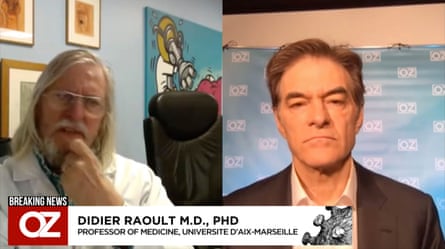
“If Oz had reviewed/read the study correctly he would have found many of the problems” that were raised about it, said Lonni Besançon, an assistant professor in data visualization at Linköping University in Sweden and a member of the international research team that did the new analysis, which was published this month in the journal Research Integrity and Peer Review.
Besançon said the now-retracted article was used to claim there was a cure for Covid, led to shortages of hydroxychloroquine and drove scientists to pour their attention into researching that drug rather than other promising leads. It also fueled conspiracy theories from people who argued the article was being attacked “because if there was a cure for Covid then they couldn’t sell their vaccines”, he said.
“A lot of time was wasted,” Besançon said. “It’s been a massively influential paper, and it’s also been used to push for an antivax agenda.”
Fauci, who was a leading member of the White House coronavirus taskforce, was asked at a news conference with Trump on 20 March 2020 whether there was evidence hydroxychloroquine could be used to combat Covid-19. Fauci, standing with the president, replied, “The answer is no,” called such research “anecdotal evidence” and noted it was not done in a controlled clinical trial. He called for rigorous scientific research to show whether it would be both safe and effective.
But the next day, Trump cited Raoult’s research in a tweet, saying hydroxychloroquine and azithromycin “have a real chance to be one of the biggest game changers in the history of medicine” and saying he hoped they would be put in use immediately.
Two days later, Oz, then a TV personality and physician, appeared on Fox & Friends, where he said he was “flabbergasted” by Raoult’s research and urged the US government to procure the drug.
“I read the study. I was stunned. Literally, a jaw dropped. I didn’t know it was possible,” Oz said.
While Oz noted it had not been a randomized trial and said he was launching his own such trial to replicate Raoult’s findings, he also called the French work a “gamechanger”.
“The data is so strong, I completely understand why America wants to start taking these pills,” Oz said, before adding that more data was needed.
Publicly, Oz interviewed Raoult multiple times in March and April for his TV show.
Behind the scenes, Oz was emailing Trump administration officials to highlight the research, according to emails later obtained by a US House select committee on the coronavirus crisis. In them, Oz vouched for the quality of Raoult’s research.
“You should know that the French researcher confirmed clinical benefits but needs more data so will not release report for another 10 days. These findings offer hope to our people,” Oz wrote on 22 March. He called it a “potential pandemic solution” in an email to Trump’s son-in-law Jared Kushner.
Six days later, he wrote that Raoult had sent him updated research and that “the treatment appears safe and results are better than expected”.
Trump’s current health secretary, Robert F Kennedy Jr, then leading the anti-vaccine activist group Children’s Health Defense, named Raoult among the “heroic” scientists to whom he dedicated his 2021 book, The Real Anthony Fauci. Kennedy’s book attacked Fauci for his stance toward hydroxychloroquine.
The Department of Health and Human Services and the Centers for Medicare and Medicaid Services did not return requests for comment about Kennedy’s and Oz’s promotion of Raoult’s work.
Widespread ethical problems
The team of researchers has been digging into the IHU’s work for years. They initially looked at 2,674 papers published by the institute between 1994 and 2024 and discovered various ethical concerns in 853 of them.
For example, the team noted that French law requires certain steps be taken when using human subjects in biomedical research in order to protect people from harm. The team estimates that at least 78 articles describe biomedical research “that appears not to comply with the applicable French law”, they wrote.
The team also found 343 articles in which no ethics approvals were ever recorded, dozens of approvals that appear to have been obtained retrospectively after the study began and repeated reuse of ethics approvals for different studies, among other issues.
They noted that while issues such as fraud and plagiarism often get more attention when it comes to research misconduct, ethical problems can undermine public trust in research and in the scientific process.
The findings have in the past few years led to 64 articles being retracted and 270 being tagged with an “expression of concern”, which can indicate that major and credible concerns have been raised about the article, the team wrote.
They called for additional review of the institute’s work “to ensure that the scientific record is corrected where appropriate”. It was critical of the institute as well as of Aix-Marseille University, which they said was largely responsible for overseeing the work there.
“These findings raise broader questions regarding the university’s governance and oversight mechanisms,” they wrote.
Besançon said millions of euros in research funds were “thrown out the window” due to the poor research practices at the IHU, and many students were improperly trained in scientific practices.
“For me, this is what’s important,” he said in an interview. “To make sure we can push for good, scrutinizable and responsible science.”
The university said in a statement that it “conscientiously and responsibly” took “all measures within its remit” from when it was first alerted to problems in 2020. It said it did its own investigation and transferred its findings to relevant authorities, then fully cooperated with the investigations. It said it also “engaged with scientific publishers” and has “continuously strengthened its prevention, support and oversight mechanisms”.
“Research ethics and research integrity are fundamental pillars of Aix Marseille University’s research policy and are at the heart of its commitment to responsible, rigorous and high-quality research,” it said.
Raoult retired in 2021. Though he responded to emails sent to him by the Guardian, he did not address questions about his research and the team’s analysis. In the past, he has stood by his research and criticized decisions to retract his studies. He told Science magazine in 2024 that he followed ethical regulations.
The Guardian also sought comment from the IHU.


















Comments