
 German (DE)
  English (US)
  Spanish (ES)
  French (FR)
  Hindi (IN)
  Italian (IT)
  Russian (RU)
  1 hour ago
The US is facing worldwide condemnation over a “barbaric” plan to execute a disabled man by firing squad and livestream it to the public, with critics comparing the Trump administration to dictatorships in Iran and Afghanistan.
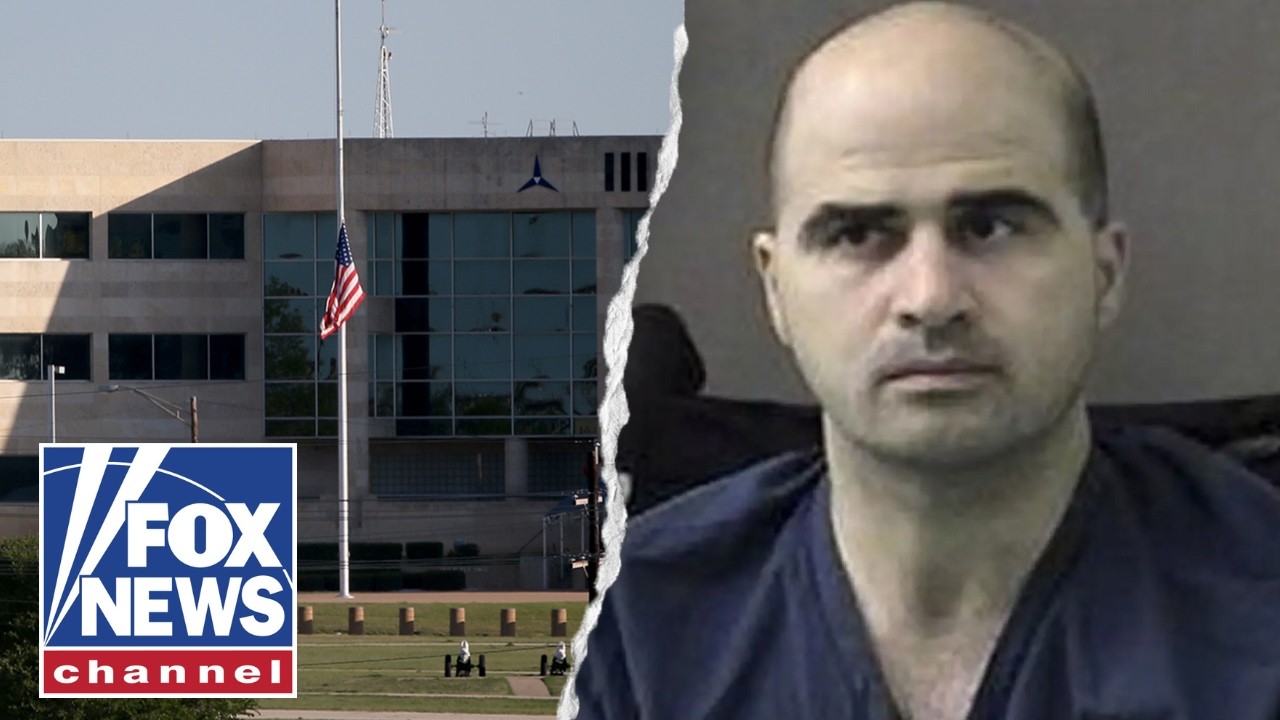
The Pentagon confirmed on Thursday that the execution of Nidal Malik Hasan, convicted of killing 13 people at a military base at Fort Hood in Texas in 2009, would be livestreamed on 3 December.
The United Nations’ office of the high commissioner for human rights warned on Friday that broadcasting the killing would amount to a public execution and “breach the absolute prohibition of torture”.
The plan also drew opprobrium from politicians, religious leaders and human rights advocates in the US and abroad. Hillary Clinton, the former US secretary of state, wrote on social media: “A barbaric idea, beneath our dignity as a country. Push back on this.”
Yassamin Ansari, the first Iranian American Democrat elected to the US Congress, posted: “In Trump’s America, we’re doing public executions now. WTF. This is what happens under brutal dictatorships like Iran and Afghanistan. It’s all part of Trump’s authoritarian takeover of the United States.”
Britain, which abolished the death penalty in the 1960s, moved to distance itself from the execution. Bridget Phillipson, the UK’s equalities minister and Labour party chair, told BBC Radio 4’s Today programme that she found the concept “rather disturbing”.
Phillipson stressed that the decision was a matter for the US government, adding: “They are a close ally. Does that mean that we support everything the US government does? No.”
Under US military law, a president must approve an execution by firing squad. Trump did so on the recommendation of his defence secretary, Pete Hegseth, according to the Pentagon.
Hegseth gleefully confirmed the livestream plan after previously saying that the execution would be public. Speaking to the conservative broadcaster Real America’s Voice, he said people should be able to watch because they need to understand that there were “serious consequences” for such crimes.
Asked whether Hasan had made any final requests, Hegseth replied: “Don’t care. We’ll see him on December 3.”
Now 56, Hasan was sentenced to death by a military jury in 2013 after being convicted of 13 counts of premeditated murder and 32 counts of attempted premeditated murder. Twelve of those killed and 30 of the wounded were soldiers.
The former army psychiatrist opened fire with a handgun at a medical facility at Fort Hood on 5 November 2009 as soldiers waited for medical checks before deployment. He was shot by a police officer during his arrest and left partly paralysed, and now uses a wheelchair.
The execution is expected to be the first by firing squad carried out by the US military since 1945, when army private Eddie Slovik was executed for desertion during the second world war. The last US military execution of any kind took place in 1961, when John Bennett was hanged.
Hasan’s case comes amid renewed scrutiny of capital punishment in the US following the botched lethal injection of Tennessee death-row prisoner Christa Pike last week. Her lawyers said she awoke in hospital “angry and confused” and remained seriously ill and shackled to her hospital bed.
Media have sought to televise US executions in the past, but have been blocked by the courts. No other country is known to televise or livestream legal executions, experts said.
Indeed, public executions have largely disappeared around the world. Amnesty International recorded at least 17 in 2025, including 11 in Iran and six in Taliban-run Afghanistan.
In the US, executions have been conducted privately for about nine decades. The hanging of Rainey Bethea in Kentucky in 1936, witnessed by thousands, is generally regarded as the country’s last public execution, although another hanging took place in Missouri the following year.
Experts said there was no known precedent for livestreaming a legal execution. The execution of the Oklahoma City bomber Timothy McVeigh in 2001 was made available to victims’ relatives through closed-circuit television, but was not broadcast publicly.
after newsletter promotion
The proposed live stream has prompted criticism from religious leaders. Archbishop Paul Coakley, president of the US Conference of Catholic Bishops, said it was a “barbaric promotion of a culture of death and must be reconsidered”.
Politicians from both sides of the aisle also spoke out. Adam Smith, the top Democrat on the House of Representatives armed services committee, said the plan was “disturbing and makes a mockery of our legal system”. The Democratic senator Chris Murphy described public executions as “medieval”.

The Republican senator Thom Tillis said Hasan should face the death penalty but that broadcasting his execution was “beyond disgusting”, arguing that public executions were associated with oppressive regimes.
Others warned that the spectacle would be counterproductive and act as a recruiting sergeant for US enemies seeking fresh propaganda.
Ned Price, a former deputy to the US representative to the United Nations, posted on X: “You can take it from those of us who’ve spent years working on terrorism: the surest way to spawn more radicalized zealots is to glorify violence, embrace a cult of death, and create a martyr for the cause.
“Or take it from [al-Qaida] and ISIS, whose tactics offer the closest modern-day approximation of Hegseth’s proposal. Either way, it’s hard to conjure a more vivid example of his trademark performative bravado, which routinely damages America’s image and, in this case, so ghoulishly leaves us more vulnerable.”
Some experts have raised questions about whether the live stream could be challenged in court. Eugene Fidell, a military law specialist at Yale Law School, said Hasan could seek legal action to block the public display of his death.
Elisabeth Semel, co-director of the Death Penalty Clinic at the University of California, Berkeley, said the announcement raised serious questions about the dignity of the condemned prisoner and the government’s motivation for staging such an unusual spectacle.
“This is a president who’s about spectacle and that’s, I think, precisely the message that he intends to deliver,” she told the Associated Press.
Justin Mazzola, deputy director of research at Amnesty International USA, said: “Livestreaming the taking of a life by firing squad would only compound the cruelty of the death penalty and perpetuate the cycle of violence that the authorities purportedly seek to end.
“This announcement adds to the display of cruelty that we have just witnessed in the senseless pursuit of the execution of Christa Pike in Tennessee. The US death penalty is irredeemably broken. It is high time that the US authorities, at all levels, use their power to show human rights leadership and end this ultimate cruel, inhuman and degrading punishment once and for all.”
Other experts argued that public access could increase transparency around capital punishment. Deborah Denno, a death penalty specialist at Fordham University, told the AP that a live stream could make the process more transparent at a time when the botched execution in Tennessee had renewed questions about how the state puts prisoners to death.
It remains unclear whether Hasan will seek to challenge his execution in civilian court, a move that could significantly delay the proceedings.














Comments