
 German (DE)
  English (US)
  Spanish (ES)
  French (FR)
  Hindi (IN)
  Italian (IT)
  Russian (RU)
  3 weeks ago
“I’m not paying my federal income taxes this year,” Rachel Cohen declared in a recent Instagram video that received more than 140,000 likes.
The 31-year-old lawyer in Chicago plans to put the $8,800 she owes the federal government in a high-yield savings account instead. She doesn’t want to fund wars in Iran and Gaza or immigration agents detaining her neighbors, she said.
Many commenters said they wanted to do the same. Others worried about her. “I’ve gotten a lot of people saying: ‘Rachel, this is illegal,’” Cohen said. “To which I say, with gentleness: ‘I am a competent attorney!’”
Cohen is part of a new generation of Americans refusing to pay some or all of their federal income taxes. It’s not a new form of dissent – one of the first protests in the United States was, after all, a protest of unfair taxation – but it’s also one that’s gaining steam, as Americans reject how their tax dollars are being spent under Trump.
Lincoln Rice, who leads the National War Tax Resistance Coordinating Committee (NWTRCC), said in Donald Trump’s second term, more and more people are removing their money from the federal tax base. In January, NWTRCC – which has been around since the early 80s – held its largest-ever “War Tax Resistance 101” training. A few years ago, such trainings would draw about a dozen attendees; two months ago, nearly 500 people showed up, and the group’s website traffic had over 110,000 unique visitors.

“Some methods of tax resistance are not legal, and anyone who attempts them should be prepared to face the risks of civil disobedience,” Rice explains in his trainings. Penalties can range from threatening letters, to wage or bank-account garnishment, to – in one famous case – the seizure of a person’s home.
To Cohen, these risks are not deterrents when about 13% of Americans’ federal income taxes are spent on the military, and 1% goes to federal law enforcement, including subsidizing Immigration Customs Enforcement (ICE).
“In a vacuum, I would certainly run the risk of a misdemeanor, as opposed to actively supporting concentration camps,” she said of ICE detention centers.
Tax resistance was one of the earliest forms of protest
Tax resistance in America goes back to the 1773 Boston Tea Party, when American colonists protested British taxation on tea imports. During the depression era, hundreds of local and state-level groups pushed back on “tax abuse” – one three-year property tax strike in Chicago nearly bankrupted the city before it was struck down in court.
Political tax resistance re-entered the mainstream during the Vietnam war, when celebrities like Joan Baez said they would decline to pay the portion of their taxes spent on armaments. An estimated 2 million Vietnamese civilians were killed in that war, on which US taxpayers spent more than $140bn. “All I can do is draw my own line now,” Baez wrote. “I am no longer supporting my portion of the arms race.”
In the early 1970s, 200,00 to 500,000 Americans reportedly refused to pay the “telephone tax”, a 10% tax on phone bills that was levied to subsidize the Vietnam war. Larry Rosenwald, then a young man in New York City, was one of them. “It was like a gateway drug for war-tax resisters – it wasn’t very much money, and it wasn’t any very drastic action,” he said. An IRS agent eventually showed up at his door, he said, and when he refused to pay, the agent went to his bank to collect the $25 he owed, plus another $25 withdrawal fee.
The IRS stopped collecting a 10% telephone tax near the end of the Vietnam war. And as that war ended, mainstream interest in tax protest waned, too. Since then, tax resistance has moved in and out of the mainstream: kept alive, often on the fringes, as a religious practice by pacifist groups like Quakers and Mennonites, for whom non-payment of taxes is above all a spiritual obligation, rather than a large-scale political tactic.
Chrissy Kirchhoefer of St Louis, Missouri, has been refusing to pay a portion of her federal income taxes since 1998. The United States was bombing Iraq, and Kirchhoeffer was getting involved with the anti-war Catholic worker movement. War-tax resistance, she said, brought her community. “I found people with similar ideas and visions for the world.” She redirected the money she would’ve spent on taxes toward community projects.
In the early 2000s and 2010s, the public face of tax protest has been much more conservative and even libertarian, interested in deregulation and the further enrichment of those who are already rich. But in the past five years, that pendulum has swung again.
During Joe Biden’s presidency, a new group of Americans withheld federal tax dollars as the US subsidized Israel’s deadly attacks in Gaza. These resisters were younger and more diverse than their Vietnam-era predecessors, Rice said. And interest in tax protest has only grown under Trump. “There have been three spikes,” since Trump’s re-election, Rice said: during the early days of the so-called “department of government efficiency” (Doge), after the passage of the One Big Beautiful Bill Act, and when the US attacked Venezuela and captured its president in January.
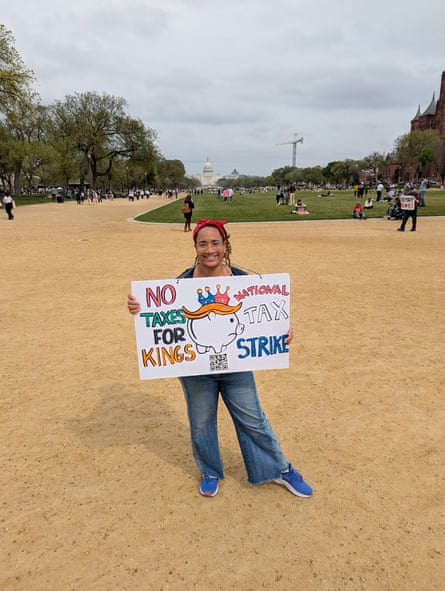
Christina Thompson, 34, is a volunteer coordinator with a year-old group called National Tax Strike, which produces tax-resistance education materials – both for those who are generally antiwar, and those who hope specifically to push against Trump.
“We’re not trying to propose that people stop paying taxes because taxation is wrong,” Thompson said. Instead, it’s a matter of priorities. “We believe our taxes should be going towards the best use for people in this country, and that’s unfortunately not happening.” Trump’s war in Iran, which the US entered just over a week ago, is likely costing American taxpayers at least $1bn per day, according to MS NOW.
“We are … being told we have to go without affordable healthcare, affordable groceries, affordable housing, because we want to fund these forever wars that enrich a small portion of the country,” Thompson said. “I really want people, especially in this moment, to ask the question: ‘Are your tax dollars being used to make your life better?’”
With the Trump administration having gutted the Internal Revenue Service – its total workforce has been reduced by 27% since last year – some tax experts wonder if the IRS will be able to process taxes on time anyway. “In the last few years, we haven’t heard of any new resistors facing garnishments or bank levies,” Rice said. However, one man who has been refusing to pay taxes since the 1980s did have his bank account levied, he added.
For Cohen, who left her job at a big law firm last year, the decision to stop paying taxes wasn’t made on a whim. She built a social media presence encouraging people to organize in support of undocumented immigrants, and has thought long and hard about how to resist what she sees as rising authoritarianism in the US.
“Of course, I’m nervous and I’m scared,” Cohen said. “But I’m doing an informed risk assessment and deciding to do these things anyway, because I think that’s the level of severity that the moment that we’re in calls for.”











Comments