
 German (DE)
  English (US)
  Spanish (ES)
  French (FR)
  Hindi (IN)
  Italian (IT)
  Russian (RU)
  2 weeks ago
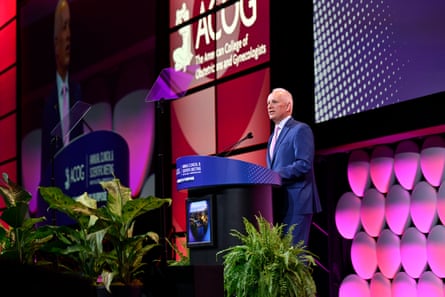
When Steven Fleischman took over as president of the American College of Obstetricians and Gynecologists (ACOG) in 2025, he knew that controversy was practically part of the job description. But the Connecticut-based physician at Yale University School of Medicine never predicted that things would get this dire.
As the premier membership group for US-based OB-GYNs, ACOG provides its more than 62,000 members with clinical guidance, educational opportunities and career help. It also advocates for abortion rights – a stance that has long made the organization far more politically active than many other major medical societies. And in the last year, the nonpartisan organization has become a leading voice in the fight against Donald Trump’s anti-science crusade and the US government’s embrace of medical misinformation, especially on the topic of pregnancy and childbirth.
After Trump suggested, without sound evidence, that women who take Tylenol during pregnancy risk causing autism in their children, Fleishman called such suggestions “highly unsettling”. After the Food and Drug Administration (FDA) convened a panel focused on the risks of taking antidepressants during pregnancy, Fleischman slammed it as “alarmingly unbalanced”. And after the Centers for Disease Control and Prevention (CDC) stopped recommending Covid vaccines for pregnant women, Fleischman accused its vaccine advisory committee of failing to follow “longstanding tradition of robust, unbiased review of reputable scientific evidence”.
ACOG is now preparing its members to handle what may prove to be one of biggest upsets in the history of US medicine: the One Big Beautiful Bill Act, whose changes to Medicaid and the Affordable Care Act will leave an estimated 10 million people without insurance and hundreds of hospitals at risk of cutting services, laying off staff, or closing altogether.
‘Who do I listen to?’
For the first time in Fleischman’s memory, if not ACOG’s lifespan, the 75-year-old organization is now advising people to question the CDC.
“That is terrible for patients, because it is really hard to figure out: ‘Who do I listen to? I’ve always listened to the CDC. Am I not supposed to listen to the CDC? Who is this ACOG that’s telling me something different?’” Fleischman said in an interview late last year.
Over the summer, ACOG became the first national medical society to reject funding from the Trump administration. The group made the move, in part, over fears that the administration’s executive orders restricting diversity, equity and inclusion (DEI) efforts from groups that receive federal funding would warp ACOG’s research and hurt efforts to advance health equity.
“I feel like we’re seeing a lot of organizations, medical and otherwise, cave. We certainly saw a lot of legal organizations caving early. I’m proud ACOG didn’t,” said Dr Kristin Lyerly, a Wisconsin-based OB-GYN and ACOG member. The group, she said, “declined federal funding so that they could continue to do their life-saving work, work that saves moms’ lives”.
The Trump administration has divided US medicine. Major medical institutions have yielded to its agenda over the last year. After the administration denounced gender-affirming care for minors, for instance, dozens of hospitals stopped providing the service. Northwestern University and Brown University – which run some of the top medical schools and hospitals in the country – have also made deals with the Trump administration to stop providing pediatric gender-affirming care (and, in Northwestern’s case, pay the administration $75m).

But some medical membership organizations have, like ACOG, grown more political. Groups like Society for Maternal-Fetal Medicine joined ACOG in rebuking the administration officials’ comments about Tylenol and Covid vaccines, while the American Academy of Pediatrics sued the administration for cutting $12m of its funding and for changing the childhood vaccine schedule. (ACOG filed an amicus brief in the latter case, alongside several other medical groups.)
As state legislatures start deciding how to implement the One Big Beautiful Bill Act’s cuts and implement work requirements for Medicaid, ACOG plans to lobby legislators to keep pregnant and postpartum patients from losing coverage, as well as push states to apply for government grants that fund rural access to healthcare. The organization is also backing a congressional bill that would expand access to rural emergency labor and delivery services, since more than 500 rural hospitals have closed their labor and delivery units over the last 16 years.
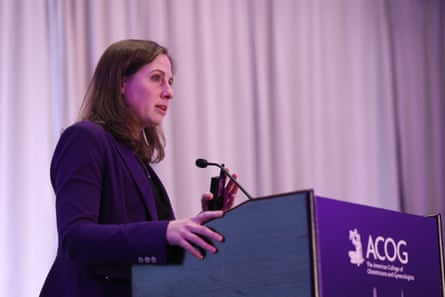
“The reality is that this is a very scary time for many people. There have been fundamental changes made to our public health infrastructure, some of which may be irreparable, though I hope that’s not the case,” Rachel Gandell Tetlow, ACOG’s vice president of government and political affairs, said in an email. “While ACOG cannot replace some of these entities or fix these monumental problems on our own, we can continue to be an unwavering voice in support of medical evidence.”
A ‘guerrilla war against science’
When Trump took office, OB-GYNs were still reeling from the supreme court’s 2022 decision to overturn Roe v Wade, which unleashed a wave of state-level abortion bans that imperiled physicians’ ability to do their jobs. Vast numbers of OB-GYNs leapt into abortion rights advocacy. Doctors who had never before lobbied started testifying in front of state legislative committees, forming political action committees and canvassing for pro-abortion rights ballot measures.
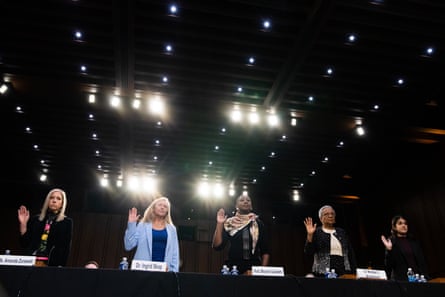
ACOG expanded its state-level lobbying efforts, since states now have far more leeway to determine their own reproductive health policies. During the 2024 election cycle, ACOG’s political action committee donated $83,400 to local and state candidates and parties – more than double what it spent on local and state elections in 2020, according to the non-profit Open Secrets, which tracks money in US politics. Now, Fleishman said, ACOG has set aside money to hire a lobbyist in every state.
“I remember going to briefings, when we had our legislative lobby days back in 2000, when we used to have 75 people come,” Fleischman recalled. “We now have over 800 people come to our lobby days.”
But ACOG’s advocacy has made it a target for the right. The Heritage Foundation’s Project 2025, a notorious blueprint of conservative policies, calls out ACOG as “pro-abortion” and urges the Department of Health and Human Services (HHS) to stop working with the group; the Alliance Defending Freedom, a powerhouse Christian law group that has architected much of the right’s legal attacks on abortion and transgender rights, also demanded that HHS cease its work with ACOG. (Between 2018 and ACOG’s decision to stop taking federal funding, the US government awarded ACOG’s non-profit affiliate almost $8m for a grant to review and update recommendations for preventative services for women.)
This political advocacy also coincided with a dramatic drop in trust in doctors – the very thing that lent ACOG’s activism credibility. A study of nearly 500,000 US adults found that, between April 2020 and January 2024, trust in doctors and hospitals plunged by about 30%. People who trusted doctors less were also less likely to be vaccinated against Covid – indicating, perhaps, that these people are drifting away from formal medicine writ large. For Fleischman, it can feel as though the mere possession of medical expertise – the quality that knits ACOG together – is politicized, cast as a cause for suspicion.
“They’re saying that we don’t know what we’re talking about,” Fleischman said. “That’s a problem.”
The Trump administration’s sweeping cuts to Medicaid may also soon intensify this problem, since people who lack insurance are less likely to trust the US healthcare system.
Daniel Treisman, a political scientist at the University of California, Los Angeles who has written about how authoritarians distort and weaponize information, suggested that some Americans now see scientists’ statements as “mere opinion”.
“You have this guerrilla war against science in the public sphere,” Treisman said. As the Trump administration tramples on scientific institutions, researchers need to cultivate independent avenues to provide the public with information, he advised. “All scientific communities, all knowledge-based communities, need to work on boosting their credibility. Performing some essential function is really crucial to their survival.”
Reckoning with misinformation has indeed become one of ACOG’s top priorities over the last year. Its Combatting Misinformation initiative has pumped out papers pushing back against unfounded rightwing claims about hormonal birth control, abortion, sex education and vaccines. The papers are often written in plain language, with straightforward titles like Facts Are Important. The goal is not only to reach providers – long ACOG’s main audience – but also patients.

The best possible cure, in Fleischman’s view, is for ACOG members to try and re-engage their patients one-on-one.
“People don’t like Congress, but they tend to like their congressman,” Fleischman said. “People don’t like or don’t trust healthcare right now, but they love their own physician. That is what we still have to hold onto – that idea [of] the trust that we have with our individual patients, which is why we’re telling our members: ‘Have these conversations, make sure you’re educating people. They trust you.’”












Comments