
 German (DE)
 English (US)
 Spanish (ES)
 French (FR)
 Hindi (IN)
 Italian (IT)
 Russian (RU)
 2 hours ago
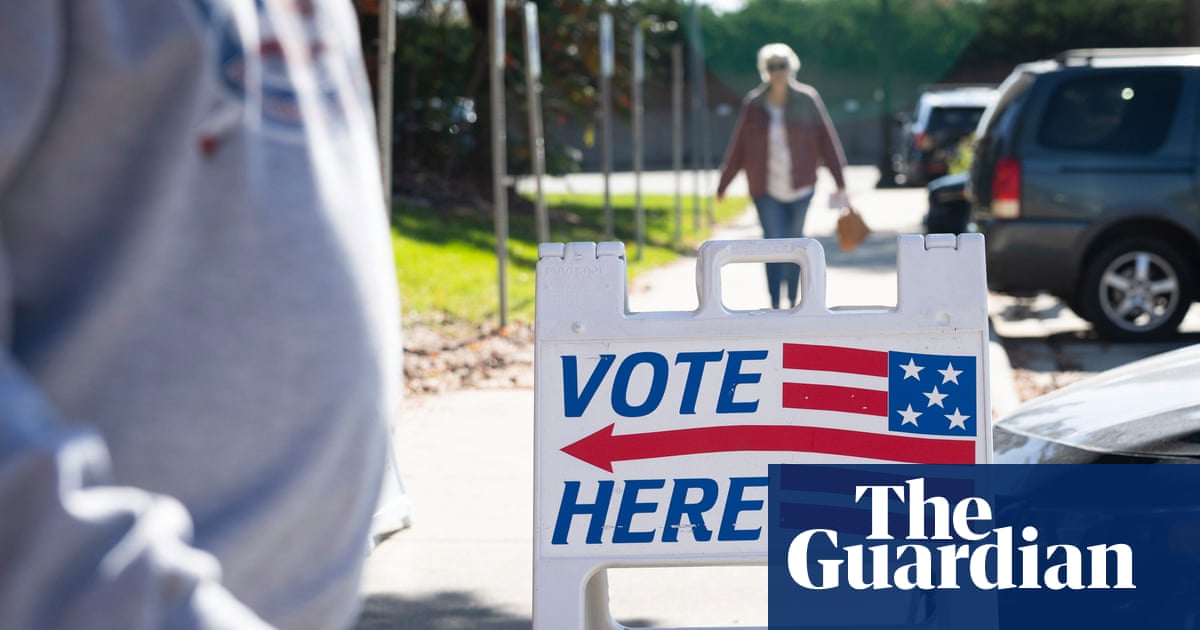
Stevie Lyn is angry at what she’s seen in her Phoenix, Arizona, neighborhood over the past year. Since US Immigration and Customs Enforcement (ICE) began conducting raids all across the city, her Latino neighbors on the west side have had to hide in their homes, too scared to grocery shop, work and vote. That’s why she volunteered to become a poll observer.
“I had to take the anger, because it was eating me alive, and direct it towards a constructive activity,” she said.
Lyn was trained by the grassroots non-profit organizations Living United for Change in Arizona (Lucha) and the Arizona Center for Empowerment (Ace), both focused on immigrant rights, to work the primaries in July. Sitting on the back hatch of her SUV 75ft from her local polling place – the legal distance allowed for poll observers in the state – she watched the area for any disorder or disturbances. She only encountered one problem in 10 hours: a campaigner for a local legislative candidate repeatedly walked with voters beyond the legal line. When she reported it, poll workers asked the campaigner to stay back.
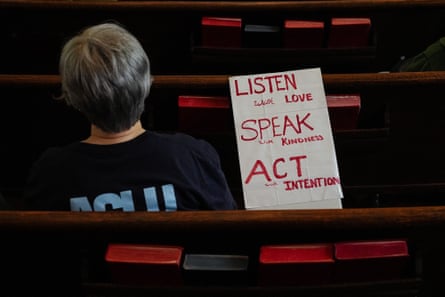
Lyn, who has been through observer training three times, called the primary a dress rehearsal. She has taken election day off work to observe again. She hopes she won’t have much to report. “I just want to be bored to death on 3 November,” she said. “That’s my goal.”
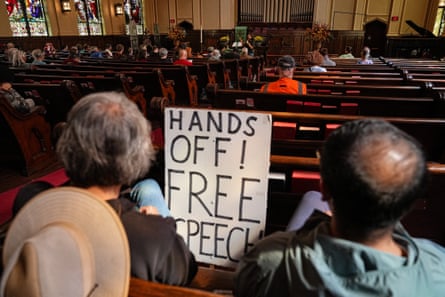
Lyn is one of the thousands of volunteers trained by organizations like Lucha and Ace to safeguard the polls against election interference. The US justice department plans to send about 1,000 federal monitors to polling sites, in what it has called the “biggest DOJ election observer effort in history”, claiming the effort will ensure elections are carried out fairly. But critics suing the government over the plan said it could intimidate voters. And the administration hasn’t ruled out sending ICE and other law enforcement officials to the polls. Poll observers want to be prepared to counter any intimidation, even if many expect election day to be business as usual.
“I am not naive about this administration and have my eyes wide open,” said Justin Levitt, a Loyola Law School professor and former Barack Obama justice department official. “But this administration wants to project power that it doesn’t have and finds it in their interest to get the electorate freaked out.”
Plans to monitor ICE – and Trump’s poll watchers
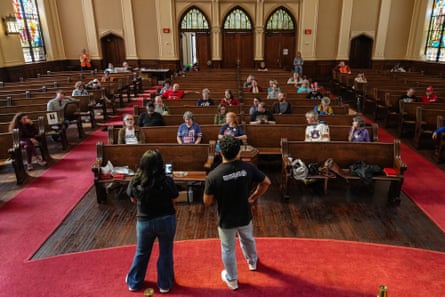
On a Monday night in late September, about 20 people logged on to learn how to protect voters in Arizona.
First, though, Karime Rodriguez, an organizer with Ace, told volunteers why the job “constitutional observer” exists. As immigration raids began surging in neighborhoods across Arizona earlier this year, Republican state lawmakers introduced a bill to station ICE agents at polling places. That’s when Ace decided to recruit and train volunteers for double duty: to monitor ICE activity in the Phoenix area’s most vulnerable neighborhoods and to keep watch at the polls during the midterms season.
“These aren’t abstract polling places,” Rodriguez told the trainees during the call. “These are our schools, our churches, our community centers where immigration enforcement has already been taking place.”
When Ace started mapping ICE activity in Maricopa and Pima counties, the map showed a pattern that the neighborhoods hit hardest by raids were often the same ones already facing barriers to voting, including polling place closures. In the two weeks before the July primary, the group recorded a spike in reported raids. There was also ICE activity around a few polling places in West Phoenix, a primarily Hispanic neighborhood. That alone discouraged some people from voting, Rodriguez said. Turning Point USA had a presence at a voting center in south Phoenix, and some voters told the groups they felt intimidated.
“ICE is in our neighborhoods and even people who are citizens are afraid that they’ll be taken if they go to vote,” said César Fierros, a spokesperson for Lucha. “We see the trucks driving by, the unmarked vehicles driving by. And we’re scared because we never know who is going to be in that vehicle.”
Organizers said the heat map has become the backbone of their election protection effort, using it to decide where to station observers and deploy its rapid response volunteers on election day. The groups’ plan is to have three or four observers at every polling place who must simply observe; if they see something suspicious, all they have to do is report it back to the leadership team. If ICE agents show up, they should also alert Lucha and Ace leaders, who will then send an alert within the group’s chat, post on social media or call for community members to show up. Volunteers who can’t be at the polls will answer phone calls and texts.
Groups like Lucha and Ace are preparing volunteers for election day all across the country. In Pennsylvania, more than 250 people participated in poll watcher training hosted by the state’s Democratic party on the same Monday night in September. They flooded the chat with questions: Could an ICE officer challenge a voter’s eligibility? Almost certainly not, a party lawyer said. Law enforcement officers can’t come within 100ft of a Pennsylvania polling place unless they are voting or the site is in a police building. The only exception he could imagine was an off-duty agent casting a ballot in his own precinct.
Jack Doyle, the communications director of the Pennsylvania Democratic party, said Democrats are building “an unprecedented voter protection program” that will deploy thousands of volunteer observers to priority locations, backed by volunteer attorneys in every county and a hotline staffed in English, Spanish, Mandarin, Vietnamese and Korean.
The American Civil Liberties Union (ACLU) has seen a similar surge. Since June, 68,000 new volunteers have signed up to be “democracy defenders”, said Molly McGrath, the ACLU’s director of national democracy campaigns, people who are ready to be called upon to watch polling places or protest in the event of election interference. The organization is focusing on battleground states, close House races and polling sites that serve historically disenfranchised communities and students, particularly in the south. The organization has recruited 1,700 poll monitors in Texas, 650 monitors in Georgia and 120 monitors in Arizona’s Maricopa county.
How election day could play out
Asked in May whether he would send ICE or national guard troops to polling places, Donald Trump said he would do anything necessary to ensure honest elections. After months of vague and contradictory statements, “administration officials confirmed a policy purporting to allow armed federal officers to conduct certain immigration and law-enforcement operations at polling locations despite acknowledging federal law that prohibits it”, according to a recent Democracy Forward report.
Still, voting rights experts are skeptical about Trump’s election monitoring plan, which Levitt said was not the largest in history. Before the supreme court’s 2013 Shelby County v Holder ruling weakened the Voting Rights Act, the justice department’s election observer operation was far bigger – and 1,000 monitors was the right size for spot-checking compliance with federal law, not for disruption, Levitt said.
Justice department monitors also carry no special authority. “They are subject to the exact same laws that any other observer in the state might be subject to,” said Lauren Miller Karalunas, senior counsel at the Brennan Center for Justice. In most states, she said, local election officials and law enforcement can remove observers who break the rules, federal ones included. Levitt pointed to Wyoming, where two justice department monitors sought access they weren’t entitled to during the primaries. Officials told them no, and they left.
What is unusual, Levitt said, is the publicity. The justice department typically doesn’t reveal details about its monitoring plan until days before an election. “To the extent there’s a strategy – it is very clearly messaging,” he said, referring to the administration’s election monitoring announcement. “Voters should continue to trust their local officials to deliver elections that are free, fair and well run.”
Organizers have raised some concerns that Trump could declare a national emergency to take control of elections. But no statute gives the president that power, Levitt said, and states and localities run elections. “The president is free to declare a national emergency all he wants,” Levitt said. “State and local election officials who do run the election process will likely ignore him.”
Sending armed federal personnel to active polling places, unless an agent is voting, has been a federal crime since the civil war era, he said. And the logistics would be daunting since most Americans can vote early or by mail, spreading any such operation across weeks.
Other ways Trump could undermine the election go beyond routine election day activities, including claiming election fraud (including claiming that noncitizens voted illegally), election machines were compromised, late-counted votes should be questioned or local election officials interfered with the results. The administration could also pressure local officials to delay or reject certification results or use a warrant or subpoena to take election materials, including ballots or voting machines. “These potential outcomes are all reasons why our work will continue past election day,” Rodriguez said.
Experts say the larger danger is that fear keeps people home. Karalunas worries that in addition to the messaging from the Trump administration, headlines about dueling armies of observers could lead some voters to skip the polls. Organizers, including the No Kings coalition, have encouraged voters to vote early and together to avoid any election day setbacks.
“For most folks, elections will go exactly as planned,” she said. Past predictions of mass observer deployments haven’t materialized and skeptics who watch the process up close often come away reassured, she said.
Levitt expects most poll observers will be “massively overprepared” and will spend election day pointing voters to the right polling place.
Organizers in Arizona say preparation is the point. Fierros said the groups want voters to feel confident, even joyful, when they arrive at the polls. “We’re not the ones fearmongering,” he said. “We’re the ones responding to the moment.”










Comments