
 German (DE)
  English (US)
  Spanish (ES)
  French (FR)
  Hindi (IN)
  Italian (IT)
  Russian (RU)
  2 weeks ago
In Watson v. RNC, decided June 29, 2026, liberal and conservative Supreme Court justices joined a noteworthy cross-ideological majority to uphold state grace periods for mail-in ballots. The decision, which went against President Donald Trump’s policy preferences, preserved the status quo, allowing states to accept and count mail-in ballots postmarked by Election Day but received after.
The case revolved around the meaning of “election day,” which federal law states is the Tuesday after the first Monday in November. The statute does not say anything about casting or counting ballots on or by Election Day.
The Constitution says the time, manner and place of elections will be managed by states. Thus, Mississippi’s Legislature passed a law in 2020 to count mail-in ballots if they are postmarked by and received within five days of Election Day. Thirteen other states and Washington also allow this grace period, which ranges from one day in Texas to 20 days in Washington. The Republican National Committee, the Mississippi Republican Party, the Libertarian Party of Mississippi and several individuals challenged the Mississippi law, saying it violates federal law because it allows the state to count votes received after Election Day.
Advocates argue that these grace periods are important, in part because irregularities in the postal service can make it difficult for people who use mail-in voting to get their ballots to an election official by Election Day. These challenges are more acute for people with disabilities and people living in remote areas or abroad.
As a legal scholar with expertise in veterans affairs, I’ve paid close attention to how the Watson v. RNC case could impact active-duty military and veterans, given the latter’s higher rates of disability and rurality.
Background on the decision
This Supreme Court ruling stems from a pandemic-era law to make mail-in voting easier. Before 2020, Mississippi required mail ballots to be received by 5 p.m. on the day prior to the election.
The pandemic changed voting behavior, with mail-in voting rates higher than they were pre-pandemic. Since Donald Trump lost the 2020 presidential election, after these laws were passed, the president’s critique of mail-in voting has often hinged on false election fraud claims. This helped make mail-in voting a partisan issue.
In the oral arguments, conservative Supreme Court justices asked about the possibility of grace periods making an election’s outcome uncertain for weeks or months. They also expressed concern that a person could potentially cast a ballot and then recall it after Election Day, which goes against the federal law’s purpose.
Liberal justices were concerned that reading the statute as requiring votes to be received on or by Election Day could undermine states’ efforts to expand voting access through early voting.
Interestingly, the decision did not turn on the issue of early voting; rather, the history and impact of active-duty military voting was central.
The conservative justices split on how to interpret the statute – how to interpret historical voting practices and previous court decisions. Justice Amy Coney Barrett and Chief Justice John Roberts joined the liberals. Barrett penned the opinion, saying that “election day” means the day by which someone chooses a candidate, not the day the ballots are received.
Importantly, the majority was concerned about preserving the Uniformed and Overseas Citizens Absentee Voting Act. This 1986 law, passed under Ronald Reagan, is the culmination of numerous efforts to ensure that active-duty military would be able to vote in federal elections.
The Uniformed and Overseas Citizens Absentee Voting Act clarifies that states can establish their own procedures for counting ballots. The majority in Watson v. RNC explained that this provision of the 1986 law would make no sense if states could not count ballots received after Election Day.
As a practical matter, if states were not allowed to count ballots received after Election Day, many active-duty military and their dependents would be disenfranchised. That’s because the main reason active-duty military votes are not counted is late-arriving mail.
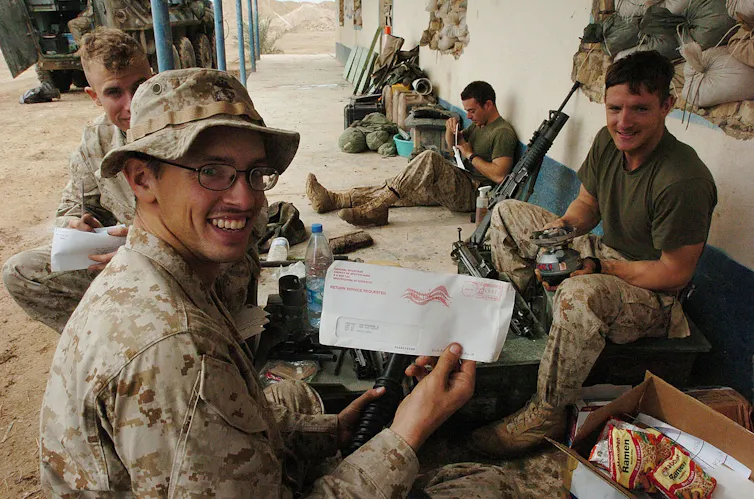
Mail-in voting and the military
Mail-in voting was first implemented to extend voting rights to active-duty soldiers during the Civil War. Soldiers submitted ballots to be counted and recorded by commanding officers, and their votes played an important role in the reelection of Abraham Lincoln.
The conservative justices split on how to interpret this history, since Civil War soldiers’ votes had to be received by Election Day. But Barrett’s opinion says that this practice tells us little about whether federal law required it.
Today, active-duty military and their families frequently go to great lengths to ensure they cast a ballot. In federal elections, they are voting for their commander in chief and members of Congress who control their budget. Many see it as a civic duty much like their military service. This sense of duty to vote remains even after active-duty military transition to veteran status.
For military stationed outside their home states or outside the country, mail-in voting is a necessity. Since 1942, Congress has passed laws to ensure that overseas military and their dependents are able to vote in federal elections. Current law protecting overseas voters requires that citizens abroad, including military, be sent their absentee ballots at least 45 days prior to the election.
The Justice Department’s Civil Rights Division has filed more than 30 lawsuits since 2000 against states and territories – including Vermont, Alabama and Guam – to ensure states properly mail and count absentee ballots of active-duty military and other Americans overseas.
In 2014, for example, a case against West Virginia ended in a judicial order that the state would count any ballots “executed” by Election Day but received up to 13 days later. Watson v. RNC reinforces these decisions designed to protect the voting rights of overseas military personnel.
Veterans’ voting rights
Veterans vote in higher proportion than the civilian population. Despite long-standing bipartisan support for veterans benefits, such as healthcare, their voting access has been controversial.
At the turn of the 20th century, Democrats tried to restrict voting rights for veterans because of their tendency to elect Republicans.
Historically, poor and disabled veterans have faced the biggest hurdles. For example, in the 1860s, Ohio state legislators passed a law so veterans in an Ohio residential facility would not count as Ohio citizens and, thus, would not be able to vote for congressional candidates.
Veterans often come from and return to rural areas, and many have disabilities, meaning they greatly benefit from mail-in voting policies because it is more difficult for them to show up in person to a polling location. Policies that make it harder for them to vote illustrate the negative impacts on Americans who also live in rural areas or are disabled, transient or otherwise unable to get to polling booths.
For these reasons, bipartisan veterans groups are actively engaged in protecting voting rights, and many have already spoken out in favor of the majority’s decision, which will help active-duty military and veterans be confident that their votes will be counted.
















Comments