
 German (DE)
  English (US)
  Spanish (ES)
  French (FR)
  Hindi (IN)
  Italian (IT)
  Russian (RU)
  3 weeks ago
Good morning. It has been two weeks since details of a settlement in the case of Trump v the Internal Revenue Service (IRS) first emerged. An out-of-court agreement with the US president created a $1.8bn fund for the Trump administration to dish out at its discretion. In response, the outrage has been unrelenting.
Critics argue the result stinks of cronyism and corruption, effectively a “scheme for the Trumps to reward political friends while indirectly benefiting the family”. There has been rare pushback from within Trump’s own party: more than a dozen Republican senators have reportedly urged the administration to change course. YouGov polling found a majority of Democrats and Republicans oppose the fund.
On Friday, a federal judge reopened the case, after a bipartisan group of federal judges filed a lawsuit in Florida arguing the settlement “is a product of collusion and is itself a fraud on the court”.
For today’s First Edition, I spoke to Guardian US political enterprise editor, George Zornick. We discussed the background to this case, Trump’s term of self-enrichment and how his (relatively) new team is covering Trump’s second presidency. First, the headlines.
Five big stories
-
UK politics | A trove of government documents about Peter Mandelson contains no record of any measures taken to mitigate serious security concerns over his appointment as Washington ambassador, the Guardian has learned.
-
Health news | A daily pill can double survival time in patients with the world’s deadliest cancer, according to the results of a clinical trial that experts are saying is a “gamechanger” and one of the biggest breakthroughs in decades.
-
Lebanon | European leaders have condemned Israel’s expanding incursion into Lebanon, after its military captured the medieval Beaufort castle and Benjamin Netanyahu vowed to push even deeper into the country.
-
Employment | An Indian citizen who came to the UK to work as a care worker through the post-Brexit visa scheme has been awarded nearly £30,000, because his employer failed to give him a single day of work for a year.
-
UK news | Facebook whistleblower Sarah Wynn-Williams was forced to sit in silence on stage at an event at Hay festival, after lawyers advised her not to speak because of ongoing legal action brought by Meta.
In depth: ‘The level of graft and self-enrichment is truly unprecedented’
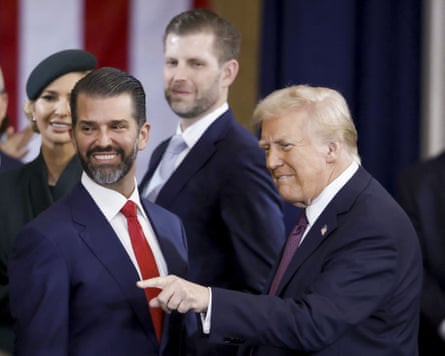
The settlement is a response to a federal case dating to January 2024, when an IRS contractor was sentenced to five years in prison for leaking the tax returns of high-net worth individuals. These revealed Trump paid just $750 in federal income tax in 2016 and 2017, and no federal income taxes in 10 of the previous 15 years.
Trump sued the IRS for $10bn over the leak, explains George. It seems to be a habit of his. A federal judge ordered a hearing to determine whether a president could sue federal agencies he oversees. “The IRS wrote an internal memo saying the lawsuit is weak and should be fought … Somewhere along the way, the administration overruled that position and settled.”
An agreement was announced: in exchange for dropping the lawsuit, US authorities would be “forever barred” from auditing the past tax returns of Trump and his family.
“It also created a $1.8bn fund to provide financial restitution to people subject to ‘weaponised lawfare’ from the federal government,” says George. This has been widely criticised as a slush fund of taxpayer cash to benefit Trump allies. Acting US attorney general, Todd Blanche, suggests anyone, not just Trump’s associates, can apply for financial restitution from the fund – although ultimately a five-member commission appointed by the attorney general, not a court or a jury, will get to decide on the merit of those applications – a highly unusual way of administering publicly funded compensation schemes.
Of the five commissioners appointed to oversee payouts, four are to be selected by Blanche himself, Trump’s personal lawyer turned legal enforcer. The fifth will be appointed in consultation with congressional leadership. “These commissioners can be fired at any time, and for any reason, by Trump himself. The idea that this is a non-partisan fund? I am sceptical,” says George.
It’s down to the sheer scale of stories like this emanating from the United States that the Guardian US’s political enterprise team was assembled. “Every day here … [there are] constant curve balls. It puts such pressure on the bandwidth of reporters and the attention span of readers,” says George. But with people specifically tasked with examining abuses of power at the federal level, George’s team are able to keep laser-focused. “We have the flexibility, once our teeth are in a story, to stay there.”
The White House is occupying much of their attention. “In my lifetime, and the modern era,” George tells me, “the level of graft and self-enrichment we are witnessing is truly unprecedented. I say this in a journalistically neutral way: there is no modern parallel.”
Power for profit
In 2016, in advance of his first presidency, Trump signalled he’d cede day-to-day control of his businesses to avoid conflicts of interest. Despite a 2017 announcement that he was handing control of his empire to his sons, Donald Jr and Eric, it soon transpired the fledgling president retained direct ties to his commercial ventures.
“His message then was, ‘I am stepping back from all of this’,” says George. “It wasn’t believable.”
Trump has lamented the lack of deals he made during his first tenure. This time, there’s no such pretension: “I found out that nobody cared. I’m allowed to,” he told the New York Times.
In January, the New Yorker suggested that Trump and his family have racked up profits in the region of $4bn by leveraging his presidential position.
The Trump family has been busy. “[Trump’s sons] Eric and Don Jr, and [son-in-law] Jared Kushner are conducting deals in places that are key to US foreign policy, building towers, golf courses and resorts.”
None of this is likely a coincidence, George believes. “Foreign governments, as part of their strategy to deal with Trump, are green-lighting projects where you wonder: would that really have been allowed otherwise?”
The domestic market is proving just as lucrative. “The sons have been particularly fast to spin up companies – whether drones, AI, crypto – which have been pretty good at winning big government contracts.” Last week, ProPublica reported that the White House asked the Pentagon to give a $620m loan to a company with ties to Trump’s eldest son. The Trump family cryptocurrency firm, meanwhile, has seen their wealth balloon by billions. A minority stake is owned by the UAE: its $500m investment steered $187m to Trump family entities.
An administration uninhibited
Allegations of self-enrichment from Trump’s first term focused on Trump’s Mar-a-Lago resort. “People would spend money eating, staying renting the ballroom, hopefully on a weekend the president was there” – all of which, critics argued, was a way to keep a steady stream of income flowing towards the president’s businesses.
Since taking office again, this has continued, “but in the second term, it’s a lot more out in the open”, says George, adding that he believes it’s been “turbo-charged”.
A 2024 supreme court ruling would certainly embolden any president looking to push limits and line pockets. In Trump v United States, justices decided former presidents have absolute immunity from criminal prosecution for “official acts”. “This is defined very broadly in the judgment,” says George.
“It also gives the president the power to pardon anyone in the administration,” he says. “Now, anyone working in the Trump administration who sees an opportunity to make money in a legal grey area or worse, knows Trump can pardon them at the end of his term.” George thinks the effects of the ruling go further. “You know that if you want that pardon in late 2028, you better stay in Trump’s good graces,” he says.
And if Trump now looks invincible to many of his supporters, you can see why: “[He left] the White House in the middle of a pandemic with terrible approval ratings. There was a riot in the capital. He [was then] hit with all these charges,” says George. Going into the 2024 election, Trump stood accused of 91 felony counts.
But then: “He beat the charges and came back to the White House.”
The new normal?
It’s widely understood that, in Washington DC, money talks. The US federal lobbying industry was worth billions long before Trump’s presidency. Wealthy donors are also handed plum jobs by Democrats. “This has always been somewhat the case,” says George. “People in each party raise billions from wealthy individuals and special interests to campaign. Certain positions are quite clearly patronage jobs.”
But George distinguishes this from what we are witnessing now: “It’s apples and oranges. This is the blending of his business pursuits with the business of being president, and allowing people he appoints to enrich themselves as they go about conducting the business of the White House.”
With the midterms coming in November, Trump’s opponents are looking for leverage. “Democrats will likely focus on corruption,” he says, “and the potential 2028 candidates already doing so. If they win with that message and mandate, and control Congress – two big ifs – you can see an early 2029 far-reaching anti-corruption package coming out of Congress.” Still, the supreme court’s presidential immunity ruling is going nowhere soon.
“The bigger question,” says George, “is the extent of the corrosive effect on American democracy, and to what extent people become numb to it.”
In recent months, he has been thinking about the optics Trump creates in the Oval Office. “When he has cameras in, Trump sits at the desk with all his people standing around him. It is almost like a king: I am the boss, I will do what I want and take my spoils.”
What else we’ve been reading

-
This morning’s New start after 60 story from a woman who became a full-time carer – about the ways our world can expand even as it feels as if is shrinking – is surprising in the most wonderful of ways. Poppy Noor, newsletters team
-
When Reform took control of Durham county council, cutting every penny of funding for the city’s annual Pride event was a priority. Hannah Al-Othman has a heartwarming report on how trade unions stepped in to keep the event afloat. This year’s parade held on Saturday was the biggest in its history. Michael
-
I easily get stuck in the habit of eating the same (delicious) meals over and over again. So Ann Lee’s list of Korean dishes to try – including some dumplings that sound particularly appetising – made me very excited. Poppy
-
I’m obsessed with Saturday magazine’s This is how we do it column, and this week’s was fascinating: “I was looking for a one-night stand. Now we’re married with two babies.” Michael
-
I was touched looking through the images from photographer Martin Parr’s funeral. He found beauty in life’s small details, and the send-off his family organised, inspired by his work, felt like a window into something very intimate and resonant. Poppy
Sport

Football | About 75 people had to be rescued from height and 16 people were arrested during Arsenal’s victory bus parade on Sunday, emergency services said.
Women’s FA Cup | Manchester City’s Khadija Shaw has been praised for not allowing speculation about her future to hinder her performances, after she scored the first goal in Sunday’s 4-0 Cup win over Brighton.
Cycling | Jonas Vingegaard completed his Giro d’Italia triumph, securing the first part of a coveted Grand Tour double in a procession finale around Rome won by the home hero Jonathan Milan.
The front pages
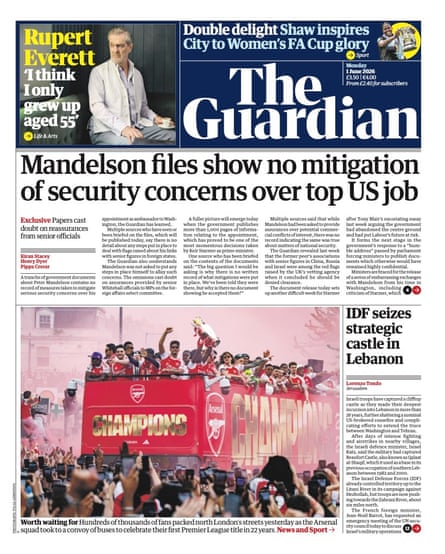
“Mandelson files show no mitigation of security concerns over top US job”, is the Guardian’s front page today.
Elsewhere on the political front, the Times leads with “Reform vote in unions at same level as Labour” and the Mail splashes “You’ve not won anything yet, Andy!”. The Telegraph runs with “Reeves looks at PFI to fund new towns” while the i Paper says “Leadership rivals back revolution in UK voting system”. Metro has “Sturgeon: 25ft motorhome? I didn’t spot it”.
The Express leads on “Cancer hope for millions as drug doubles survival”, and on the same story the Mirror says “Precious gift of time”. Lastly, the FT splashes “Wall St’s bulls bet US stocks rally has further to go”.
Today in Focus
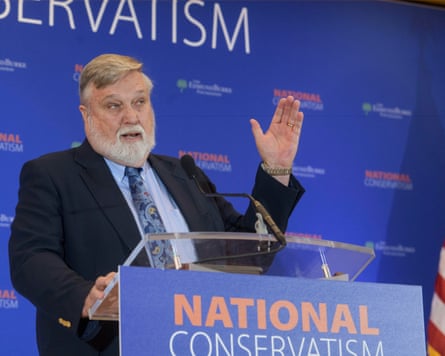
‘A husband expects a yes’: wife schools and the Christian nationalist movement
Alaina Demopoulos, a features writer for Guardian US, reports on the Christian influencers telling women to submit to their husbands. And Mariah Wellman, an assistant professor at Michigan State University, explains what a shifting culture on women’s rights means for policy.
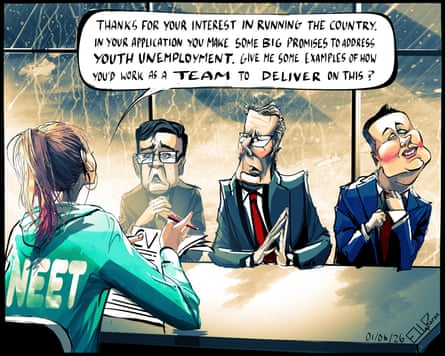
Cartoon of the day | Ella Baron
The Upside
A bit of good news to remind you that the world’s not all bad

It’s a tonic for burnout, anxiety and insomnia, and it’s not the latest peptide or wellness trend. Although it can’t cure all ailments, being outdoors in nature is “a great healer”, according to Guardian readers, who responded to a recent study finding that almost half of adults in the UK spend fewer than three hours a week outdoors in nature, and shared stories about why being in nature means so much to them.
Hannah Powell, who has dealt with burnout and functional neurological disorder told us: “I have to look at plants every day.” David Lynch, meanwhile, says of being outside: “I am more fully human, my whole self. Anxiety levels drop, all worldly concerns are put in perspective and I feel younger.” Others shared the gratitude they feel to be in green spaces. In the words of reader Yve: “I believe that nature and being outdoors is a great healer.”
Sign up here for a weekly roundup of The Upside, sent to you every Sunday
Bored at work?
And finally, the Guardian’s puzzles are here to keep you entertained throughout the day. Until tomorrow.








Comments