
 German (DE)
  English (US)
  Spanish (ES)
  French (FR)
  Hindi (IN)
  Italian (IT)
  Russian (RU)
  1 hour ago
Octavius Valentine Catto died as he lived, advocating for a more equitable society. Accordingly, the city of Philadelphia has decided to honor his legacy – again.
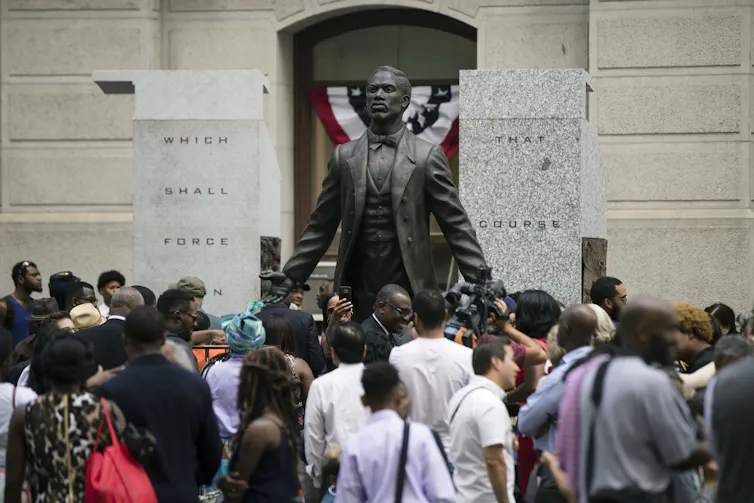
Philadelphia previously honored Catto with a commemorative statue outside City Hall in 2017. Of the city’s 1,500 public statues, it was the first to honor an individual Black person.
On Oct. 8, 2026, the intersection of 8th and South streets was formally renamed Octavius Catto Way. This is where Catto was assassinated 155 years ago during a tumultuous Election Day in 1871.
Speaking at the renaming ceremony, NAACP Philadelphia Branch President Catherine Hicks said the moment was about ensuring Catto’s legacy was remembered and understood.
As a civil rights lawyer and professor in the Africology and African American Studies department at Temple University, I find Catto’s activism immensely important. I hope more Philadelphians are encouraged to learn about Octavius Catto, the man former Philadelphia Mayor Jim Kenney described as the “Jackie Robinson and Rosa Parks of his day.”
A teacher, baseball player and civil rights leader
Octavius Catto was born in Charleston, South Carolina, in 1839 to a free Black woman named Sarah Isabella Cain and a formerly enslaved man named William Catto, who purchased his freedom and later became a Presbyterian minister.
William Catto brought his family north to Baltimore with plans to eventually travel to Liberia as missionaries. William Catto had to adjust his plans when members of Charleston’s Presbyterian leadership discovered a letter he had written they believed would incite an insurrection among enslaved people. They alleged the letter would “excite discontent and insurrection among the slaves.” An arrest warrant was issued for William and Sarah. They fled Baltimore and later settled in Philadelphia. There, William Catto would become an abolitionist, which had a profound influence on his son Octavius.
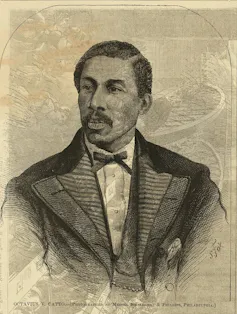
Octavius Catto spent his formative years and subsequently launched his career as a public servant in Philadelphia. He attended the Institute for Colored Youth – now Cheyney University – and graduated at the top of his class in 1858.
The next year, he started teaching English and mathematics at the institute. By his early 30s, Catto had worked with Frederick Douglass to recruit all-Black regiments to fight for the Union Army during the Civil War. He co-founded, managed and played for an all-Black baseball team, the Philadelphian Pythians baseball club. He also worked with other civil rights leaders like Lucretia Mott and his fiancé, Caroline LeCount, to desegregate Philadelphia’s horse-drawn streetcars and the Franklin Institute.
The fight for Black suffrage in Philadelphia
More than a century before the civil rights protests erupted in Selma and Birmingham, Octavius Catto led desegregation efforts and voting rights campaigns in Philadelphia in the 1860s. The New York Times covered some of his desegregation efforts in 1867.
His civil rights advocacy was met with violent opposition, especially after the ratification of the 15th Amendment in February of 1870. The 15th Amendment guaranteed voting rights for citizens regardless of their “race, color, or previous condition of servitude.” Legal scholars such as Travis Crum argue the 15th Amendment “re-founded the United States as a multiracial democracy.” It gave the federal government key enforcement powers that prior legislative acts that secured the right to vote – such as the First Reconstruction Act – did not have.
In 1780, nine decades before Catto’s murder, the Pennsylvania General Assembly had passed the Act of Gradual Abolition of Slavery, which set the conditions freeing Pennsylvania’s enslaved people. It was the first legislation of its kind in America.
Despite these provisions, varying interpretations of Pennsylvania’s Constitution of 1776 left it unclear whether Black men could vote without restriction. The state Constitution restricted the vote to freemen, which it defined as “of full age of twenty-one years, having resided in this State for one whole year before the day of election … and paid public taxes during that time.”
Sixty-two years later, the state made it painfully clear who it intended to allow to vote. In 1838, Pennsylvania’s Constitution explicitly restricted the right to vote to “white freemen.”
Philadelphia became a key location for the fight for suffrage and other pivotal civil rights. The city had a large Black population, a storied history of abolition and an abundance of Black institutions, yet racial discrimination was still endemic.
Targeted by white supremacists
Election Day of 1871 was one of the most consequential in the history of Philadelphia, at the time an epicenter for the simmering tensions surrounding Black suffrage. According to W.E.B. Du Bois’ “The Philadelphia Negro,” about 5,500 Black men were eligible to vote in 1870. The prospect of Black men voting in the election sparked violent outrage in the city.
Both city officials and private citizens engaged in targeted violence to intimidate Black voters. Armed mobs harassed Black neighborhoods, attacked residents and forcibly closed polling locations.
Four Black Philadelphians – Levi Bolden, Isaac Chase, Jacob Gordon and Moses Wright – died during the coordinated racial violence that occurred that day and the evening before. It all left many of the city’s Black residents “considerably frightened,” according to a Philadelphia Inquirer report. Catto became a fifth victim.
Around 3:30 p.m., Catto was standing near his Philadelphia home when Frank Kelly, a political operative who opposed Black suffrage, fatally shot him.
Catto’s impassioned advocacy had made him a target of white supremacists in the region, but he did not waver in the face of this growing danger. In speaking of Catto’s legacy, Du Bois wrote, “And so closed the career of a man of splendid equipment, rare force of character, whose life was so interwoven with all that was good about us, as to make it stand out in bold relief, as a pattern for those who have followed after.”
Dedicated to empowering Black Philadelphians
Philadelphia Martyrs Day is an annual observance that pays homage to the five Philadelphia men who fought for Black suffrage and were killed in the 1871 election. These memorials often emphasize Catto because of his civil rights and voting rights advocacy.
Despite this and the statue outside City Hall, I and others in Philadelphia believe Catto’s influence remains largely unsung. In describing the importance of the street renaming, Leland Morroccos, executive director of It’s the Little Things Foundation, a local civic engagement and community advocacy organization, said, “Octavius Valentine Catto deserves to be remembered not simply as a name in Philadelphia’s history, but as a man who devoted his life to educating, organizing and empowering Black Philadelphians to participate fully in the civic life of their city and their country.”
“Philadelphia should forever remember Octavius V. Catto,” Morroccos continued, “not only for how he died, but for how he lived, what he believed, and the doors he worked to open for others.”
I hope all who stroll along Octavius Catto Way will come to learn that too.
Read more of our stories about Philadelphia and Pennsylvania, or sign up for our Philadelphia newsletter on Substack.














Comments