
 German (DE)
  English (US)
  Spanish (ES)
  French (FR)
  Hindi (IN)
  Italian (IT)
  Russian (RU)
  3 weeks ago
Benjamin Netanyahu has called for negotiations with Lebanon after worldwide condemnation of Israel’s intense bombardment of Beirut and other Lebanese cities, which threatened to undo the US-Iran ceasefire before it was barely a day old.
The Israeli prime minister said the talks should focus on the disarmament of Hezbollah and the establishment of “peace relations” with Lebanon, but gave no undertaking that the bombardment would stop, and there was no immediate sign of a let up in Israeli strikes. The Lebanese government had requested a ceasefire before talks began.
More than 200 people were killed by Israeli bombing in the 24 hours after the announcement of a ceasefire in the Iran war on Tuesday night. The bombardment, ostensibly aimed at Hezbollah targets, included strikes with heavy munitions on densely populated areas, which drew outrage from the International Committee of the Red Cross and other international humanitarian organisations.
The ferocious attack on Lebanon had threatened to derail hopes of a negotiated end to the war in Iran, which began with a US-Israeli attack on 28 February. Despite claims by the US president, Donald Trump, that the Pakistani-brokered ceasefire had marked significant progress towards bringing a durable peace to the Middle East, the truce looked in danger of collapsing on its first day.
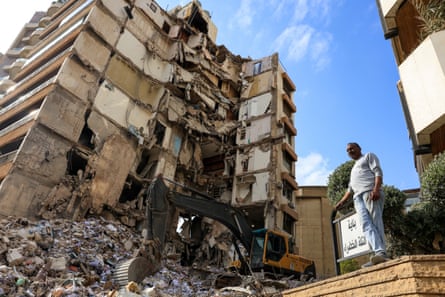
Iran warned that, in response to the Israeli attacks after the ceasefire, it would once more close the strait of Hormuz, the economically critical waterway it had agreed to open for the two-week duration of the ceasefire. The country’s president, Masoud Pezeshkian, said negotiations were “meaningless” as long as Israel continued to bomb Lebanon, placing in doubt US-Iranian talks in Pakistan scheduled for Saturday. Pezeshkian vowed Iran would not abandon the Lebanese people.
According to Iran’s deputy foreign minister, Saeed Khatibzadeh, Iran had been held back from responding forcefully to Israel’s escalation in Lebanon by Pakistani intervention urging restraint in the interests of a broader peace agreement. Pakistan’s prime minister, Shehbaz Sharif, condemned Israel’s “ongoing aggression against Lebanon”.
Netanyahu had insisted Lebanon was not included in the Tuesday night ceasefire agreed by Donald Trump, and vowed the Israeli military would continue to strike Hezbollah targets “wherever necessary”. The Israeli prime minister said his forces had killed the secretary to Hezbollah’s leader, Naim Qassem.
Trump himself backed Netanyahu’s version, telling the public broadcaster PBS that Lebanon was “not included in the deal” because of Hezbollah’s role. He referred to the conflict in Lebanon as a “separate skirmish” from the Iranian war and added: “That’ll get taken care of, too. It’s all right.”
CNN reported that Netanyahu’s announcement of peace talks with Lebanon had come at the urging of the US president, who is keen to extricate the US from a war that he was persuaded to join by Netanyahu, according to multiple accounts of the lead-up to the conflict.
The US vice-president, JD Vance, assigned to lead the US delegation to peace talks in Pakistan, suggested there had been a “legitimate misunderstanding” on the geographic reach of the ceasefire deal.
Pakistan, which accelerated its mediation efforts after Trump threatened a civilisation-ending onslaught, has said Lebanon had been part of the agreement.
Robert Malley, a former American envoy who led earlier US-Iranian negotiations, said: “I would trust the Pakistani mediator that Lebanon was included. They put out a statement that it was included and we did not hear any American correct the Pakistani version for many hours.
“It looks like a case of the US reneging and giving the Israeli prime minister [permission] to go ahead [with bombing] for another 24 hours before they are ‘restrained’”.
Malley said the best-case scenario for peace talks in Pakistan was that the region was returned to the status quo before the US-Israeli attacks began on 28 February, with the strait of Hormuz open, and options for limiting Iran’s nuclear programme on the table along with some form of financial compensation for Tehran.
Authorities in Islamabad began implementing strict security measures in anticipation of the arrival of delegations for talks, expected to begin on Saturday.
As the future of the ceasefire looked in peril, Trump issued his latest ultimatum on social media, vowing a return to US attacks (as he put it, the “Shootin’ Starts”) if Iran failed to comply with “the real agreement”. He made clear that Tehran had to reopen the strait of Hormuz fully to international shipping, and that it should have “no nuclear weapons”. He did not mention Lebanon.
US allies have insisted the ceasefire should be comprehensive. A joint statement by the UK, EU countries, Canada and Japan called on “all sides to implement the ceasefire, including in Lebanon”, where Israel is seeking to destroy the Iranian-backed Hezbollah movement.
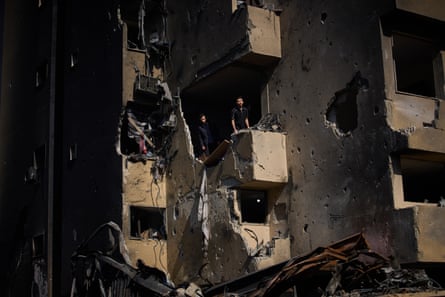
Kaja Kallas, the EU foreign policy chief, said on Thursday: “Hezbollah dragged Lebanon into the war, but Israel’s right to defend itself does not justify inflicting such massive destruction. Israeli strikes killed hundreds last night, making it hard to argue that such heavy-handed actions fall within self-defence.”
France’s foreign minister, Jean-Noël Barrot, condemned the Israeli strikes as “unacceptable” and his British counterpart, Yvette Cooper, described them as “deeply damaging”, adding that failure to include Lebanon in the ceasefire would “destabilise the whole region”.
Diplomatic efforts worldwide have focused on reopening the strait of Hormuz, the gateway to a fifth of the global flow of oil and liquefied natural gas. Only 11 ships – four Iranian, four Greek, one Chinese, one Omani and one unknown – were allowed to pass through the strait in the 24 hours after the ceasefire, less than a tenth of the prewar flow.
About 1,400 ships remain anchored in the Gulf, trapped first by the war then the uncertainty that has accompanied the vague and shaky truce. After an initial plunge in the global oil price after the announcement of the ceasefire, it began to creep up again towards $100 a barrel on Thursday.













Comments