
 German (DE)
  English (US)
  Spanish (ES)
  French (FR)
  Hindi (IN)
  Italian (IT)
  Russian (RU)
  3 weeks ago
Smitha MundasadHealth reporter

 BBC
BBC
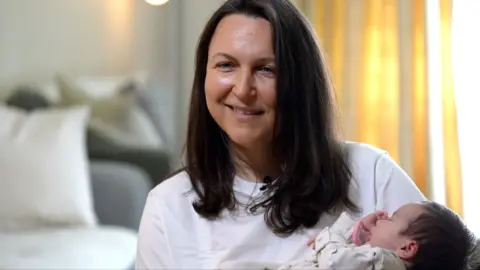
New mum, Tania Esparza, says pregnant women are "becoming more specialised for the job"
"Baby brain" is a cliche long-used to describe women becoming forgetful and feeling less capable during pregnancy.
But a recent study - the largest to date - indicates that pregnancy has a profound structural impact on brains and offers new clues into the neurological changes in mums‑to‑be.
It suggests that grey matter - the nerve-rich part of the brain involved in processing information, emotions and empathy - decreases by an average of nearly 5% during pregnancy.
But rather than being a cause for concern, these changes may be beneficial when it comes to caring for newborns, say scientists working on the project in Spain.
One of the dozens of women, now a new mum, who took part in the study told us she welcomed the findings and was "tired of pregnant women being infantilised".
"Rather than becoming dumber, we are becoming more specialised for the job," said Tania Esparza.
The BBC was given exclusive access to the Be Mother project and those who have been taking part in it.
The brains of 127 pregnant women were scanned - before, during and after pregnancy - and compared to scans from a smaller number of women who were not expecting.
The greater the changes in the brain, the more likely women were to say they were relating to, and bonding well, with their babies - the team of scientists found.
These might be positive changes when it comes to caring for newborns, says Prof Susana Carmona, at the Gregorio Marañón Health Research Institute in Madrid.
"We find in biology, as in life, sometimes less is more."
This could represent the brain "rewiring" or remodelling its architecture to "prime it for motherhood", says Carmona, co-lead of the study along with Prof Oscar Vilarroya.
"I like to use the metaphor of pruning a tree," she says. "Some of the branches are cut to make it grow more efficiently."

The brain could be rewiring in a positive way to adapt for motherhood, says Susana Carmona
Pregnancy changes many organs in the body - the mum's heart can grow bigger, the capacity of her lungs can increase - and so it makes sense pregnancy can change the brain too, Carmona says.
We should not just focus on potential memory deficit, she says. "New mums learn a whole set of new skills."
Studies of the brain during pregnancy are few and far between - but more research is needed into this pivotal time in women's lives, she adds.
The mums-to-be in Madrid and Barcelona had five MRI scans each, they also took hormone tests and filled in questionnaires about how their emotions changed during and after their pregnancies.
For comparison, the team also scanned the brains of 52 women who had never been pregnant. This included 20 women who were partners of pregnant women already involved in the research.
"We did this to try to start to tease out whether the changes they saw were to do with the biological process of pregnancy or more the process of becoming a mum," Carmona says.
There is more to parenting than pregnancy, she added: "You can be many types of parents, and you don't need to be pregnant to be a good one."

Dozens of women, most of them pregnant, were studied in Madrid and Barcelona
The study, published in the journal Nature Communications, was not designed to look directly at the long-held notion of so-called baby brain - the brain fog and memory problems that some women say come with pregnancy. Even so, it offers clues that the brain does change structurally.
While the pregnant women lost an of average nearly 5% of their grey matter, it then partially returned - although not fully - by six months after giving birth. In contrast, the amount of grey matter in the women who were not pregnant stayed quite steady.
There will be a small amount of fluctuation in every person's grey matter over time, but these results with a dip of nearly 5% are unexpected, Carmona says.
One of the areas of grey matter with the most pronounced and persistent changes was the so-called default mode network - which is involved in self-perception, empathy and altruism.
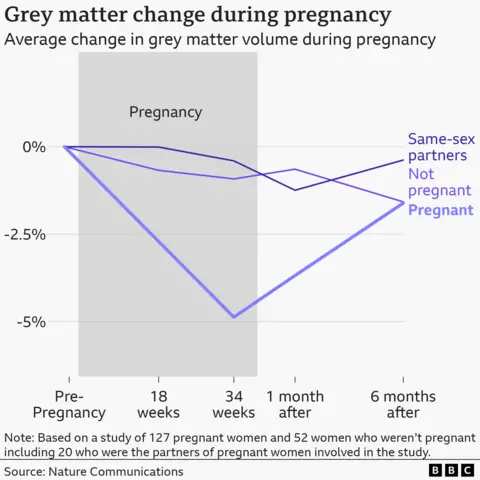
The transformation could be down to the pruning of nerve networks, and changes to blood vessels and cells that support nerves, says Carmona, and could represent the brain rewiring in a positive way.
It has long been argued there is a similar phenomenon seen in adolescence as the brain matures from childhood to adulthood, she says.
A number of studies in teens have suggested a pattern of grey matter thinning through adolescence with a "refining or pruning" of nerve networks as brains mature.
There are also decades of animal research that reveal pregnancy is a time of profound brain alteration for several mammals, adds Carmona.
Some studies in mice have suggested that pregnancy hormones work on specific groups of nerve cells in the brain to help "turn on" parenting behaviour. Without these hormones, mice virtually ignore their new offspring.
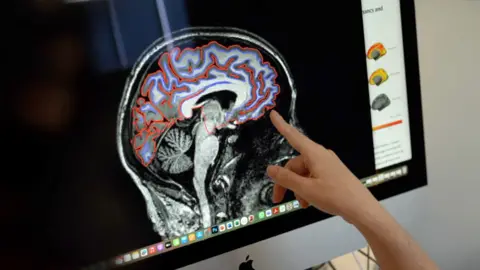
Scientists measured the amount of grey matter shown in the brain scans
Carmona's team found that hormones may be a key part of the process in humans.
The scientists collected urine and saliva samples from the women on five occasions and discovered that, in some cases, rising oestrogen levels tracked closely with the reduction in grey matter.
Much more work is needed to build a detailed neurological map of the pregnant brain and to chart how it transforms during the transition to motherhood, says Carmona - whose study is funded by the European Research Council.
This could help not just with pregnancy in general, but also when things go wrong, including postpartum depression, she says.
Prof Liz Chrastil, from the University of California, agrees and says Carmona's work is important because it can also "help with attachment between caregivers and infants, and to find better ways to provide support and recovery for new moms."
This study did not look specifically at changes in women's memory functions during pregnancy, but, in 2016, Carmona's team carried out a small study of 25 pregnant women and saw no significant change - although evidence from other studies is mixed.
And she says some women do feel more forgetful and she doesn't want to diminish women's varied experiences.
"Pregnancy places a huge metabolic load on your body," she says, "so you may have less energy and less sleep and feel less alert and forgetful."
Ana Mudrinic, a new mum we spoke to in London, says that, at times during her pregnancy, she felt forgetful and explains: "I wanted to send an email to my boss and in that moment, I simply couldn't remember her name."
I might forget to do things not related to my baby, but I've learnt to prioritise her, says Ana
On the other hand, she says she is now more resilient in her job: "I don't get emotionally impacted by stress as I used to before, because all of a sudden, some things are not as important as they used to be."
"I might forget to do things that aren't related to [my baby], but I've learnt to prioritise her," she says.
Back in Spain, Tania Esparza says Carmona's earlier work in this field had influenced her decision to have a child.
"I was excited by the idea that I could meet a new, different version of myself."
She says it is time to rethink how we are treating mothers.
"They are undergoing tremendous transformation, and we need to approach them as someone who is coming outside of a cocoon and becoming something different."
















Comments