
 German (DE)
 English (US)
 Spanish (ES)
 French (FR)
 Hindi (IN)
 Italian (IT)
 Russian (RU)
 2 hours ago
Three times a week, Amber Titus wakes up at 5 a.m. to get ready for the 45-minute drive to the methadone clinic.
Titus, 38, and her husband live with their two young children in Bisbee Junction, Arizona, a rural community near the U.S.-Mexico border. The couple started taking methadone, a medication that treats opioid addiction, in early 2025.
“It’s been a godsend,” she said.
But accessing methadone is not easy. The closest place they can receive treatment is a clinic in Sierra Vista, about 30 miles from their home.
The clinic opens on weekdays at 4:30 a.m. but closes before midday. Titus has to get her methadone dose and arrive at work in Bisbee before her shift starts at 9 a.m.
Arriving just 10 to 15 minutes late for an appointment can mean missing a dose because rules are so strict, she said, even when the clinic is still open.
That’s the routine when they have their own transportation. In August, their car was totaled in a crash. Until they got another one, Titus called Medicaid, her insurance provider, to schedule rides to the clinic.
“They said they’d be at my house at 6 o'clock in the morning,” Titus told The Conversation. The driver was late every day. “I missed my methadone dose for the whole week,” she said.
Nationwide, more than 120 people a day died from opioid overdoses in 2025, according to federal estimates. Methadone is one of the most effective medications for opioid use disorder, cutting the risk of fatal overdose by roughly half. Yet only 22% of people with the disorder ever receive it.
For more than five decades, only specialized, government-approved clinics, known as opioid treatment programs, have dispensed methadone, not regular doctors or pharmacies. Many clinics require patients to show up in person every single day, with average one-way drive times approaching 50 minutes in rural communities.
Today, private equity firms have acquired large shares of the market for methadone clinics, telling lawmakers their capital has expanded treatment and modernized care.
I am a healthcare economist at Brown University who studies how private equity is reshaping American medicine. My recent research on private equity’s growing footprint in addiction treatment, co-authored with researchers from the University of Pittsburgh and RAND, found that despite acquiring over one-third of methadone clinics in the U.S., private equity investments have not expanded methadone availability or the construction of new facilities.
This research has informed federal investigations into the role of private equity in expanding access to medications for addiction treatment. Currently, U.S. Sen. Maggie Hassan, D-N.H., has an investigation into three of the country’s largest methadone clinic operators, citing concerns that they oppose expanding treatment access for financial reasons rather than patient safety.
Why methadone fits the private equity model
Because methadone is so tightly regulated, opioid treatment programs are, in effect, a government-created monopoly.
In most of the country, if you want methadone, there’s a short list of clinics licensed to give it to you and no other way to get it. Moreover, people with opioid use disorder generally must travel to opioid treatment programs every day, where staff must observe them taking methadone, with strict limits on how much methadone patients can take home and when they can do so.
Take-home methadone varies based on the state, time in treatment and clinician discretion. Only 19% of people who received take-home methadone received three or more days’ supply.
That kind of guaranteed, captive demand is exactly the sort of investment that can be profitable for private equity investors. Whoever controls the clinics in a region controls access to the medication and can set the terms for patients in most need of medication.
Private equity firms have invested more than US$1 trillion in U.S. healthcare over the past two decades, touching everything from fertility clinics to hospice care. Many Americans have never heard the term private equity, but these firms now own more than 400 U.S. hospitals and oversee doctors in more than a quarter of the country’s emergency rooms.
In opioid treatment specifically, firms have used a platform and add-on strategy: buying one large clinic, then steadily acquiring smaller nearby ones, similar to a company quietly buying up every gas station in a county until, years later, one owner controls them all. Individually, each deal looks too small to matter. Collectively, a single firm can end up controlling an entire region’s methadone supply.
To be clear, private investment isn’t inherently harmful. Research shows that in markets where quality is easy to see, competition is robust and there’s no government subsidy – restaurants, for instance – private equity can have neutral or even positive effects. Healthcare has none of those features. Patients often can’t judge provider quality, they rarely pay for care directly, and government programs act as both payer and regulator.
Market share grew, methadone supply didn’t
My research has quantified what actually happened after private equity acquisitions of opioid treatment programs.
Previous research I have done, which my ongoing work builds upon, examined acquisitions from 2011 to 2019 and found that within two years of a private equity firm moving into a county, it typically controlled 67% of the local methadone treatment market – and in more than a quarter of counties, a single firm controlled all of it.
Despite acquiring that much market power, these acquisitions generally do not result in the construction of new methadone clinics or an increase in methadone treatment. Additionally, the data shows that methadone shipments, or what clinics have to dispense to patients, and opioid-related deaths were unchanged during the study period.
In plain terms: Private equity firms haven’t been building new capacity – they’ve been buying up the capacity that already existed.
As of October 2026, there are 1,572 methadone clinics registered with the Centers for Medicare & Medicaid Services. Nationally, 35% of opioid treatment providers are affiliated with private equity firms, and in 19 states and the District of Columbia more than half have private equity owners.
Montana has four clinics, all owned by Community Medical Services, more commonly known as CMS. The company was operating there before it was acquired by private equity. In North Dakota, CMS owns three of the state’s four methadone clinics. In Arizona, CMS owns the Sierra Vista clinic where Titus gets her methadone.

In 2018, a prospective investor advised shutting down CMS’ Montana and North Dakota clinics as unprofitable. Nick Stavros, CEO of CMS, opted to partner with a different private equity firm to keep the clinics open.
Before private equity investment, CMS had 14 clinics in four states. It now has 79 clinics in 14 states, according to Stavros. The total includes five clinics in prisons and three mobile units.
Unlike the typical private equity investment strategy of acquisitions, a majority of the company’s recent growth – 49 clinics – has come from new sites, he said.
No expansion has taken place in Montana. Building a new clinic costs about $2.5 million, more than many rural areas can support, Stavros said.
Proponents of private equity ownership argue it can help fill gaps left by inadequate public funding for addiction treatment. The strongest evidence in their favor: One study found clinics became significantly more likely to accept Medicare and Medicaid after acquisition, likely because large chains can afford administrative infrastructure that small, independent clinics cannot. That’s a real benefit worth acknowledging.
But look past insurance acceptance and ask whether more people are actually getting – and staying on – treatment, and the picture darkens.
For buprenorphine, a related medication that can be prescribed more broadly than methadone, one study found patient volume at private equity-acquired facilities rose about 22% after acquisition. Similar data for methadone was not available. But the same study found the share of patients who stayed continuously on buprenorphine for 180 days – the national quality benchmark – fell by nearly 8 percentage points. Early discontinuation is one of the strongest predictors of relapse and overdose.
A proposal to expand methadone access
These findings matter beyond academic journals, because they are at the heart of an active policy debate. Congress is weighing the Modernizing Opioid Treatment Access Act 2.0, which would let regular doctors prescribe methadone and let pharmacies dispense it, breaking the decades-old rule that methadone can be dispensed only at opioid treatment programs.
The Modernizing Opioid Treatment Access Act was introduced in 2023. After facing opposition, it did not reach a House or Senate vote before the end of the congressional term.
Lawmakers later reintroduced the bill with changes as Modernizing Opioid Treatment Access Act 2.0, which is currently in consideration by the Energy and Commerce and Judiciary committees. The committees have not yet scheduled the next step, a markup of the bill, and the current congressional term ends in January 2027.
In an email, U.S. Rep. Donald Norcross, D-N.J., one of the bill’s sponsors, recalled a snowstorm years earlier when he noticed a single track of footprints crossing an otherwise empty street to a methadone clinic.
“I realized that no matter what else is happening in the world,” Norcross said, “some of our neighbors’ lives literally revolve around getting to that building every single day.”
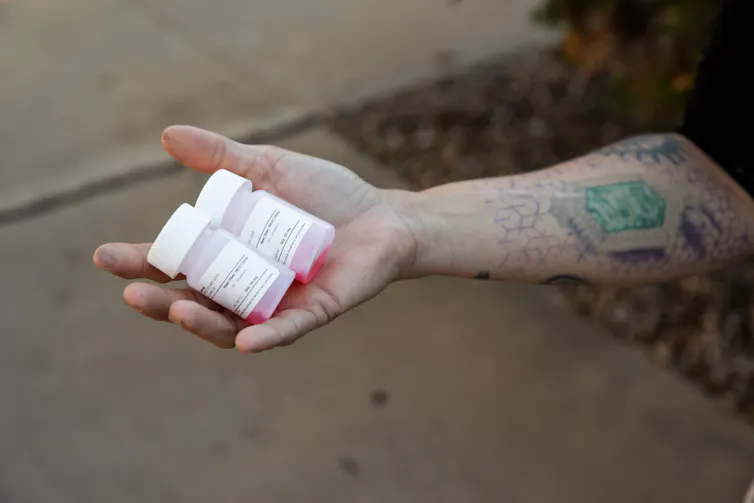
The bill has widespread support from patient advocacy organizations and medical societies. At the same time, a STAT investigation found that the main opposition to the legislation comes from the American Association for the Treatment of Opioid Dependence, AATOD, a major trade group representing methadone clinics. This coalition argues that expanded prescribing and pharmacy dispensing of methadone would increase diversion and overdose risk.
The evidence so far does not support that claim. Moreover, firms that control large shares of their local markets may have a financial incentive to keep new competitors, including doctors and pharmacies, out.
Mark Parrino, AATOD’s president, told The Conversation the trade group opposes the bill for two reasons. First, the bill would let the Health and Human Services secretary determine which additional practitioners are qualified to prescribe methadone for opioid use disorder. Second, it would allow methadone to be dispensed in dispersible tablet as well as liquid form.
Tablets “were definitely” involved in a rise in methadone-related deaths that began around 1999, Parrino said. The Centers for Disease Control and Prevention and a Food and Drug Administration advisory tied those deaths to methadone prescribed for pain, not addiction treatment.
Stavros, who is AATOD’s Arizona representative, said he did not see the bill as a threat to CMS’ business model, but he cited concerns that removing all regulation too quickly could allow a few bad providers to drive up methadone overdoses and increase stigma against the drug.
“We need to find ways to increase access,” he said. “If somebody would come up with … a slow, gradual transition that led to pharmacy prescribing,” Stavros said he would support it.
Dr. Melody Glenn, associate professor of addiction and emergency medicine at the University of Arizona, previously worked at a methadone clinic in Tucson and supports MOTAA 2.0, though she said the legislation should go further.
“It’s time to remove the regulatory barriers to these lifesaving medications,” Glenn told The Conversation in an email.
The bill would allow doctors specializing in addiction medicine, like her, to prescribe methadone. Glenn said it’s frustrating that such an effective treatment for opioid use disorder exists, yet many people who could benefit never receive it.
“They don’t have to die,” she said.
Bringing private equity deals into view
Two other policy responses are gaining traction.
The first is ownership transparency. Regulators, researchers and patients cannot scrutinize what they cannot see, yet private equity is exempt from the disclosure rules that apply to publicly traded companies.
Indiana, California and Maine have enacted or proposed reform to disclose private equity and management company ownership as a condition of being able to bill Medicare or Medicaid. Vermont passed similar legislation this year, on which I was invited to provide expert testimony.
The second is lowering the reporting threshold for acquiring a healthcare company to make them more visible to agencies enforcing U.S. antitrust laws, which are intended to promote competition and prevent monopolies.
The U.S. Department of Justice and the Federal Trade Commission consider ownership of 30% or more of a local market for a product or service a red flag for anticompetitive behavior. Yet, as my research shows, private equity chains typically control at least 67% of a local methadone market within two years of their first clinic purchase in a county.
The reason most never trigger the federal reporting requirement is because these acquisitions happen through a series of smaller, piecemeal deals rather than one large merger. The reporting requirement applies only to deals worth more than about $134 million. Some states have introduced proposals to lower thresholds to around $10 million specifically for healthcare deals, so the vast majority become visible to enforcement agencies before they close.
Structural barriers to getting treatment
The U.S. is experiencing an ongoing and severe opioid crisis. In 2023, approximately 80% of the more than 100,000 drug overdose deaths involved an opioid. In 2024, federal data shows the number of people who died from drug overdoses declined to nearly 80,000, and more than 54,000 of those deaths involved opioids.
We already have medications that work. The barriers preventing people from accessing them are not primarily clinical. They are structural – and, in this case, actively maintained by financial investors who profit from the status quo.

“Addiction isn’t a choice,” Titus told The Conversation.
She and her husband work for Cochise Harm Reduction, a grassroots nonprofit organization based in rural southeast Arizona that works to make life better for people who use drugs.
“It’s a learning curve and eventually … you get tired of it and you want help.”
Aleka Kroitzsh, researcher, and Kristi Tanner, senior accountability editor, contributed reporting. The author of this article is supported in part by Arnold Ventures, which also provides funding for accountability reporting at The Conversation.

















Comments