
 German (DE)
  English (US)
  Spanish (ES)
  French (FR)
  Hindi (IN)
  Italian (IT)
  Russian (RU)
  3 weeks ago
The circumstances of many of the record number of deaths in US immigration custody under the second Trump administration have left loved ones often searching in vain for answers amid a lack of transparency over key investigations.
Immigration and Customs Enforcement (ICE) reports mandated by Congress, autopsy reports and 911 calls collected by the Guardian raise questions about the quality of medical care, allegedly inadequate or haphazard responses to emergencies, and contraction of diseases and infections inside detention facilities that in some cases contributed to detainee deaths.
Families and their attorneys, as well as immigration advocates and Democratic elected officials have struggled to navigate a bureaucratic labyrinth of multiple federal agencies, local medical examiners and coroners, walled-off detention facilities, and, in some cases, local law enforcement, to obtain answers about the many deaths.
Just in the last week, Afghan asylum seeker Mohommad Nazeer Paktyawal, 41, who had worked with US special forces in military operations in his home country, died in ICE custody in Texas, and then 19-year-old Royer Perez-Jimenez, from Mexico, died in what ICE has called a “presumed suicide” at a facility in Florida. He became the youngest to die in ICE custody since Donald Trump returned to the White House and it brought the figure of known deaths in ICE custody during this administration to 42.
Veronica Escobar, a Texas congresswoman, said the maze of local and federal agencies and facilities, as well as private contractors operating detention facilities is a “massive problem”.
“It’s a quagmire created by choice … This is not how things should work,” she said.
Escobar’s district covers El Paso in west Texas, where Camp East Montana was built on the Fort Bliss army base last summer to hold up to 5,000 detainees in tents as the largest immigration facility in the US.
Escobar and fellow Democrats have joined advocates and protesters calling for the closure of Camp East Montana, where the ACLU and others have alleged poor conditions and abuse of detainees. Several deaths have occurred at the camp.
And nationwide, there have been six suicides in immigration custody in the last 13 months – the most in a 13-month period in the last eight years, according to the limited US government records available.
The 42 deaths occurred among those detained in facilities scattered coast to coast, where almost 70,000 immigrants are now locked up – more than any time in US immigration history. The Trump administration is rushing to expand detention further with plans to convert warehouses in several states.
Escobar said to the Guardian in a telephone interview that the deaths across the US are “alarming and incredibly tragic”.
“The federal government is failing miserably either through incompetence or abject cruelty and neglect,” she said.
As more are detained, the death toll rises.
The Department of Homeland Security (DHS), which includes ICE, was sent detailed questions and requests for comment and has responded.
“There has been NO spike in deaths. Consistent with data over the last decade, death rates in custody are 0.009% of the detained population,” an unnamed DHS spokesperson said.
DHS did not provide a source for the figure it cited in its response. The statement continued: “As bed space has rapidly expanded, we have maintained higher standard (sic) of care than most prisons that hold US citizens – including providing access to proper medical care. For many illegal aliens this is the best healthcare they have received their entire lives.”
DHS’s response to questions for this story included pointing out the criminal histories of some of the detainees who have died. Others who have died have no criminal past.
Government data shows that detainees with no criminal histories make up the largest portion of those in ICE detention, a total that peaked at more than 70,000 this January, a fresh record. Breaching immigration law is a civil offense, not criminal.
Austin Kocher, an assistant research professor at Syracuse University and an immigration data and policy expert, posted on BlueSky: “ICE detention deaths are now occurring at a rate of roughly one every four days. Three weeks ago that rate was one every six days. The pace is accelerating, and Congress has not launched a single investigation.”
In early January 2026, Victor Manuel Diaz, 36, was arrested by ICE in a Minneapolis suburb for being in the US illegally. On 14 January, he was found dead inside a medical clinic at Camp East Montana, where ICE said his death was presumed to be a suicide, and the official cause was under investigation.
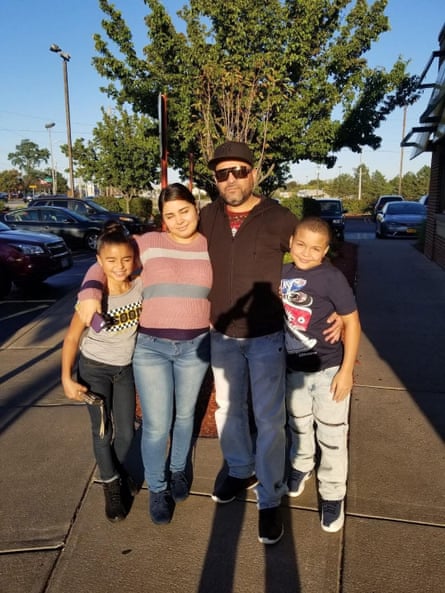
However, members of Diaz’s family told the Associated Press that they are suspicious of the idea that he took his own life because he was not depressed and was about to be reunited with his mother and other relatives upon being deported to Nicaragua. Like so many other bereaved loved ones, they are waiting and hoping to hear more that would explain the loss of their relative.
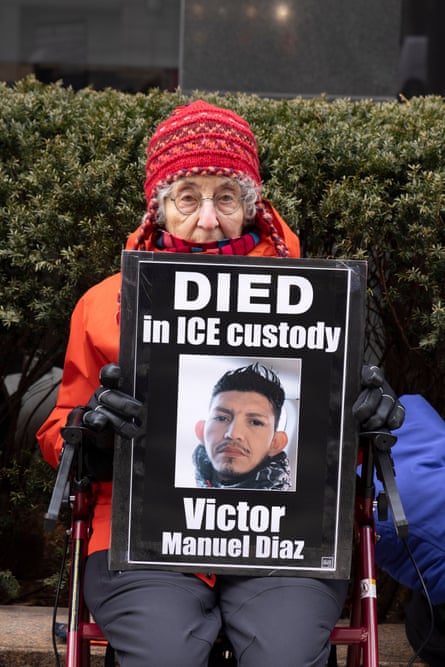
Diaz’s death came not long after another man died at the camp, Geraldo Lunas Campos, 55, on 3 January. ICE first announced that Campos died after experiencing “medical distress” and it was investigating. Then, the Washington Post broke news that the El Paso county medical examiner’s office was preparing to rule Campos’ death a homicide. DHS issued a fresh version of events to say that Campos died during a struggle as staff tried to prevent him from killing himself.
The local medical examiner’s office subsequently issued its report, in which Adam Gonzalez, the deputy medical examiner for El Paso county, did conclude that Campos had died as the result of a homicide. The death was caused by “asphyxia due to neck and torso compression” when he was restrained by guards, while also suffering multiple other injuries. ICE then issued a report citing “spontaneous use of force” in an attempt to prevent self-harm by the detainee. Relatives of Campos are reportedly planning to sue over the death.
Escobar told the Guardian that it was her understanding, from conversations she had with staff at the camp, that there is video of Campos’s death but that the footage has not been released by the authorities.
“I have zero faith in the (DHS) Office of Professional Responsibility being transparent about this homicide,” said Escobar, referring to the office that is investigating the incident.
DHS did not respond to questions regarding any footage of Campos’s death.
While the cause of Campos’s death was investigated by the local medical examiner’s office, ICE announced that the cause of the subsequent death, of Diaz, would instead be determined by the military authorities.
Now a lawyer for Diaz’s family, Randall Kallinen, wants to know why it was decided that the cause of Diaz’s death would be determined by the military. Autopsies for immigrants who die in ICE custody are typically conducted by the offices of local medical examiners or coroners.
“This is a big problem,” Kallinen said in an interview with the Guardian. “The county of El Paso is an uninterested party. The US government is an interested party.”
Iliana Holguin, an El Paso county commissioner, said it was her understanding there “was some confusion about jurisdiction” following Campos’ death. “But now the jurisdictional confusion has been cleared up and the feds will do all future autopsies again going forward,” Holguin said.
The El Paso county medical examiner’s office did not respond to questions about why Diaz’s autopsy is not being handled by the office, saying “jurisdictional” questions should be directed toward ICE.
Kallinen also said he’s concerned about the federal government’s broader investigation into Diaz’s death, and demanded greater transparency. Kallinen questioned why the army was involved at all.
“Remember this is a civilian, not a soldier or a sailor,” Kallinen said. “They’re taking control of civilian death information.”
The contract between DHS and Acquisition Logistics, the private company currently running Camp East Montana, says that in the event of a death “the contractor shall notify the coroner of the local jurisdiction to request a review of the case, and if necessary, examination of the body”.
However, the contract also allows Acquisition Logistics to “establish coroner notification procedures outlining such issues as performance of an autopsy, who will perform the autopsy, obtaining state-approved death certificates, and local transportation of the body”.
The press office at Fort Bliss did not respond to multiple requests for comment. The Pentagon referred questions about the army handling autopsies of detainees at Camp East Montana to ICE, which did not respond to those questions.
“Deaths occurring at Camp East Montana fall under exclusive federal jurisdiction and should be coordinated with the Office of the Armed Forces Medical Examiner,” a DHS spokesperson said. The department did not clarify why autopsies prior to Diaz were handled by the local authorities.
“The jurisdictional issues are very blurred. It makes oversight and accountability very challenging,” Escobar said.
The website of Acquisition Logistics provides only the residential home address of Ken Wagner, its CEO and a former naval officer. He briefly spoke to the Guardian when reached by telephone earlier this week and was asked to comment on deaths at the facility.
“Since I’m under contract with the government, I’m not allowed to give my opinion on anything other than … something that’s not under contract, so unfortunately I can’t take this call,” Wagner said before hanging up.
Among the relatives back in Nicaragua that Diaz was scheduled to see very soon were his two sons, aged 10 and 15, Kallinen said.
“Putting someone in immigration detention shouldn’t amount to a death sentence. But that’s increasingly a risk, given last year we saw a record number of people die in detention because of neglect, abuse, or delayed medical care,” Rebekah Wolfe, director of the Immigration Justice Campaign at the American Immigration Council, alleged. “There is no reason to be holding tens of thousands of people in detention right now when the vast majority of them have never been convicted of a crime, and could have their cases managed through ways that are far safer and more humane than locking them up,” she added.
The Guardian requested comment from DHS on allegations that the deaths since Trump returned to the White House are partly due to conditions inside facilities. DHS did not respond but has previously said in response to allegations of abuse that “any claims that there are ‘inhumane’ conditions at ICE detention centers are categorically false.”
The Diaz and Campos families are far from alone in their bewilderment over why their relatives died.
Chaofeng Ge, 32, was found dead last August after five days in ICE custody at Moshannon Valley processing center, 130 miles north-east of Pittsburgh, Pennsylvania. He served a short stint prior in local jail for fraud-related crimes and was set to be deported back to China. His death was deemed a suicide but Scripps News reported that an autopsy showed that Ge was found with “his hands and feet tied behind his back”, prompting the family to demand answers.
And there were two deaths reported as suicide in Missouri last year involving people technically in the custody of ICE while held in local jails on the federal agency’s behalf via an arrangement known as an immigration detainer.
Leo Cruz Silva, 34, of Mexico, took his own life last October at the Saint Genevieve county jail in Missouri after what ICE described as a mental health crisis. The report of his death came out last month, 35 days over the time limit set by Congress that ICE must release such reports 90 days after a death in its custody, according to KY3, a local NBC affiliate.
And last April, Brayan Garzón-Rayo, 27, who had arrived in the US from Colombia two years before, died in the Phelps county jail in Rolla, Missouri, just more than 100 miles south-west of St Louis. Garzón-Rayo’s mother has questioned his death, telling St Louis Public Radio that he “didn’t have the drive to kill himself”.
An ICE report on Garzón-Rayo’s death shows that intake screening noted a “denial of suicidal thoughts, self-harm, hopelessness, depression, or medication use”. Two days later, Garzon-Rayo tested positive for tuberculosis and Covid, and complained of “severe head pain, body aches, sweating”, according to ICE records, and was sent to a local emergency room. When he returned to the jail, still complaining of symptoms, he was given anti-nausea medication, according to the report.
“He had a mental health appointment scheduled for April 5 [2025], but it was rescheduled due to a positive Covid diagnosis,” a DHS spokesperson said.
The local Phelps county coroner, Ernie Coverdell, told the Guardian he had viewed video from inside the jail. Coverdell arranged for Garzón-Rayo’s autopsy to be conducted by Darren Dake, the nearby Crawford county coroner whose staff includes a licensed forensic pathologist, a typical practice in rural counties.
Neither man agreed to requests from the Guardian to release Garzón-Rayo’s autopsy report.
“There is absolutely no reason for that info to be released … As a matter of privacy to the family, I will not release” the report, Coverdell said in a telephone interview.
Hillary Baker, Dake’s deputy coroner, said state law regarding autopsies allows reports to be released “only to the personal representative or administrator of the estate of the deceased, the surviving spouse, or a surviving child, parent, brother, or sister of the deceased”.
Meanwhile, Eric Basler, the coroner for Ste Genevieve county, has agreed to release the autopsy report of Luis Cruz Silva.
It is common in Missouri and many other states for the decision to release autopsy reports to be up to individual coroners, according to A Jay Wagner, an expert in public records laws and professor of journalism at Marquette University, based in Milwaukee, Wisconsin.
In Missouri’s public records law “there is no mention of it and the courts haven’t decided one way or the other”, Wagner added.
Jonathan Peters, a school of law and school of journalism faculty member at the University of Georgia, said the situation represented a “classic transparency problem”.
“When state public records laws are silent or ambiguous on a particular category of records, access can end up turning on local practice or the discretion of individual officials,” Peters said, adding of autopsy reports: “Some jurisdictions clearly define them as public records, while others treat them as confidential or quasi-confidential.”
The Missouri state highway patrol, which investigated the deaths of Silva and Garzón-Rayo, said it concluded that both men had taken their own lives. The agency did not answer questions about the investigations and has not released records or videos related to the incidents.
Despite the conclusion of suicide in both cases, Garzón-Rayo’s mother has said in an interview with St Louis Public Radio that he “didn’t have a reason” to take his own life.
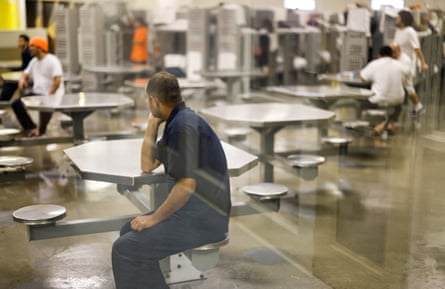
Two suicides have also occurred involving men in ICE custody in Georgia in the last seven months – Heber Sanchaz Dominguez, 34, of Mexico, who died on 7 January 2026 at the Robert Deyton detention center in Lovejoy, and Jesus Molina-Veya, 45, of Mexico, who took his life on 7 June 2025 at the Stewart detention center in Lumpkin.
A 911 call obtained by the Guardian shows that staff at Stewart had to ask each other twice whether Molina-Veya was still breathing.
“Is he breathing?” a dispatcher asks.
“Uh, central patrol to unit four, is that 01 breathing?” an officer at Stewart can be heard asking a colleague. The second officer’s response is garbled, prompting the first officer to ask again.
“Is he breathing?” the first officer asks again.
“Negative,” the second officer replies. The term “01” appears to be a reference to detainees.
Meanwhile, records of deaths of others who have died in ICE custody in the Trump administration show possible inadequate response to medical emergencies, diseases contracted inside facilities and minor ailments that later turned serious.
DHS provided the Guardian with responses to questions about some of the deaths detailed in this article, while not responding to questions about others.
-
Emmanuel Damas, 56, of Haiti, died on 2 March 2026 at a facility in Florence, Arizona, after reporting severe tooth pain. Damas was an asylum seeker who had been living in Dorchester, Massachusetts, and that the state’s lawmakers Senators Ed Markey and Elizabeth Warren and Congresswoman Ayanna Pressley wrote a letter to DHS saying: “ICE’s failure to provide timely medical care to Mr Damas appears to have contributed to his worsening medical condition and tragic death” and demanding answers. DHS did not provide a statement on Damas’ death in response to the Guardian’s questions.
-
Huabing Xie, 53, of China was left unattended for 45 minutes while experiencing a medical emergency at the Adelanto processing center, a facility in California, an autopsy report obtained by the Guardian shows. On the afternoon of 29 September 2025, Xie collapsed and “began shaking”, according to the report. A nurse noted that Xie had an abnormal heart activity, and left him at 1.36pm to seek permission to have him transferred to a nearby hospital. The nurse didn’t return for almost 45 minutes, at 2.12pm. Xie died of a heart attack and was pronounced dead at 3.15pm, according to the autopsy report. DHS did not address the 36-minute time window mentioned in the autopsy report. “Facility staff reported that Xie experienced what appeared to be a seizure and became unresponsive at about 2.13pm. He was immediately provided medical care by medical personnel at the detention center including CPR and a defibrillator before emergency medical services arrived,” a DHS spokesperson said.
-
Ismael Ayala-Uribe died on 22 September 2025 after complaining of severe rectal pain for three weeks while incarcerated at the same Arizona facility as Damas, according to an autopsy report. Ayala-Uribe, originally from Mexico, was detained at Adelanto beginning on 17 August. “About three weeks ago, Ismael was complaining of having a fever, shivers, and rectal bleeding,” according to an autopsy conducted by the San Bernardino county coroner, that also noted: “Family stated the ICE facility did not provide him with medical attention and were only administering Tylenol.” On 21 September, Ayala-Uribe was taken to a hospital, where staff found an abscess that required surgery. Ayala-Uribe died before the surgery could take place. “Any allegation this detainee was denied medical care for three weeks is FALSE,” a DHS spokesperson said in a statement, adding: “Ayala-Uribe received medical attention on September 18 and was referred to a local hospital on September 21 for an abscess on his buttocks and was scheduled to have a surgery to remove it. Hospital staff declared him deceased at 2.32am” the next day.
-
Lorenzo Antonio Batrez Vargas, 32, died of complications from pneumonia after being infected with Covid and influenza B while in detention at Florence, according to his autopsy report. DHS did not provide a statement to the Guardian on Vargas’ death.
-
Francisco Gaspar-Andrés, 48, died of complications of cirrhosis, according to an autopsy report obtained by the Guardian. Gaspar-Andrés was first incarcerated by ICE in September 2025 at the Krome detention center in Miami. There, medical staff reported alcohol withdrawal problems like delirium tremens and anemia, as well as low blood sodium and blood platelets, pneumonia, and the inability of a heart chamber to close properly. On 19 September 2025, ICE sent Gaspar-Andrés to Camp East Montana, where his condition began to deteriorate rapidly, according to an ICE report on his death. Over the next two months, Andres complained of a stunning variety of symptoms, including bleeding gums, body aches, insomnia, rectal bleeding, acid reflux, headaches. Medical staff found he had jaundice, an elevated heart rate, low blood pressure and had contracted pneumonia. On 19 November, Gaspar-Andrés was finally sent to a hospital, where staff found “blood pooling in his liver, renal failure and sepsis”, according to the ICE report. Gaspar-Andrés was intubated until he died on 3 December. When his body arrived at the El Paso county medical examiner’s office, Andrés weighed 123lbs. There, his cause of death was attributed to “complications of alcoholic hepatic cirrhosis”. DHS did not provide a statement to the Guardian on Andrés’ death.
“Putting so many people in these facilities and holding them for so long in such terrible conditions is an absence of compassion on an incredibly profound scale,” Escobar said.



















Comments