
 German (DE)
  English (US)
  Spanish (ES)
  French (FR)
  Hindi (IN)
  Italian (IT)
  Russian (RU)
  2 weeks ago
The Trump administration is removing 760,000 people enrolled in the Affordable Care Act (ACA) marketplace on allegations of fraud, officials said on Tuesday – adding to previous efforts to chip away at federally subsidized insurance programs and likely causing some of the lowest-income Americans to forego healthcare, experts said.
The US government is also investigating about 420,000 people whom they suspect of fraud, and they are putting a six-month enrollment moratorium on new agents and brokers selling Obamacare policies, officials said at a press conference.
The removed enrollees are a mixture of “phantoms” and “ghosts” as well as people who don’t meet the eligibility requirements of Obamacare, said Mehmet Oz, the administrator for the Centers for Medicare and Medicaid Services (CMS).
“These are not real people,” he said, claiming that expelling them from the ACA marketplace would save the federal government $2.2bn.
JD Vance, who is leading a federal taskforce on fraud, claimed: “We’re actually making sure that the people receiving Obamacare subsidies are actually entitled to receive them.”
No details were provided about how many enrollees were fictional, enrolled by fraudulent brokers without their knowledge or expelled because of income restrictions.
“There’s no transparency about who these people are and why they’re being disenrolled, but I think it’s a reasonable concern that some number are being disenrolled inappropriately,” said Edwin Park, a research professor at the Center for Children and Families at Georgetown University’s McCourt School of Public Policy. “A common theme here is to make it incredibly burdensome for individuals to enroll and stay enrolled in their health coverage.”
Without more information, “there is no way to know how many legitimately enrolled people had their plans canceled”, said Cynthia Cox, senior vice-president and director of the Program on the ACA at KFF, an independent health policy organization.

The move follows recent rules and legislation to reduce enrollment in Medicaid, Medicare and the ACA, said Park, who added: “A lot of these actions are intended to sharply undercut the success of and the long-term viability of the ACA’s coverage expansions, which have been an incredible success in terms of reducing the number of people without health insurance.”
About 19.2 million Americans are enrolled in the ACA marketplace, but nearly 3 million people lost their coverage between February 2025 and February 2026, according to the Center on Budget and Policy Priorities.
The fraud taskforce has also withheld $2.2bn in Medicaid payments from California and Minnesota over alleged fraud – primarily in home health aide programs, which disability advocates say are a lifeline.
Officials followed an unusual path to verify ACA enrollment, experts said. The administration sent to insurers a list of more than a million people suspected of being fraudulently enrolled in the ACA marketplace, also known as Obamacare. Officials said on Tuesday that they used AI tools to identify the enrollees.
The people were identified by three factors: they’d been enrolled by a broker or agent, had all of their ACA premium paid by the tax credit, and they had not supplied social security numbers or immigration documents.
Insurers were asked to try to make contact with those enrollees; they were permitted to filter out people who had a previous claim or had communicated with the insurer. The enrollees had 30 days to respond, or their coverage was canceled.
“It is entirely possible that many of these people were enrolled without their knowledge or were so-called phantom enrollees,” Cox said. “It is also entirely possible that many of these people were legitimately enrolled and simply did not respond in time.”
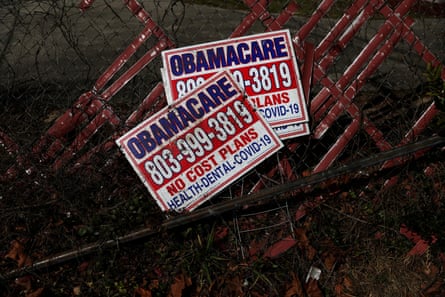
People can appeal and be reinstated once they prove their identities – but this will likely function as an additional hurdle making it harder for people to stay enrolled, Park said.
“We know that when you add a lot of red tape, increase the amount of complexity and the requirements for paperwork,” Park said, that “leads to eligible people being disenrolled.”
Vance spoke of two fraudulent brokers who were convicted of quietly enrolling people to collect commissions from insurance companies, acknowledging that “some of those people were probably legitimate”, but he did not speak of the steps necessary to reinstate them or to prevent future disenrollments.
after newsletter promotion
Ending unscrupulous broker practices has been a bipartisan issue, and the Biden administration was the first to act, finalizing a rule to crack down on shady brokers. Officials under Biden decertified about 200 such brokers – but Trump administration officials recertified them last year.
About 35% of ACA enrollees have never used their health insurance, Oz said. “That’s just not possible,” he said, adding, “So we know there is fraud.”
But it’s not unusual for healthy people to be enrolled in insurance and not need to use it, Park noted: “You can expect in any insurance risk pool that there’s going to be a lot of people who don’t use much healthcare or use healthcare at all.” By removing lower-risk enrollees, insurance premiums could increase or insurers could decide to leave markets entirely, he said.
Some enrollees also appear to have been cut because they are low-income. The Affordable Care Act was intended to include a Medicaid expansion for those living under the poverty line, but a supreme court decision made the expansion optional. In states that chose not to expand Medicaid, there is a group of low-income people who make too much money to qualify for Medicaid – earning between $16,000 and $22,000 per year – but don’t make enough to qualify for the ACA.
“We’re going to make sure that they actually meet the income threshold requirements in order to receive these Obamacare benefits,” Vance said of this group. Oz called their disenrollment “a little bit painful”.
Park said that there have been a series of “at best misleading” allegations arguing that a large share of current marketplace plan enrollees are fraudulently or inappropriately enrolled. Reports from the Paragon Institute and the US Department of Health and Human Services (HHS) have indicated millions of fraudulent enrollees – but those analyses are “flawed”, Park said.
These reports directly compare administrative data and unadjusted census data, but income and household sizes are calculated differently in these two measures. The census counts all individuals living in the household, while Medicaid and the ACA marketplace exclude non-dependent relatives.
“That has a big effect on the number of people who appear to be in certain income ranges,” Park said. “That has been used to say a huge percent of people don’t look like they have incomes in the right eligibility range.”
These disenrollments are happening in the context of major cuts to the marketplace. Premiums skyrocketed, doubling or tripling for some enrollees, after Republicans opposed extending the enhanced tax credits at the end of last year. Alongside other financial pressures, like higher energy and food costs, “there’s going to be an increasing number of people who can no longer afford their share of the premium”, Park said.
The healthcare cuts of the budget reconciliation law HR1 “in many ways were designed to undermine the Affordable Care Act coverage expansions” without explicitly repealing it – a longtime Trump promise, Park said.
The Trump administration has also created new regulations to restrict marketplace enrollment, he noted, adding: “You add it all together, and you’re going to have certainly significant reductions in enrollment – with those enrollment losses increasing over time.”
When people lose their health insurance, it has ripple effects – including added pressure on health systems that affect all patients.
“Providers, particularly safety net providers, operate under thinner operating margins. If they’re facing payment cuts, they’re facing higher uncompensated care costs, as a result of more uninsured [patients],” Park said, which may lead hospitals to cut services or staff, or close their doors entirely. “And that makes it harder for everyone to access the care they need.”
















Comments