
 German (DE)
  English (US)
  Spanish (ES)
  French (FR)
  Hindi (IN)
  Italian (IT)
  Russian (RU)
  3 weeks ago
Inside an old Craftsman on the northern end of California’s Sacramento valley, Audrey Denney is spending the day on the phone – calling constituent after constituent to discuss rising healthcare costs, wildfire insurance premiums and cuts to benefits – and to solicit donations.
It’s the mundane way in which an epic, and uphill, battle for control of the US Congress is being fought.
Denney, a 41-year-old Democrat who has pledged not to take any money from corporate Pacs, is trying to win a region comfortably held by Republicans for nearly half a century. She’s trying to win it not just once, but twice, in what can rightly be described as one of the most chaotic and confusing election years in this rural corner of the state.
Last year, California’s first congressional district, which extends from the almond orchards and rice fields of the Sacramento valley to the forested and fire-prone foothills of the Sierra Nevada and Cascades, was thrust at the center of a political firestorm.
The district was one of several remade under a bold redistricting proposal that redrew the state’s voting map to favor Democrats. Its new boundaries include counties to the west and south, making it competitive for Democrats for the first time in years. Doug LaMalfa, the Republican who had long held the district’s seat, was readying for a long-shot bid for re-election. Denney saw her opening.
Then, on 6 January, LaMalfa suddenly died.
Voters in the district will now first elect someone to serve out the remainder of LaMalfa’s term in an election that will use the old district map. In November, there will be a fresh election for the seat, using the new congressional map.
At stake is not just representation for the district, but the balance of Congress. Republicans have only a five-member majority in the House of Representatives at present after the resignation of Marjorie Taylor Greene and the death of LaMalfa.
Denney, an educator and consultant with a background in agriculture, is urgently pressing her case: “There’s all kinds of huge threats happening at once,” she said. “They’re all connected. The economic and the political systems that we are a part of are serving corporate greed and billionaires at the expense of regular people. This is not the democracy we want to live in.”
“We need to elect people who will stand up to all of those forces at once.”
The region has faced no shortage of challenges. The area was already grappling with a severe housing shortage when several years of large wildfires destroyed thousands of homes, pushing more people on to the streets. Wildfires have scorched nearly 40% of land in the county in the last decade, causing astronomical increases in home insurance costs.
Last fall, one community in the district lost its sole emergency room after the federal government eliminated a special designation that had helped it keep its doors open for more than two decades. People are grappling with rising health insurance premiums.
Residents of all political persuasions are quick to approach Denney at protests and community events to thank her for running, or share their challenges, she said. “Maybe it’s because I used to be a bartender,” Denney quipped.
Since declaring, she’s logged thousands of phone calls and countless miles around the district, visiting communities destroyed by fire and holding events in small-town coffee shops where people speak about their concerns around wildfires, forest health and democracy.
She spends much of her time thinking about wildfire insurance, she said, and how the country can find the political will to establish non-profit single-payer healthcare, the only thing that will save rural healthcare, she argued.
She wants to see key funding for rural schools increased and made permanent and to work with federal agencies to ensure the district, where nearly 42% of land is federally owned, is “ecologically healthy and sound”.
Denney’s been beating this drum for years, challenging LaMalfa for the seat twice before. But over the decades, even as California has grown more Democratic, the area remained reliably red. It sent LaMalfa, a fourth-generation rice farmer, to the US House seven times. Trump has a strong base of support, consistently carrying the area since 2016, and in 2024 he received 61% of the vote to Kamala Harris’s 36%.
LaMalfa, who had served in public office for more than two decades, worked most notably on water and forestry policy and was a loyal supporter of the president. He was a trusted figure among conservatives in the region, and could frequently be seen at community events across his sprawling district, building trust in a part of the state that frequently feels ignored by lawmakers in California’s capital and DC.
There were some growing areas of discontent. LaMalfa challenged the election outcome in 2020, voting against certifying the result, and expressed skepticism about the climate crisis and its cause. That last stance in particular drew frustration from some in his region, which has repeatedly been hit with deadly wildfires.
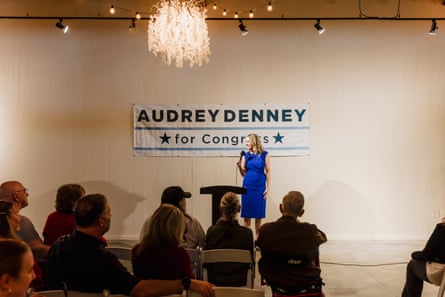
In 2018, Denney closed LaMalfa’s historic 30-plus-point lead in the primary down to 9.5%, and raised $1m, but LaMalfa ultimately prevailed, and did so again in 2020. Denney came to view the district as unwinnable.
The inclusion of Democratic-heavy areas in the district after the passage of Prop 50 renewed hopes of a blue win. But in the June election to replace LaMalfa, Denney is facing a very tough fight.
A Democrat winning the special election is an “impossibility”, argued Matt Rexroad, a Republican political consultant.
“I’m impressed with [Denney],” he said. “[But] this district is overwhelmingly Republican. They love President Trump and a Republican will win the seat.”
Running against Denney is state lawmaker James Gallagher, an assemblyman who previously served as the minority leader and was a friend of LaMalfa’s. Jill LaMalfa, the late congressman’s wife, endorsed Gallagher in a statement.
“The tireless work and unimaginable hours spent away from family by Doug and his entire staff cannot be left to end in vain,” Jill LaMalfa said in a statement. “Through much prayer, I believe there is a way forward. A way that leaves very little to change from how Doug would have done it, the way he would have cared for all of you in the first congressional district of California.”
Still, Denney is hopeful that even with the strong conservative base in the district she can win and provide stability and support to constituents.
“I’ve been fighting for our communities in the north state, especially when things are hard, especially when things are challenging. That’s what I want to keep doing,” she said.
The country is at a perilous moment, she argued, with a president who is an “adjudicated sex offender and a war criminal who treats the constitution like it’s an annoyance instead of the law of the land”.
Denney would like to see Democrats elected who are “not bought and paid for by corporate interests [and] are ready to take on an authoritarian president”, in addition to the elimination of insider stock trading and a constitutional amendment overturning Citizens United.
Officials in Washington will be watching. The seat is critical for Republicans trying to maintain a majority in the House of Representatives, said Christopher Witko, a political scientist and the executive director of the University of California Center Sacramento.
The margin for Republicans in the district is significant, and while a Democratic candidate has a “slight chance” of winning in a special election, by showing strength in that race they could have a better chance in November, he said.
“If [Denney] does surprisingly well that’s going to cause a lot of concern among Republicans in Washington DC, I imagine,” Witko said.
With two elections ahead of her, Denney’s campaign schedule is packed with events, candidate forums and, of course, phone calls. “Politicians take corporate Pac money because it’s easy. Corporations and Pacs will walk in with a $5,000 or $10,000 check, and that’s one phone call.”
“Meanwhile, I’m spending hours and hours and hours calling individuals who live in our communities, asking them for $50 at a time and asking them to believe that we deserve a voice and we deserve representation that is only accountable to us. Her best day saw about 128 calls, no small feat considering she’s a “yapper”, she joked.
“In the economic condition we live in, people are still willing to say, ‘Here’s my $10 a month contribution because I’m playing my part in this.’ I think it’s beautiful and it’s inspiring and I’m honored,” she said.
Then she got back to her calls.










Comments